[pageLogInLogOut]

#Research & Development

Peter Dornier Foundation Prize 2022 honours textile research on woven heart valve
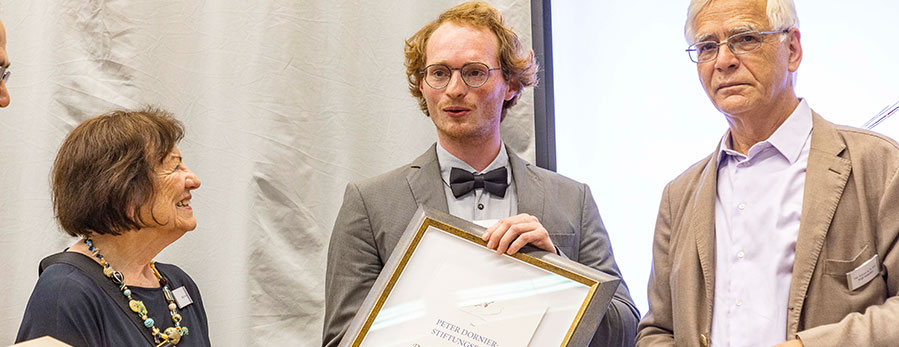
Maja Dornier (lhs) and Prof. Dr. Wolf Mutschler (rhs) hands over the Peter Dornier Foundation Award, endowed with 5,000 euros, to the award winner Dipl.-Ing. Mathis Bruns / Source: Christian Flemmig
According to the World Health Organization (WHO), cardiovascular disease is one of the most common natural causes of death. Every year, it is the cause of death of around 17 million people worldwide. The Peter Dornier Foundation Prize 2022 has now awarded a research work that is to improve the medical care of people with insufficient heart valve function in the future and prolong the patients' lives.

The human heart is a high-performance machine: over the course of a person's life, it beats almost three billion times, pumping around 200 million litres of blood through the body. Enormous stresses that can sometimes lead to life-threatening signs of wear and tear. If a heart valve gets out of step, patients usually get artificial-mechanical or biological valves as a replacement. However, mechanical solutions imply patients to take blood-thinning medication for the rest of their lives. In addition, there may be audible closing noises. For example, almost a quarter of patients with mechanical heart valves complain of sleep disturbances. Biological heart valves, on the other hand, such as those made from animal tissue, require a great deal of manual work and have a shorter lifetime.

Potential of weaving for medical products demonstrated

For this reason, Graduate Engineer Mathis Bruns at the Institute for Textile Machinery and High-Performance Textile Materials Technology (ITM) at the TU Dresden is researching an implant alternative made of fabric. As part of a research project that also involved heart surgeons from the Dresden Heart Centre and the University Hospital in Würzburg, Mr. Bruns provided important findings for weaving an artificial heart valve in his diploma thesis. For his work entitled "Development of tubular structures with integrated valve function", Mathis Bruns has now received the Peter Dornier Foundation Prize 2022, endowed with 5,000 euros. In his laudation, Dr. Adnan Wahhoud, former head of the development department of air-jet weaving machines at DORNIER in Lindau, said: "With his work, the winner of the award demonstrates very clearly the potential of weaving technology to produce fabrics of complex form, geometry and structure with the aim of prolonging and improving people's lives." The award-winning thesis enriches research into three-dimensional tissues for use in medicine.

Weaving replacement heart valves without seams

"A particular advantage of our approach is the integral production method", says foundation prize winner Mathis Bruns. “The geometry and function of a heart valve is that complex that woven heart valves could not be produced in this form previously. Through the combined use of a flexible rapier weaving machine with bobbin shield and a Jacquard machine, it is possible to weave the replacement heart valve in such a way that it no longer has be sewn together. Even the tubular structures for the blood vessels and the integrated valve function are ‘all of one piece’. Seams are always a weak point in textile medical products," Mr. Bruns adds. “Another advantage of the woven heart valve is the possibility to insert it by the help of minimally invasive surgery. Hence, the folded valve which is about the size of a tea light is to be pushed with a catheter via the bloodstream to the target position in the heart and unfolded there. The patient's chest and heart would then no longer have to be cut open”, explains prize winner Mr. Bruns.

Textile structure is similar to human tissue

A wide variety of medical products have always been produced on DORNIER weaving machines. Customers use them to produce fabrics for bandages, prostheses, blood filters and orthoses among other things. For Mathis Bruns, it is only evident that implants such as heart valves will more and more be woven on the machines from Lindau in the future. "Textile tissue is very similar to human tissue," he says. The human body consists largely of thread-like materials, just as a textile fabric is made up of thousands of individual threads. "Muscle fibres convey force impulses, nerve tracts send stimuli such as pain and brain cells convey information via thread-like dendrites and axons." Because of their ‘thread-like properties’, woven implants are therefore particularly suitable for medical applications.


Foundation purposes medical research and hospice

Maja Dornier, Chairwoman of the Peter Dornier Foundation, also honoured the research achievement between medicine and weaving innovation.

At the award ceremony in the Lindau DORNIER "Weaving Technology Centre" in front of around 85 guests she said, "The results of Mr. Bruns' thesis could be the basis for significantly improved medical care for people with insufficient heart valve function. The work therefore represents a great medical and social step forward.”

The Peter Dornier Foundation Prize was the idea of Peter Dornier (1917-2002), founder of Lindauer DORNIER GmbH. Since 2021, the prize is awarded annually for excellent scientific work by young people in the fields of textile technology, film stretching technology and composites as well as aviation. 
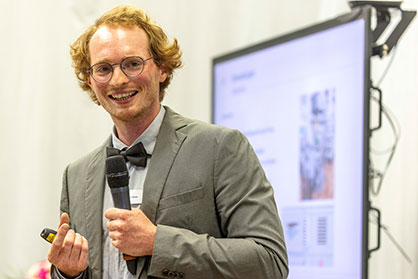
Award winner Mathis Bruns presenting his thesis / Source: Christian Flemmig


Funding for medical research is just as much a part of the aims of the Peter Dornier Foundation's as the promotion of hospice facilities for a self-determined and dignified life until the end.

Background information Lindauer DORNIER GmbH:

Lindauer DORNIER GmbH with its product lines Weaving machines, Special machines and Composite Systems® is one of the world's technology leaders. In 2021, the German family-owned company with around 1,000 employees (thereof more than 60 trainees) achieved incoming orders of approximately 510 million Euro. DORNIER weaving machines meet all the requirements of modern fabric production: flexible and gentle material use, extreme material and pattern variety, absolute functional reliability, fabric without faults and short downtimes. The DORNIER system family, consisting of rapier and air-jet weaving machines, is the contemporary answer to the demanding catalog of market requirements. In the Composite Systems Division with its P2 roving loom, 3D weaving machine, Tape production line and Tape weaving machine, the machine manufacturer bundles its decades of experience in the design of weaving machines and film stretching lines. All machines and plants are manufactured at the German production sites in Lindau and Esseratsweiler. The export share is 90% (status 2021).
More News from Lindauer DORNIER GmbH

#Techtextil 2026

From carbon to canvas: DORNIER presents flexible and reliable weaving technologies for 3D weaving and dynamic markets at Techtextil

At Techtextil from 21 to 24 April 2026 in Frankfurt am Main (Hall 12.0, Stand D95), Lindauer DORNIER will be showcasing reliable and flexible weaving technologies for ever-changing market requirements. The machine and plant manufacturer will present retrofits for existing machines, the new TRITOS® FLEX 3D weaving technology, intuitive automation concepts and software solutions for data-sovereign networking of the weaving machine fleet.

#Weaving

Lindauer Dornier announces leadership transition in weaving machine business

After more than ten successful years at Lindauer DORNIER GmbH, Mr Wolfgang Schöffl will leave the family-owned company at the end of the year to enter well-deserved retirement.

#ITMA Asia + CITME Singapore 2025

DORNIER celebrates its anniversary at ITMA Asia + CITME

To mark its 75th anniversary, machine and plant manufacturer Lindauer DORNIER will be presenting the latest developments in its rapier and air-jet weaving machines at ITMA Asia + CITME in Singapore (Hall 2, Stand B401) from 28 to 31 October 2025. The focus will be on energy-efficient weaving technologies, new IoT solutions for networked textile production and systems for the series production of modern fibre composite components.

#Weaving

From the Venus flytrap to foldable aircraft wings: Peter Dornier Foundation Prize 2025 honours bionic research on 3D weaving technology

Long wings with foldable tips have the potential to reduce aircraft fuel consumption and make aviation more sustainable. An interdisciplinary research team has now developed a new solution based on the Venus flytrap: Freely movable wingtips made of fibre composites which are produced using innovative 3D weaving technology. For this pioneering combination of textile technology, aviation and bionics, researchers Patrick Meyer (TU Braunschweig) and Michael Vorhof (TU Dresden) were awarded the Peter Dornier Foundation Prize 2025 in mid-July.

More News on Research & Development

#Research & Development

Elastic yarns to become more recyclable and environmentally friendly in future

On 29 April 2026, ITA student Tobias Dickmeiß was awarded a sponsorship prize by the Wilhelm Lorch-Stiftung for his innovative approach, to replacing conventional elastane with elastic yarns made from thermoplastic copolyester elastomers (TPC). Thanks to their thermoplastic nature and compatibility with typical polyesters used in the textile industry, elastic TPC yarns offer improved recyclability. Furthermore, the use of the melt-spinning process in yarn production eliminates the need for solvents that are harmful to the environment and human health.

#Research & Development

Walter Reiners Foundation Prize awarded to three ITA graduates

Sabina Dann, Lukas Balon and Annegret Storm from the Institut für Textiltechnik (ITA) of RWTH Aachen University were awarded the Walter Reiners Foundation Prize by the German Engineering Federation (VDMA) for their master’s and bachelor’s theses. Peter Dornier, Chairman of the Walter Reiners Foundation, presented the awards during Techtextil at the VDMA stand in Frankfurt am Main, Germany.

#Techtextil 2026

Young talents honoured – 60 years Walter Reiners Foundation

At the Techtextil trade fair in Frankfurt at the end of April, Peter D. Dornier, chairman of the VDMA’s Walter Reiners Foundation, presented awards to five successful young engineers. Promotion and sustainability awards were presented in the categories of bachelor’s/project theses and diploma/master’s theses. Academic theses are eligible for the sustainability awards if, for example, they develop solutions for resource-efficient products and technologies.

#Research & Development

Regional hemp bast for lightweight construction profiles

The cultivation of fibre hemp for the production of ropes and clothing has a long tradition in Saxony. Due to its excellent fibre properties, it is also suitable as a renewable raw material for reinforcement in fibre composites. At the STFI and IWU in Chemnitz, the CannaPul project is cur- rently investigating how a regional value chain for hemp-based lightweight construction profiles can be established. To this end, the technical processing of hemp fibres into continuous fibre strands and their embedding in a suitable bio-based matrix are being investigated.

Latest News

#INDEX 2026

ANDRITZ at INDEX ’26: Driving sustainability with next-generation nonwoven technologies

From May 19-22, ANDRITZ Nonwoven & Textile is presenting its innovative solutions for the nonwoven & textile industry in Geneva, Switzerland. ANDRITZ will focus on technologies for sustainable and durable nonwovens, converting, sustainable fiber processes, textile recycling, and life-cycle services on booth 2114 in hall 02.

#INDEX 2026

INDEX™26: World’s leading nonwovens exhibition presents groundbreaking product launches, exclusive seminars and immersive experiences

From 19 to 22 May 2026, 620 exhibitors from 44 countries will gather in Geneva at Palexpo for INDEX™26. The exhibition aims to demonstrate how the future of technical materials will increasingly be shaped by collaborative supply chains and integrated innovation across the nonwovens industry. This year’s edition focuses not only on individual technological advances, but also on how cooperation throughout the value chain can enhance the performance, sustainability and value of nonwoven solutions.

#INDEX 2026

The LYCRA Company launches LYCRA® ADAPTIV fiber for nonwovens, advancing comfort and fit in disposable hygiene at INDEX™ 26

The LYCRA Company, a leader in innovative and sustainable fibers for apparel and personal care, today announced the official global launch of LYCRA® ADAPTIV fiber for nonwovens at INDEX™ 26, in Geneva, Switzerland, May 19–22. This breakthrough stretch fiber, already trusted by leading global apparel brands, now ushers in a new era of comfort, fit, and performance for baby diapers, disposable hygiene products, adult incontinence, and feminine care.

#INDEX 2026

Innovations for today – solutions for tomorrow: Trützschler Nonwovens at INDEX™ 2026

From 19 to 22 May, Trützschler Nonwovens will present itself at booth 1641 as a long-term partner to its customers. The focus will be on new products for all nonwoven processes, further developments of the digital working environment T‑ONE, and an expanded service portfolio.

TOP