[pageLogInLogOut]

#Weaving

From the Venus flytrap to foldable aircraft wings: Peter Dornier Foundation Prize 2025 honours bionic research on 3D weaving technology
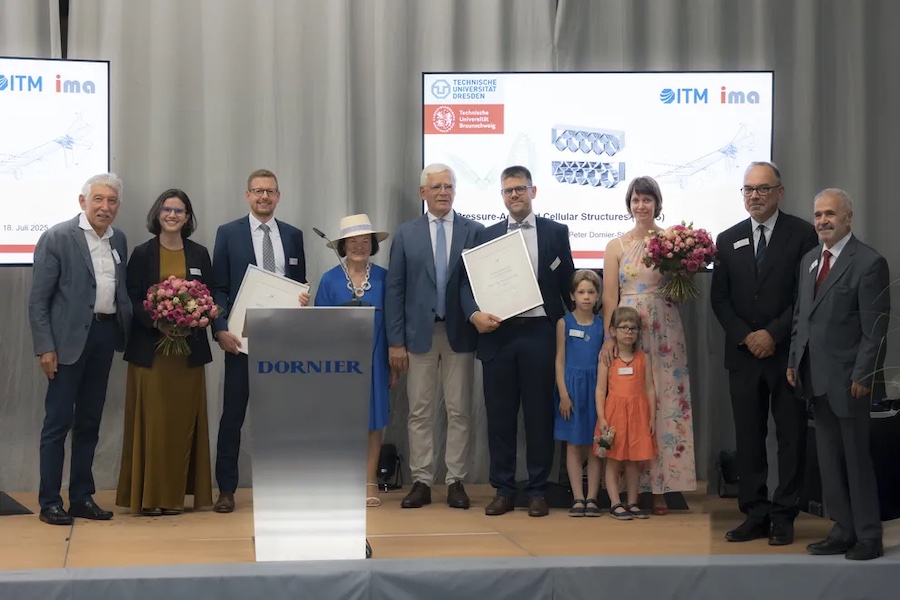
Long wings with foldable tips have the potential to reduce aircraft fuel consumption and make aviation more sustainable. An interdisciplinary research team has now developed a new solution based on the Venus flytrap: Freely movable wingtips made of fibre composites which are produced using innovative 3D weaving technology. For this pioneering combination of textile technology, aviation and bionics, researchers Patrick Meyer (TU Braunschweig) and Michael Vorhof (TU Dresden) were awarded the Peter Dornier Foundation Prize 2025 in mid-July.
Nature as a role model, 3D weaving technology as the key: for their work on foldable aircraft wings, Dr. Patrick Meyer and Dr. Michael Vorhof have been awarded the Peter Dornier Foundation Prize 2025 © 2025 DORNIER


Longer aircraft wings can increase the efficiency and sustainability of commercial airplanes because they reduce aerodynamic drag and thus lower fuel consumption. The problem: aircraft with long wings encounter spatial limitations at airports, for example on taxiways or at gates. ‘That's why we simply fold up the wingtips,’ says Dr Patrick Meyer, a research assistant at the Institute of Mechanics and Adaptronics at TU Braunschweig until July and now a development engineer at Lufthansa Technik. The idea of foldable wingtips is not new: Boeing, for example, has opted for foldable wings on the ground for its latest model, the 777X. Airbus is also working on movable wingtips. According to Meyer, however, there is even more potential in the concept of foldable wingtips: ‘By using pressure-controlled actuators with customisable mechanical properties, wingtips could become multifunctional control surfaces.’ The inspiration for this concept came from nature.

Carnivorous plant serves as a role model

In principle, the Venus flytrap works like a hydraulic system: as soon as an insect falls into the trap, the plant closes its leaves in a fraction of a second by specifically changing the pressure in its cell walls. These so-called nastic movements form the basis of ‘PACS’ (Pressure-Actuated Cellular Structures) – a still young technology that is essentially based on research work at the TU Braunschweig and the German Aerospace Centre. ‘In principle, PACS is a technical replica of the mechanics of the Venus flytrap and has precisely the properties that robust yet easily manoeuvrable wingtips need.’ To implement the PACS concept for his idea of controllable wingtips, Meyer teamed up with textile researcher Dr Michael Vorhof from the Institute of Textile Machinery and High Performance Materials Technology at TU Dresden. ‘Plants are made of fibres – if you want to copy them, you also have to copy their complex, fibre-based structure,’ explains Vorhof.

3D weaving paves the way for sustainable aviation

In order to transfer the complex structure and mechanics of the Venus flytrap into a woven and movable wingtip that can be bent by changing the pressure, Vorhof used a weaving machine from machine and plant manufacturer Lindauer DORNIER GmbH, whose 75th anniversary is being celebrated this year. 'The robust design, the composite-compatible layout and the high precision of the DORNIER weaving machine were crucial in helping us to implement the complex fibre structure required for PACS,' says Vorhof. The woven semi-finished products consist of glass fibre and polyamide threads and are melted in a thermo press to form the fibre composite plastic component. ‘This is significantly cheaper than using an autoclave,’ says Vorhof. Aeroelastic analyses on the model of a Cessna Citation show: The woven lightweight wingtip, inspired by nature, is able to bear the loads exerted during a flight and can be moved up and down in seconds.

Interdisciplinary achievement honoured

For their joint research work as part of their dissertations, the two doctoral students from aerospace and textile technology were honoured in July with the Peter Dornier Foundation Prize 2025, which is endowed with 5,000 euros each. At the award ceremony at the Lindauer DORNIER Weaving Technology Centre, the trustees Dr Bernd Sträter and Dr Adnan Wahhoud acknowledged the special significance of the work: ‘These are two excellent dissertations that use well-known process parameters of modern 3D weaving technology from DORNIER to develop practical applications related to current advances in aircraft construction to make aviation more sustainable.’ Peter D. Dornier, son of the founder and responsible for the foundation prize in the advisory board of the Peter Dornier Foundation, emphasised in his speech to about 120 guests: 'My father would have been delighted with this interdisciplinary research work, because it builds on two of his core areas of interest: aircraft construction and textile technology. With his pioneering ideas, the founder of DORNIER has shaped both areas – for example, by developing the positively controlled rapier weaving machine and supplying it to French glass and carbon weavers, who used it to produce fibre composite aircraft components already at an early stage. The foundations for the Composite Systems division, which was established in 2014, were thus laid back in the 1970s; today, this division includes, among other things, 3D weaving machines for the production of 3D carbon fibre fabrics for turbine blades, explained Dornier, longstanding Managing Director and now Chairman of the Supervisory Board of Lindauer DORNIER. He also praised the interdisciplinary cooperation between the two institutes in particular: ‘In Germany, several chairs often conduct parallel research on highly interesting topics – this cooperation is exemplary of how two different institutes can work together systematically and successfully on a future-oriented project,’ said Dornier.

The future of foldable wings

The two young researchers expressed their appreciation at the award ceremony in Lindau: ‘It is a great honour for us to be awarded the Peter Dornier Foundation Prize, as it combines textile innovations with aviation and thus recognises interdisciplinary research such as ours,’ said Meyer, who undertook research flights in a Dornier Do 228 as part of his studies. In order to further develop the concept, the prize winners' institutes are planning follow-up projects and the construction of the first prototypes. “If everything goes well, our technology could be used in the second next generation of aircraft,” the two prize winners cautiously anticipate.

The Peter Dornier Foundation Prize

The idea of the Peter Dornier Foundation Prize goes back to Peter Dornier (1917-2002), the founder of Lindauer DORNIER GmbH. Since 2021, the prize has been awarded to young people for outstanding scientific work in the fields of textile, film and composite technology as well as aviation. Funding medical research is just as much a part of the foundation's purpose as supporting hospices for a self-determined and dignified life until the end.
More News from Lindauer DORNIER GmbH

#Weaving

Lindauer Dornier announces leadership transition in weaving machine business

After more than ten successful years at Lindauer DORNIER GmbH, Mr Wolfgang Schöffl will leave the family-owned company at the end of the year to enter well-deserved retirement.

#ITMA Asia + CITME Singapore 2025

DORNIER celebrates its anniversary at ITMA Asia + CITME

To mark its 75th anniversary, machine and plant manufacturer Lindauer DORNIER will be presenting the latest developments in its rapier and air-jet weaving machines at ITMA Asia + CITME in Singapore (Hall 2, Stand B401) from 28 to 31 October 2025. The focus will be on energy-efficient weaving technologies, new IoT solutions for networked textile production and systems for the series production of modern fibre composite components.

#Weaving

Pattern-controlled “pic-a-pic” setting of rapier release timing on right-hand side

DORNIER PIRO enables the operator to set the timing of the rapier release on the right-hand side of the machine “pic-a-pic” and pattern-controlled. For applications with weft yarns of different fineness or elasticity, the optimum timing can be set for each weft channel. This offers great potential for reducing weft waste on the right-hand side.

#Weaving

DORNIER introduces contactless chain wear detection for clip chains

DORNIER has unveiled a groundbreaking innovation in chain wear detection technology, offering enhanced efficiency and reliability for clip chains. The new contactless measurement system enables easy recognition of maintenance intervals and reduces the wear and tear on parts.

More News on Weaving

#Research & Development

More safety and comfort for protective clothing thanks to auxetic fabrics

When everyday materials are pulled, they stretch or elongate in the direction of the pull and become narrower in cross-section. We can also observe this property in two-dimensional textiles. Auxetic structures behave differently here. They have the striking property of not changing under tensile stress or even increasing their width or thickness. These properties are advantageous, for example, in protective textiles or textile filter media. The DITF are researching auxetic fabrics for various applications.

#Weaving

Itema announces strategic partnership with Ivy Decarb to accelerate decarbonization in weaving process

Itema is pleased to announce the strategic partnership with Ivy Decarb, the digital platform helping textile companies measure and reduce their carbon footprint.

#Exhibitions & Events

Groz-Beckert showcases textile innovation at ShanghaiTex 2025

From December 16 to 19, 2025, the global textile industry will gather at ShanghaiTex at the Shanghai New International Expo Center (SNIEC), where Groz-Beckert will present its latest highlights and innovations across its five product areas – Knitting, Weaving, Nonwovens, Sewing, and Spinning – at Hall N3, Booth A05.

#Weaving

Vandewiele Group: Innovation across the textile value chain at ICFE Istanbul 2026

At the 2026 Istanbul Carpet & Flooring Expo (ICFE), Vandewiele Group presents its latest advancements spanning the entire textile value chain. From spinning and weaving to tufting, carpet manufacturing and digital finishing, the Group demonstrates how integrated innovation can boost performance, efficiency and sustainability across all stages of production. As a global technology leader, Vandewiele continues to develop solutions that strengthen processes, enhance product quality and enable smarter, greener manufacturing.

Latest News

#Associations

Latest news from Bremen: ICAC Plenary Meeting to take place right before the International Cotton Conference

The International Cotton Advisory Committee (ICAC) will hold its 83rd Plenary Meeting on 23–24 March 2026 at the Parliament building in Bremen. The meeting will take place immediately ahead of the 38th International Cotton Conference Bremen (25–27 March 2026) and marks a historic premiere: for the first time, the ICAC Plenary will be hosted in close cooperation with the Bremen Cotton Exchange and the Faserinstitut Bremen e.V. (FIBRE).

#Yarns

Yarn spinning partner Tearfil continues to support Spinnova’s fibre and technology

Spinnova Plc has signed non-binding Letter of Intent (LOI) with Portuguese yarn spinning company, Tearfil Textile Yarns to secure access to SPINNOVA® fibre volumes.

#Yarns

B.I.G. Yarns achieves EcoVadis Platinum Rating, ranking among top 1% of companies worldwide

B.I.G. Yarns, the carpet yarn brand of B.I.G. and a leading manufacturer of polyamide (PA), polypropylene (PP) and polyester (PET) yarns for contract, automotive, and high-end residential applications, has been awarded the EcoVadis Platinum Medal, placing the company among the top 1% of more than 130.000 companies assessed globally.

#Digital Printing

Mimaki upgrades TS330 series for vibrant and seamless dye sublimation printing

The TS330 Series now provides users with an extended colour gamut, offering the flexibility to serve different markets profitably from one solution – from fashion to décor to signage – with improved colour vibrancy, fidelity and accuracy. Mimaki also introduces a larger solution to the TS330 Series, the TS330-1800, able to accommodate single-piece, wide textile fabrics, ideal for larger home décor applications.

TOP