[pageLogInLogOut]

#Research & Development

“Production is a product”

Univ.-Prof. Prof. h. c. (MGU) Dr.-Ing. Thomas Gries © 2026 TexData International
From technical textiles and AI-driven robotics to the limitations of textile circularity: Professor Dr Thomas Gries looks back on more than two decades of development at ITA Aachen. In the interview, he explains why production technology remains a decisive success factor, discusses international collaborations and innovation ecosystems, and shares his views on the transformation of production landscapes and the challenges facing an increasingly regulated industry.

Interview

Professor Dr Thomas Gries

Director

Institut für Textiltechnik of RWTH Aachen University

by Oliver Schmidt, Editor in Chief, TexData International


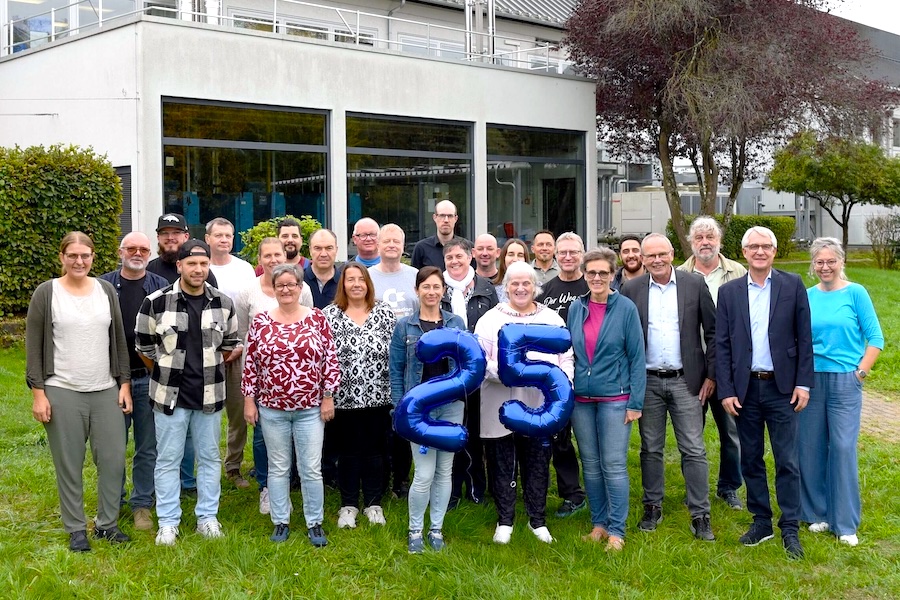
25 YEARS OF PERSONAL COMMITMENT TO ITA

Prof. Gries, you recently celebrated your 25th anniversary and have played a key role in building and shaping ITA Aachen. Looking back, which developments and milestones have been most decisive for the institute and its strategic direction?

It is actually even more years than that. I attended my first Techtextil around 40 years ago – as a student at the time – and I was already fascinated by the enormous diversity of the industry. Topics such as carbon fibres, early textile concrete applications or textile solutions for medical applications were just emerging. At the same time, interdisciplinarity was becoming increasingly important.

We were later able to build on these developments. Of course, in the beginning you also make mistakes, and there were phases in which we had to reposition ourselves strategically. Parallel to the transformation of the textile industry towards technical textiles, the institute itself also had to redefine its position.

One decisive step was expanding ITA along the entire textile value chain. Based on my experience in plant engineering – from fibre production to finished technical textiles – we developed the institute more strongly as a full-range provider. Simultaneously, we continuously expanded interdisciplinary cooperation in areas such as construction, medical applications and later Smart Textiles. Especially in Smart Textiles, we were able to help shape production technologies at a very early stage. Together, we consciously invested in organisational development and corporate culture. Sustainable growth only works when structures and processes evolve as well. That is why we repeatedly adapted and further developed the organisation step by step.

Important milestones later on included the new institute building, which brought many areas together and created additional synergies, as well as the expansion of fibre technology around carbon fibres. At the same time, our partnership with McKinsey enabled us to establish the Digital Innovation Center Europe (DICE). Overall, this period was characterised by a strong development boost and numerous innovation and start-up activities. Not everything worked out – for example, our attempt to establish a research institute in Turkey was ultimately unsuccessful. What was missing there was the entire innovation ecosystem consisting of research, industry and infrastructure.

Today, however, I see a very stable foundation for the next stages of development. The goal now is to further develop and sustainably secure the grown structure in the long term. The next step should move towards a foundation structure.


ITA IN AN INTERNATIONAL CONTEXT

ITA Aachen has developed into one of the leading institutes for textile technology. From your perspective, what were the decisive factors behind this positioning – and how has international collaboration changed over the years?

“First of all, it is important to say that we are not alone in Germany. Strong competition is part of the system. Institutes such as Dresden or Denkendorf have also positioned themselves extremely well. This kind of healthy competition ultimately makes everyone stronger and ensures that the institutes develop different profiles.

One key success factor in Aachen is certainly our strong focus on production technology, textile chemistry and the transfer of research into industrial applications. While some institutes are more strongly focused on fundamental research, our strength lies in actually bringing new technologies into production. That is why our machinery infrastructure is also set up differently. We do not simply work with existing technologies; we continuously develop the next generation of production technology. As a result, we are in a constant state of transformation. This has become an important part of our positioning.

Internationally, we have also seen for years a clear trend towards technical textiles – for example in Korea, India or Japan. Many international partners have strong expertise in products or materials, but far less frequently in process and production technologies. That is often where our role begins.

I often say: ‘Production is a product.’ This mindset has historically been very strong in Germany. Other countries often have excellent individual technologies or exciting material ideas. But turning these into a stable industrial production line and a marketable product is often the real challenge. This is exactly where many of our international collaborations emerge.

It is also important to know your own strengths and limitations. Successful international cooperation only works when every partner understands the contribution they can make. This clarity has helped us in many projects.”


TRANSFORMATION OF THE TEXTILE VALUE CHAIN

You have closely followed the textile industry for decades. How has the textile value chain changed during this time – and where do you see the biggest structural shifts today?

“The textile industry is essentially in a constant state of transformation. During one of my trips to India, I once read a headline that still holds true today: ‘The textile industry is always dying but never dead.’ That describes the industry quite well.

Looking back historically, there have always been fundamental changes – both in raw materials and in products and production structures. Flax was replaced by cotton, wool lost importance, and later man-made fibres emerged. Even there, we saw constant change – from wood to coal and later petroleum as the raw material base.

At the same time, entire industrial sectors changed or disappeared. When I was studying in Aachen, there was still a traditional woollen spinning industry there. Today, it no longer exists. At one go, technical textiles have grown significantly and have become one of the key drivers of the industry.

Globally, we are now seeing a strong concentration around only a few major market players. This affects many sectors – from apparel to technical applications. Large-volume markets are increasingly dominated by a small number of international players. Smaller companies can often only survive through specialisation and added-value strategies.

Particularly in machinery and technical textiles, I therefore see the greatest opportunities in highly specialised niches and value-added products rather than standardised mass products. This development will continue to intensify.

At the same time, we are seeing new discussions around reshoring, decentralised production structures and regional value creation. I believe that within the next 20 years we will once again experience a very fundamental reorganisation of production landscapes – especially in Europe.

Smaller, flexible and technologically well-supported structures may become increasingly important again. Topics such as repair, recycling, regional production or new logistics models will play a larger role in the future. Nobody can fully predict exactly what this development will look like. But I am convinced that we are once again facing a profound transformation of the industry.”


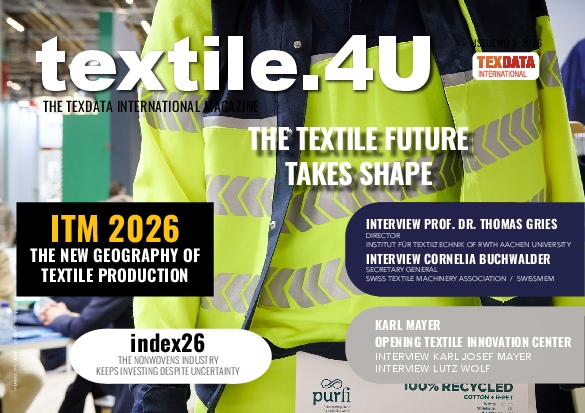
The full interview can be read in the latest issue of textile.4U, available for free download here:



More News from TEXDATA International

#ITM 2026

ITM 2026: The new geography of textile production

New production hubs are emerging across North Africa and Central Asia, while Türkiye is accelerating its transformation toward higher-value, technology-driven and more sustainable textile manufacturing.

#Knitting & Hosiery

“We need to move away from the price trap and return to a value-driven mindset.”

With its new Textile Innovation Center, KARL MAYER is sending a strong signal for innovation, collaboration, and the future of textile applications. In this interview, Karl Josef Mayer discusses new opportunities in warp knitting, the processing of staple fibres, recycling, the changing role of machinery manufacturers, and why the textile industry must once again focus more strongly on the value of textiles. by Oliver Schmidt

#Associations

“Innovation, resilience and international experience remain the great strengths of the Swiss textile machinery industry”

Geopolitical uncertainty, growing competitive pressure from China, new free trade agreements and the shift towards a circular economy are currently reshaping the global textile industry. In this interview, Cornelia Buchwalder discusses the current mood within the Swiss textile machinery sector, the industry’s distinctive innovative strength, new market opportunities in India and Asia, and the technological trends that could shape the upcoming trade fair cycle leading up to ITMA 2027.

#Technical Textiles

“ We have multiple companies and divisions operating in textiles, and we decided to integrate them into one platform. ”

At Techtextil 2026, the Aditya Birla Group presented its textile activities as a unified platform for the first time. In this interview, Kapil Agrawal, Business Head Textiles, Acrylic Fibres & Overseas Spinning, explains how the group is expanding from traditional textile products towards integrated technical textile solutions, circularity and higher-value applications – and outlines the role India could play in scaling fibre-to-fibre recycling in the years ahead.

More News on Research & Development

#Research & Development

ALADIN paves the way for circular and demand-driven textile production in Europe

Textile production can be organized sustainably by utilizing short supply chains and preventing overproduction. This can already be achieved today by intelligently connecting and efficiently utilizing existing infrastructure. At the same time, production becomes circular when innovative technologies and materials are used that enable high-quality recycling. The ALADIN research project, launched in May 2026 and co-funded with five million euros under the EU Horizon Europe program, is creating the conditions for this.

#Research & Development

TERIS reaches milestone: Fraunhofer consortium develops new standards for tire analysis

In the “TERIS” project, the Fraunhofer institutes ICT, IGD, and IWM—led by the Fraunhofer Institute for Structural Durability and System Reliability LBF—have reached a decisive milestone. For the first time, the teams aim to generate, analyse, and predict tire wear in the laboratory in a standardized and practical manner. As part of this milestone, results are now available on reference abrasion, particle analysis, tribological models, AI-based surface analysis, a test bench concept, and methods for accelerated aging and VOC detection. The tire industry, testing services, and environmental agencies will in future benefit from reliable, rapid laboratory procedures for emissions assessment.

#Research & Development

Geotextiles made from recycled materials: GREEN leads the way into the industry

For the industry, recycled materials are creating new opportunities in geotextile production. In the GREEN project, the Fraunhofer Cluster of Excellence Circular Plastics Economy CCPE demonstrates that recycled polypro-pylene (PP), polyethylene terephthalate (PET), and high-density polyeth-ylene (HDPE) can be processed into nonwovens, fibers, and membranes that meet industrial requirements. This creates opportunities for use in existing production lines and new value chains in the geotextile market.

#Research & Development

2026 general meeting of the Friends and Supporters of RWTH Aachen at ITA

The Friends and Supporters of RWTH Aachen e. V. (proRWTH) looked back on a successful year of support at their 2026 general meeting. The meeting took place at Institut für Textiltechnik (ITA) of RWTH Aachen and was combined with a joint session of the Executive Board and the Administrative Board. Before the general meeting began, participants were given a guided tour of ITA, providing them with fascinating insights into current research and development topics in textile engineering.

Latest News

#Recycled Fibers

Recover™ and Ünteks Group partner to scale recycled cotton in knitwear

Recover(TM), a global producer of low‐impact, high‐quality recycled cotton fiber, announces a new partnership with Ünteks Group, a vertically integrated textile manufacturer based in Turkey. The collaboration focuses on the development of circular knit fabrics and garments, combining Recover’s recycled cotton fiber with Ünteks Group’s integrated capabilities across knitting, dyeing, printing, and garment production.

#Spinning

STEELTOP®: A new benchmark in flat tops for spinning preparation

Modern carding generations achieve higher production performance, placing significantly greater stress on flat tops. Higher cylinder speeds and increased fiber density, combined with tighter carding gaps, create more demanding operating conditions. At the same time, poorer raw material quality and the increased use of recycled materials further intensify these challenges. With STEELTOP®, Trützschler introduces a new full steel flat top series developed for these demanding modern carding processes.

#Textile processing

YKK develops concept EXCELLA® zipper tape using nonwoven fabric partially derived from used clothing

YKK Corporation has developed a concept version of its premium EXCELLA® zipper series made from nonwoven fabric sheets created by fiberizing used clothing and other textile materials. Based on a proposal by fashion designer Yuima Nakazato, this item was created as a result of collaboration between Nakazato, Seiko Epson Corporation and YKK. The concept zipper was incorporated as a material component for pieces in the newest YUIMA NAKAZATO Couture Collection, “INFERNO,” which was unveiled in Paris, France on July 8, 2026.

#Textiles & Apparel / Garment

Texworld Apparel Sourcing Paris highlights evolving global sourcing landscape

From 31 August to 2 September 2026, Texworld Apparel Sourcing Paris will bring together more than 1,000 international exhibitors at Paris-Le Bourget Exhibition Centre. This edition reflects the new global balance of textile and apparel sourcing, highlighting a strong diversity of sourcing countries — some unexpected.

TOP