[pageLogInLogOut]

#Research & Development

Textile climate control system in workwear – exhibition at the 2026 SME Innovation Day!

Conventional protective workwear often reaches its limits during strenuous physical activity. In particular, the transport of sweat and excess body heat poses a problem. The German Institutes of Textile and Fiber Research (DITF) conducted research on flow-optimized, air-conducting textile structures that enable targeted climate control directly on the body. These structures can be integrated straight into protective work garments. The textile climate control system supports the body’s natural thermoregulation. This contributes to improved workplace safety and comfort.

To power the air-conducting structures, pneumatic pressure generators were developed that utilize the body’s everyday movements. For example, a compressible insole in the shoe generates compressed air from the normal act of walking. This allows the system to operate independently without an external compressed air connection. The air volume generated while walking is routed via a hose system in work protective pants to the climate control element in the upper garment. A specially designed belt buckle allows the pants to be intuitively detached from the upper garment during the workday, thereby interrupting the airflow.
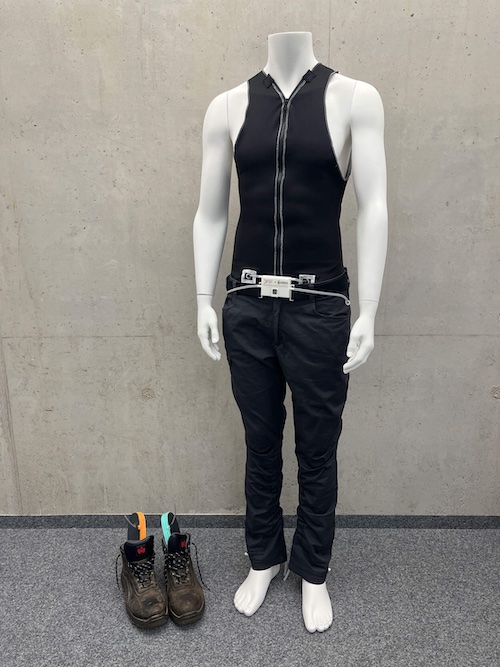
Demonstrator featuring insoles that function as pneumatic air compressors, pants with an integrated air conduit, a top with air-conducting structures for climate control, and a belt buckle to separate the pants from the top. Photo: DITF © 2026


The project demonstrated that combining air-conducting textile structures with pressure generators significantly improves heat and moisture management. This not only reduces the risk of overheating but also has a positive effect on wearing comfort and work performance.

The project was carried out in cooperation between DITF and Hero Textil AG. It was funded as part of the Central Innovation Program for SMEs (ZIM) by the Federal Ministry for Economic Affairs and Energy on the basis of a decision by the German Bundestag.

The StAirS textile climate control system was selected as a successful project example for the 2026 SME Innovation Day in Berlin and will be presented there on June 11 jointly by DITF and Hero. With the Innovation Day, the Federal Ministry for Economic Affairs and Energy is creating a meeting place to showcase innovative projects, new technologies, and creative ideas.

More News from Deutsche Institute für Textil- und Faserforschung Denkendorf

#Techtextil 2026

Stylish design made from sustainable materials – two DITF research projects receive Techtextil Innovation Awards

Materials made from domestic, renewable raw materials reduce CO₂ emissions, prevent microplastics from entering the environment, and close the material cycle. The German Institutes for Textile and Fiber Research Denkendorf (DITF) are developing nature-based alternatives to synthetically produced and predominantly petroleum-based materials. Two research projects have received a prestigious Techtextil Innovation Award. NUO Flexholz and the lignin-coated material FormLig demonstrate that sustainable concepts can meet high standards of functionality and design. Both projects were carried out in close collaboration with industry.

#Research & Development

Textile cascade filter for removing microplastics from wastewater

Microplastics are now found almost everywhere, even in remote regions of Antarctica. They enter the human body through the food chain. Studies indicate that microplastics may have negative effects on the human health.

#Research & Development

Fabolose: Fabricating vegan and circular leather alternatives from bio-tech-derived cellulose

Fabulose is an EU funded project coordinated by the German Institutes of Textile and Fiber Research (DITF). Its consortium consists of leading research institutes, biotech innovators, and industry stakeholders who aim to create high-performance, biobased and recyclable leather-like fabrics, using efficient biotech production routes for bacterial cellulose, cyanophycin and bacterial pigments

#Research & Development

More safety and comfort for protective clothing thanks to auxetic fabrics

When everyday materials are pulled, they stretch or elongate in the direction of the pull and become narrower in cross-section. We can also observe this property in two-dimensional textiles. Auxetic structures behave differently here. They have the striking property of not changing under tensile stress or even increasing their width or thickness. These properties are advantageous, for example, in protective textiles or textile filter media. The DITF are researching auxetic fabrics for various applications.

More News on Research & Development

#Research & Development

Elastic yarns to become more recyclable and environmentally friendly in future

On 29 April 2026, ITA student Tobias Dickmeiß was awarded a sponsorship prize by the Wilhelm Lorch-Stiftung for his innovative approach, to replacing conventional elastane with elastic yarns made from thermoplastic copolyester elastomers (TPC). Thanks to their thermoplastic nature and compatibility with typical polyesters used in the textile industry, elastic TPC yarns offer improved recyclability. Furthermore, the use of the melt-spinning process in yarn production eliminates the need for solvents that are harmful to the environment and human health.

#Research & Development

Walter Reiners Foundation Prize awarded to three ITA graduates

Sabina Dann, Lukas Balon and Annegret Storm from the Institut für Textiltechnik (ITA) of RWTH Aachen University were awarded the Walter Reiners Foundation Prize by the German Engineering Federation (VDMA) for their master’s and bachelor’s theses. Peter Dornier, Chairman of the Walter Reiners Foundation, presented the awards during Techtextil at the VDMA stand in Frankfurt am Main, Germany.

#Techtextil 2026

Young talents honoured – 60 years Walter Reiners Foundation

At the Techtextil trade fair in Frankfurt at the end of April, Peter D. Dornier, chairman of the VDMA’s Walter Reiners Foundation, presented awards to five successful young engineers. Promotion and sustainability awards were presented in the categories of bachelor’s/project theses and diploma/master’s theses. Academic theses are eligible for the sustainability awards if, for example, they develop solutions for resource-efficient products and technologies.

#Research & Development

Regional hemp bast for lightweight construction profiles

The cultivation of fibre hemp for the production of ropes and clothing has a long tradition in Saxony. Due to its excellent fibre properties, it is also suitable as a renewable raw material for reinforcement in fibre composites. At the STFI and IWU in Chemnitz, the CannaPul project is cur- rently investigating how a regional value chain for hemp-based lightweight construction profiles can be established. To this end, the technical processing of hemp fibres into continuous fibre strands and their embedding in a suitable bio-based matrix are being investigated.

Latest News

#INDEX 2026

“We clearly see that reliability, flexibility, service and total cost of ownership are becoming increasingly important again.”

The nonwovens industry continues to face a challenging market environment. Nevertheless, AUTEFA Solutions reports successful projects, new line sales and growing demand for energy-efficient and flexible solutions. In this interview, André Imhof of AUTEFA Solutions talks about competitiveness against Chinese suppliers, new service and recycling concepts, the growing importance of application development and the opportunities created by countercyclical investments.

#INDEX 2026

“Needle punching technology is more universal and sustainable than ever!”

Needle punching technology was long regarded as a rather traditional and comparatively slow technology within the nonwovens industry. In this interview, Johann Philipp Dilo explains why needle punching is more relevant than ever today – ranging from energy efficiency and resource conservation to hygiene applications, new machine concepts and design-oriented nonwoven solutions.

#Nonwovens

PET spunbond from China – EDANA welcomes imposition of provisional anti-dumping measures

On 13 May 2026, after eight months of investigation, the European Commission imposed provisional anti-dumping duties of 45.6-50.0% on imports of PET spunbond from China. EDANA welcomes this expression of the Commission’s clear determination to protect EU industries from the unfair trade practices of Chinese producers.

#INDEX 2026

ANDRITZ at INDEX ’26: Driving sustainability with next-generation nonwoven technologies

From May 19-22, ANDRITZ Nonwoven & Textile is presenting its innovative solutions for the nonwoven & textile industry in Geneva, Switzerland. ANDRITZ will focus on technologies for sustainable and durable nonwovens, converting, sustainable fiber processes, textile recycling, and life-cycle services on booth 2114 in hall 02.

TOP