[pageLogInLogOut]

#Sustainability

H&M Foundation backs women garment workers in Bangladesh
The non-profit H&M Foundation is initiating a long-term project to support women garment workers in Bangladesh, starting with their urgent needs connected to COVID-19. As a first step, 12 million SEK (1.3 million USD) is donated to WaterAid, CARE and Save the Children to provide around 76,000 young women, their families and community members in around Dhaka with emergency relief, also reaching 1 million people with messages on COVID-19 and hygiene practices. The H&M Foundation also calls for others to show their support.
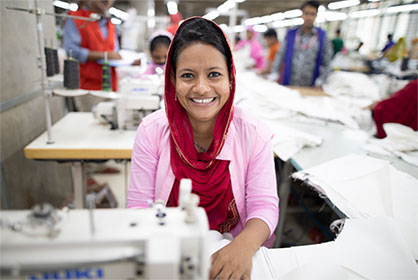
Photo: CARE. Lipiya (20) is Senior Sewing Operator at a ready-made garment factory in Gazipur, Bangladesh.


Bangladesh has been identified by WHO as one of the 25 most vulnerable countries to be affected by the COVID-19 pandemic, with a high population density, poor infrastructure, weak health systems and low awareness of basic preventive measures. As the coronavirus is rapidly spreading within the country some high-risk areas are currently in lockdown to maintain social distancing and flatten the curve.

The textile sector is one of the largest contributors to the country’s GDP and the local and global effects of the pandemic has a great impact on textile workers within the garment industry. At the same time, the use of automation and digital technology is making its way into the textile industry, also creating a great risk of unemployment for millions of Bangladeshis.

Women are particularly at risk, as they represent the majority of the total workforce within the garment industry and are often employed to execute the tasks which are highly susceptible to automation. There is an urgent need to create a skilled female workforce to save jobs and create new job opportunities.


From urgent needs to long-term support

H&M Foundation is initiating a long-term project, running over several years, to support women garment workers in these excessive transitions, starting with their urgent needs connected to COVID-19. As a first step, they are donating 12 million SEK (USD 1,3 million) to WaterAid, CARE and Save the Children to provide 26,700 young women and their families in and around Dhaka with emergency relief, also reaching 1 million people with messages on COVID-19 and hygiene practices.

“We will directly support women and their families with for example cash assistance for food, medication and other necessities, provide COVID-19 awareness raising and testing, hygiene materials and handwashing facilities. We hope to see more donors show their support in different ways", says Carola Tembe, Program Manager, H&M Foundation.

H&M Foundation is also supporting families where gender based violence increases as an effect of the crisis, as well as specifically supporting disadvantaged children, focusing on child protection and child education.

To follow up, a holistic approach will be taken to involve important players from different sectors to achieve systemic, long-lasting change, equipping women garment workers in Bangladesh for a future where work is defined by automation and digitalization. H&M Foundation will for example be looking at upskilling, re-skilling, digital literacy efforts and entrepreneurship. They will also be launching community programs and utilizing social innovation to solve challenges or spark new ideas relevant to female textile workers employability.




More News from TEXDATA International

#Techtextil 2026

Performance Apparels: Functional textiles drive innovation at Techtextil 2026

From high-performance fibres and advanced membranes to smart textiles and sustainable material concepts – functional apparel is becoming one of the most dynamic innovation fields in technical textiles. At Techtextil 2026, exhibitors demonstrate how new materials, finishing technologies and digital functions are shaping the next generation of protective, workwear and outdoor systems.

#Texprocess 2026

Texprocess 2026: Automation, digitalisation and AI reshape textile processing

Investment decisions in textile processing have become increasingly complex. Rising energy prices, labour shortages and geopolitical uncertainties are forcing companies to prioritise technologies that deliver measurable improvements in efficiency and process stability. This applies not only to apparel production, but also to the processing of technical textiles and high-performance materials. Modernisation projects are therefore being evaluated more selectively – but the pressure to upgrade production systems continues to grow. Texprocess 2026 reflects this tension between cautious investment behaviour and increasing technological demand.

#Techtextil 2026

Textile Chemicals & Dyes: Innovation in Textile Chemistry moves into focus at Techtextil 2026

From PFAS-free finishes and water-saving dyeing technologies to advanced coatings and recycling-compatible formulations, innovation in textile chemistry is accelerating across the industry. Reflecting this development, Techtextil 2026 introduces Textile Chemicals & Dyes as a dedicated product segment, highlighting the growing role of chemical solutions in shaping the next generation of technical textiles.

#Recycling / Circular Economy

textile.4U publishes special edition “Top 100 Textile Recycling Companies 2025”

With a comprehensive 176-page special edition, textile.4U is dedicating its latest issue entirely to one of the most dynamic and influential topics in today’s textile industry: textile recycling. The new issue, published exclusively in high-quality print, presents the Top 100 textile recycling companies researched and selected by TexData – organizations that already play a key role in the transition to circular textiles or are expected to have a significant impact in the near future.

More News on Sustainability

#Natural Fibers

Global Standard gGmbH launches second public consultation for GRTS Draft 2 for the textile industry (1–30 April 2026)

Global Standard gGmbH is pleased to announce the release of Draft 2 of the Global Responsible Textile Standard (GRTS) for its second public consultation. The consultation will be open from 1 April 2026 to 30 April 2026, inviting stakeholders across the textile and apparel value chain to provide input and contribute to the further development of this new Standard.

#Sustainability

Practical toolkit to drive coordinated climate action launched

An open-access workshop toolkit enables brands, suppliers, policymakers and investors across the textile industry to apply the System Map in their own work, identifying leverage points to halve emissions and enable a just transition.

#Raw Materials

Textile Exchange publishes cotton Life Cycle Assessment study to strengthen impact data

Textile Exchange has published the first in a series of seven Life Cycle Assessment (LCA) studies designed to improve the quality and robustness of environmental impact data for raw material production across the fashion, textile, and apparel industry. The first LCA study focuses on cotton and addresses critical data gaps and methodology variability through new high-quality data across key producing countries. The study includes organic, regenerative, recycled, and country averages for conventional cotton production systems, providing a clearer picture of the associated environmental impact.

#Sustainability

Experts publish APAC policy priorities

Cascale today announced the publication of its APAC Policy Priorities Paper, developed by the Asia-Pacific (APAC) Policy Member Expert Team (MET) to identify key regional sustainability challenges and provide practical, aligned recommendations for policymakers and industry stakeholders across Asia-Pacific.

Latest News

#Raw Materials

New study shows low environmental impact by Cotton made in Africa Organic Cotton from Tanzania

Today, the Aid by Trade Foundation (AbTF) is announcing the results of a comprehensive life-cycle analysis (LCA) for cotton produced in Tanzania under the Cotton made in Africa Organic (CmiA Organic) standard. The study emphasises the small ecological footprint of CmiA Organic verified cotton. This can largely be traced back to the absence of synthetic pesticides, artificial fertilisers, and artificial irrigation. Consequently, CmiA Organic cotton can help the textile industry meet regulatory requirements as well as science-based targets. The results also show that the consequences of climate change threaten the livelihoods of these cotton farmers, even though the type of agriculture they practise barely contributes to climate change.

#Raw Materials

Better Cotton Initiative strengthens regenerative focus in standard update

The Better Cotton Initiative (BCI) has strengthened the regenerative focus of its field-level standard with the launch of a new version of its Principles & Criteria (P&C), which marks the next step in the organisation’s journey to becoming a regenerative standards system.

#Man-Made Fibers

Selenis and Kintra Fibers partner to scale 100% bio-based synthetic fiber technology

Selenis, a leading global specialty polyester manufacturer, today announced a strategic manufacturing partnership with materials science company Kintra Fibers to scale Kintra’s patented fiber-grade PBS resin - a 100% bio-based and biodegradable material designed for textile applications.

#Functional Fabrics

PERFORMANCE DAYS proves its relevance as the industry’s key meeting point

Held on March 18–19, 2026, PERFORMANCE DAYS once again confirmed its position as a leading international platform for functional textiles. A total of 3.366 trade visitors and around 560 exhibitors gathered in Munich, with the event already kicking off successfully on DAY 0, which received highly positive feedback for its interactive format. Despite challenging conditions caused by the public transport strike in Munich, the event saw strong attendance and a consistently high level of activity across both exhibition days.

TOP