[pageLogInLogOut]

#Sustainability

Closing the Footwear Loop reveals challenges and opportunities for circular footwear

New report shows half of post-consumer footwear is unsuitable for reuse – while dedicated sorting and recycling solutions begin to emerge

The footwear industry faces one of the most complex circularity challenges in the fashion sector. A new Phase 1 report from the Fashion for Good initiative Closing the Footwear Loop, developed together with Circle Economy, provides new insights into the composition, condition and recycling potential of post-consumer footwear waste.

The project analyzed footwear waste streams through pilot activities involving CETIA, Matoha, Picvisa and The 8 Impact.

According to the report, around 50% of post-consumer footwear collected is classified as non-rewearable, while 46% remains suitable for reuse. The remaining 4% is contaminated, preventing both reuse and recycling. Among the reusable footwear, approximately 90% is exported, mainly to the UAE, China and Pakistan.

One particularly noteworthy finding is that 24% of shoes categorized as non-rewearable showed no visible physical damage. This suggests that current sorting and assessment practices may not always capture the full potential for reuse or recovery.

Footwear complexity remains a major barrier

The report highlights the enormous challenge facing the sector. Around 23.8 billion pairs of shoes are produced globally each year. A typical shoe contains more than 60 different components, including textiles, plastics, rubber compounds, foams and adhesives. This complex multi-material construction makes sorting, disassembly and recycling significantly more difficult than in many apparel applications.

As a result, recent studies estimate that around 90% of footwear still ends up in landfill at the end of its life.

The pilots also revealed technical limitations in current recycling processes. Nearly 38% of non-renewable sole materials could not be identified using near-infrared (NIR) scanning technology, underlining the need for improved material transparency and identification systems.

New sorting technologies tested

As part of the project, dedicated footwear sorting technologies were tested by Matoha, CETIA and Picvisa. According to the project partners, these represent some of the first technologies specifically developed to sort footwear waste streams for circularity applications.

The initiative also demonstrated the technical feasibility of closed-loop recycling for sports shoes and sneakers. Working with footwear collected through the French Extended Producer Responsibility (EPR) system, The 8 Impact successfully processed footwear waste into recycled material streams, providing further evidence that circular solutions for selected footwear categories are becoming increasingly viable.

Building the foundation for footwear circularity

The Closing the Footwear Loop initiative aims to establish the infrastructure needed for a circular footwear industry. Alongside waste stream mapping and technology validation, the project is developing design-for-circularity guidelines in collaboration with circular.fashion. The objective is to improve recyclability, durability and repairability while supporting the development of scalable end-of-life solutions.

The findings underline both the scale of the challenge and the opportunities emerging as new sorting, disassembly and recycling technologies begin to mature. While footwear remains one of the most difficult product categories to circularize, the project demonstrates that dedicated infrastructure and design improvements could significantly increase reuse and recycling rates in the future.

Download the report:

https://www.fashionforgood.com/case-study/closing-the-footwear-loop/?utm_source=MPL&utm_medium=MPL&utm_campaign=MPL


More News from Fashion for Good

#Recycling / Circular Economy

Project REWEAR investigates diverse economies of rewear as a global practice of circularity

Every year, European households discard millions of tonnes of clothing. Around a quarter of what gets separately collected is exported, much of it classified as rewearable. A significant share ends up in markets like Kantamanto in Accra, Ghana, where an estimated 15 million garments arrive every week. New research published today reveals what happens when that clothing arrives.

#Recycling / Circular Economy

Solving the Feedstock Gap: Unlocking Post-consumer Feedstocks for Textile-to-Textile Recycling in Europe

Fashion for Good launches Project FAE (Feedstock Activation Europe) to develop the sorting and pre-processing infrastructure needed to channel non-rewearable post-consumer textiles into textile-to-textile (T2T) recycling at scale. The project is a practical response to one of the most pressing problems in textile circularity: making post-consumer waste a viable, commercially competitive raw material for recyclers.

#Raw Materials

Fashion for Good mobilises industry to adopt mass balance attribution and accelerate decarbonisation

Fashion for Good launches today the Mass Balance Demonstrator project, a collaborative industry initiative to implement and scale the mass balance attribution (MBA) chain-of-custody model for biomass-attributed PET in textile applications. The project represents a concrete step toward accelerating brand-driven decarbonisation across the apparel value chain.

#Recycled Fibers

Advancing the future of stretch: Fashion for Good launches new project to validate bio-based and recycled elastane

Launched today, Stretching Circularity is a collaborative project initiated by Fashion for Good dedicated to accelerating the adoption of lower-impact elastane alternatives that are compatible with circular textile systems. By validating bio-based and recycled elastane solutions through pilot-scale testing and demonstrator garments, the initiative aims to remove one of the most significant technical barriers to a circular textile economy.

More News on Sustainability

#Man-Made Fibers

The updated poster on biodegradable Polymers in various environments has been released

As part of the PerPlacsBio project, nova-Institute has updated its popular poster on the biodegradability of polymers in different environments. The updated version reflects current standards, certifications and the latest scientific findings. The poster can be used to assess biodegradable alternatives for use in agriculture and forestry, and it is now available in German for the first time.

#Sustainability

A new standard to combat plastic waste in forests

With DIN SPEC 35808 “Tree Shelter for Forestry Applications,” the testing and research service provider Hohenstein, in collaboration with Rottenburg University of Forestry, as well as forestry authorities and industry partners, has established a clear framework for bio-based and fully biodegradable tree shelters. The pre-standard defines requirements and practical testing methods designed to reduce plastic waste in forests and strengthen the long-term protection of soil and the environment.

#Denim

Denim moves towards sustainability

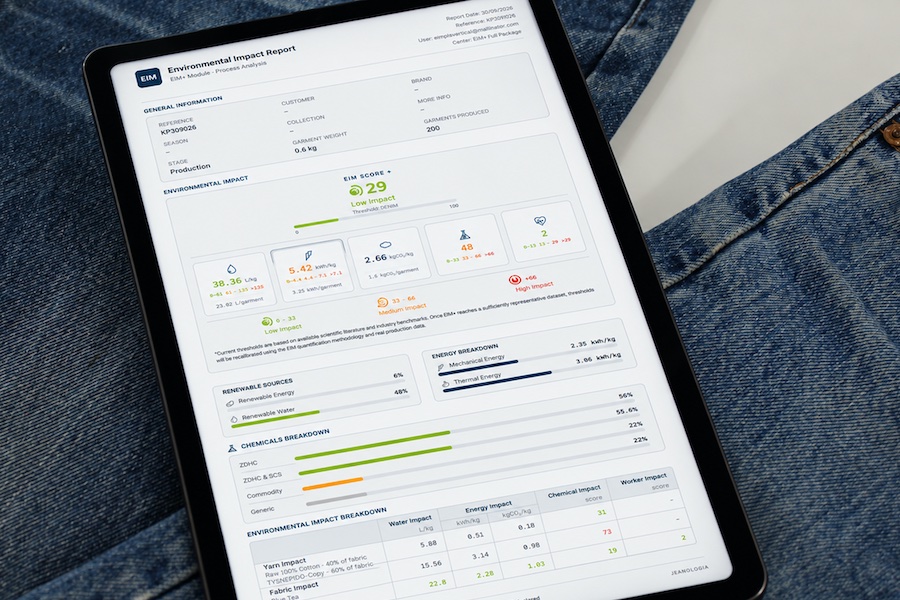
EIM (Environmental Impact Measurement), the global reference platform for measuring the environmental impact of garment finishing, presents the second edition of its annual report Denim Industry Progress & Insights 2025. The study analyses over 100,000 real denim finishing processes, providing an accurate and up-to-date view of the industry’s evolution towards more sustainable models.

#Recycling / Circular Economy

Europe’s textile future at a turning point: New 2030 Circularity Blueprint aims to scale recycling and unlock investment opportunities

The EU textile system is at a critical crossroads. Today, less than 1% of discarded garments are recycled into new garments, despite EU-wide obligations for separate collection. In response, Global Fashion Agenda (GFA) is launching the 2030 Circularity Blueprint, in partnership with ReHubs. This ambitious initiative is designed to support the transformation of the EU textile ecosystem to advance textile-to-textile recycling and drive the transition to a circular economy.

Latest News

#Research & Development

“Production is a product”

From technical textiles and AI-driven robotics to the limitations of textile circularity: Professor Dr Thomas Gries looks back on more than two decades of development at ITA Aachen. In the interview, he explains why production technology remains a decisive success factor, discusses international collaborations and innovation ecosystems, and shares his views on the transformation of production landscapes and the challenges facing an increasingly regulated industry.

#Knitting & Hosiery

“We need to move away from the price trap and return to a value-driven mindset.”

With its new Textile Innovation Center, KARL MAYER is sending a strong signal for innovation, collaboration, and the future of textile applications. In this interview, Karl Josef Mayer discusses new opportunities in warp knitting, the processing of staple fibres, recycling, the changing role of machinery manufacturers, and why the textile industry must once again focus more strongly on the value of textiles. by Oliver Schmidt

#Associations

“Innovation, resilience and international experience remain the great strengths of the Swiss textile machinery industry”

Geopolitical uncertainty, growing competitive pressure from China, new free trade agreements and the shift towards a circular economy are currently reshaping the global textile industry. In this interview, Cornelia Buchwalder discusses the current mood within the Swiss textile machinery sector, the industry’s distinctive innovative strength, new market opportunities in India and Asia, and the technological trends that could shape the upcoming trade fair cycle leading up to ITMA 2027.

#Textile processing

YKK invests USD 150 million in new manufacturing facility in India

YKK Corporation has announced plans to construct a new manufacturing facility in India, reinforcing its long-term commitment to one of the world's fastest-growing textile and apparel production hubs. The new factory will be built at Origins by Mahindra in Chennai, Tamil Nadu, and will become the third manufacturing site of YKK India Private Limited. The facility is expected to be completed by February 2028 and represents an investment of approximately USD 150 million, covering land, buildings, machinery and equipment.

TOP