[pageLogInLogOut]

#Denim

EIM, the global standard for measuring the environmental impact of textile finishing, presents its annual report

Denim moves towards sustainability

EIM (Environmental Impact Measurement), the global reference platform for measuring the environmental impact of garment finishing, presents the second edition of its annual report Denim Industry Progress & Insights 2025. The study analyses over 100,000 real denim finishing processes, providing an accurate and up-to-date view of the industry’s evolution towards more sustainable models.


The textile industry, as one of the sectors with the greatest environmental impact, plays a key role in the transition towards more sustainable production models. To move forward, measuring, understanding, and acting are essential. EIM acts as a compass for the industry, enabling the objective assessment of process impacts and supporting decision-making towards more eco-efficient production.

The report confirms that the denim industry continues to make progress in reducing its environmental impact. Currently, 66% of processes are already classified as low impact, reflecting a positive trend driven by process optimization and the adoption of more efficient technologies.

In terms of resource use, significant progress has been made in optimizing water and energy, although there is still room for improvement to reach more advanced standards. Water consumption remains stable at around 30 liters per garment, indicating a plateau after years of continuous improvement. Energy shows the strongest performance, with 85% of processes classified as low impact, driven by equipment modernization and automation.

However, the report highlights that chemical impact remains the industry’s main challenge, with 27% of processes still classified as high impact. Factors such as the use of generic chemicals, lack of transparency in formulations, and the persistence of legacy practices, such as pumice stones or potassium permanganate, continue to limit progress, despite the availability of more sustainable alternatives.

At the same time, worker health impact has improved significantly, with 68% of processes classified as low impact, driven by the increasing adoption of automated technologies replacing more harmful manual techniques.

“The industry has proven that it can improve when it measures its impact, but the next step requires accelerating the adoption of technologies and leaving behind practices that are no longer sustainable,” says Begoña García, creator of EIM and co-author of the report. “Today more than ever, we need reliable data to make informed decisions and move towards a real transformation of the industry.”

This second report further establishes EIM as a global reference standard to measure and track environmental impact in denim finishing. Its annual nature allows brands and manufacturers to benchmark performance, identify improvement areas, and move forward together towards more ambitious sustainability goals.

The full report is available for download and will be updated annually, reinforcing the industry’s commitment to transparency, continuous improvement and environmental impact reduction.

EIM, a global standard to measure and compare environmental impact

EIM, Environmental Impact Measurement, is a globally recognized tool for assessing the environmental performance of garment finishing processes.

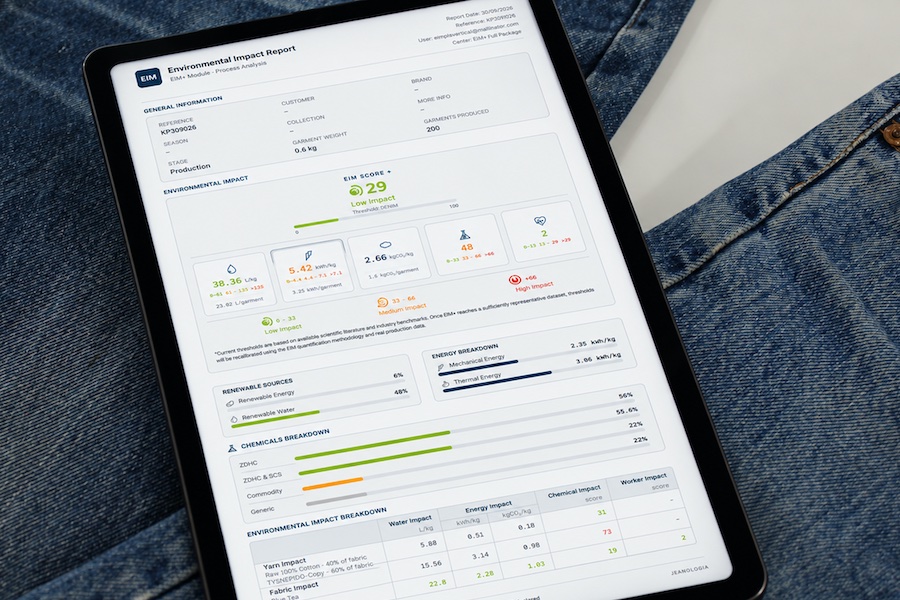
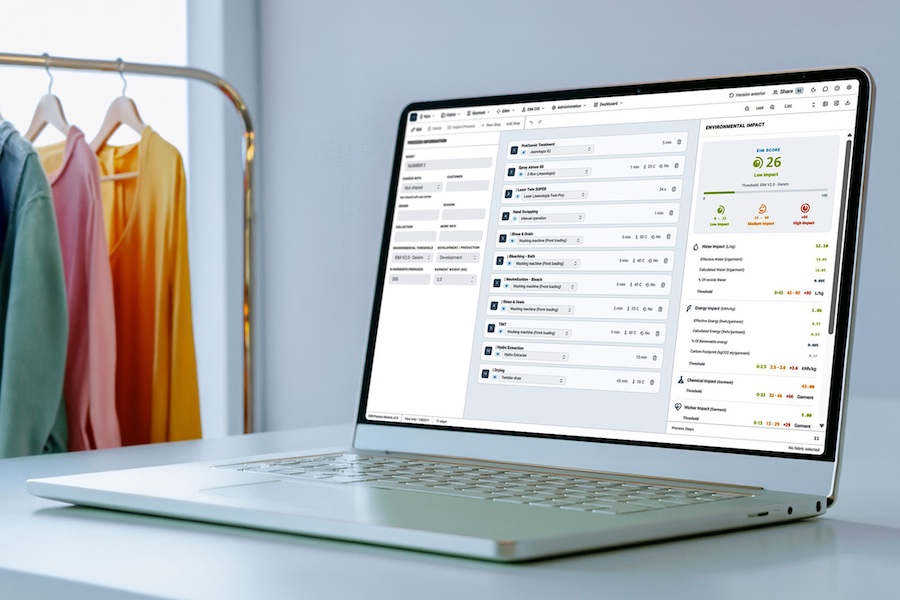
It evaluates four key categories, water consumption, energy consumption, chemical impact and worker health impact. Each process is assessed and classified into three levels, low, medium or high impact, according to standardized benchmarks.

EIM includes specific benchmarks for denim finishing, garment washing and garment dyeing, ensuring that results are accurate, comparable and relevant for each type of process.

This methodology enables brands and manufacturers to measure their processes with precision, track improvements and communicate environmental performance in a transparent and verifiable way.

More News from JEANOLOGIA S.L.

#Recycling / Circular Economy

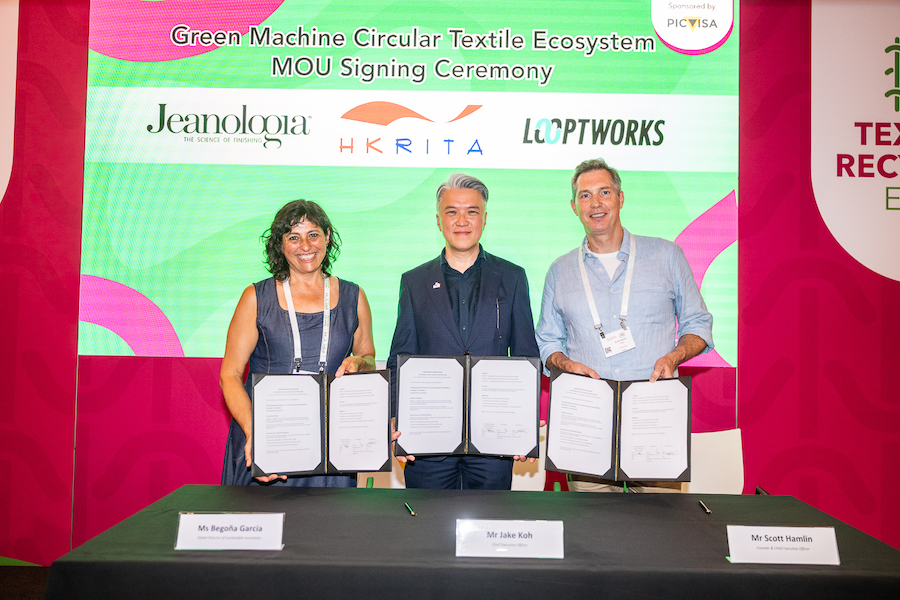
HKRITA signs MoU with Jeanologia and Looptworks to establish the Green Machine Circular Textile Ecosystem

The Hong Kong Research Institute of Textiles and Apparel (HKRITA) yesterday officially signed a landmark Memorandum of Understanding (MoU) with two key global partners, Jeanologia and Looptworks, to establish the Green Machine Circular Textile Ecosystem – a first-of-its-kind collaboration to accelerate the large-scale recycling of blended textiles.

#Denim

Jeanologia brings “Billy” to China, the AI transforming denim design

The denim industry is turning its attention to Hangzhou this week, where a new edition of Kingpins, the leading international trade show for the sector, takes place on May 21 and 22. There, the Spanish company Jeanologia, a global leader in sustainable technologies for the textile industry, is introducing its latest innovation to the Chinese market: “Billy”, the first artificial intelligence specifically developed for denim finishing design.

#Textile processing

Jeanologia showcases the future of product development

Jeanologia is showcasing how software is transforming product development in the fashion industry at PI Apparel Europe: The Fashion Technology Show, taking place on March 30–31 in London.

#Denim

Jeanologia launches Billy

The new AI extracts precise laser designs from a garment image in minutes, transforming how vintage denim is recreated for production. If Jeanologia’s laser changed the way jeans were made at the end of the last century, its AI now takes the next step: moving from reproducing wear to designing it. / archive photo © 2026 Jeanologia

More News on Denim

#Recycled Fibers

Eastman Naia™ brings its inside-out denim vision to Kingpins New York

Following its debut at Kingpins Amsterdam, Eastman Naia™ brings the next chapter of its denim story to Kingpins New York, taking place July 22–23. At Booth Green 7, Naia™ presents its denim proposition built around three complementary design directions: Performance Denim, Fashion Denim and Authentic Denim.

#Denim

ISKO brings conscious color, texture, and tactile evolution to Bluezone Munich

At Bluezone ISKO is debuting its FW 27–28 Collection, structured around a trio of core sensory pillars: color, texture, and touch. This season, the textile leader showcases a creative vision where emotional connection and advanced technical innovation come together. The entire range is anchored by a dedicated commitment to eco-conscious material creation, utilizing patented processing technologies and high-quality Next-Gen materials powered by RE&UP.

#Denim

Officina39 brings modular Low Temperature Reactive Dyeing and a new vision of denim efficiency to Denim Première Vision Milan 2026

At Denim Première Vision Milan 2026, at Stand G21, Officina39 returns to the international denim stage with a clear message: the next phase of denim innovation will be shaped by process efficiency, creative flexibility and the ability to rethink established industrial routines.

#Denim

ISKO unveils a new circular vision of color, texture and tactile innovation at Denim Première Vision Milan

At Denim Première Vision Milan (booth G3), ISKO introduces its FW27-28 Collection, built around three defining elements: color, texture and touch. This season, ISKO presents a vision where emotion and advanced textile innovation converge, rooted in a steadfast commitment to responsible material development by utilizing patented technologies and high-quality raw materials, powered by RE&UP.

Latest News

#Weaving

Lindauer DORNIER GmbH welcomes new apprentices and dual-study students

For 22 new “DORNIER Talents”, these days mark the beginning of a new chapter at Lindauer DORNIER. For the family-owned company, in-house training is a key pillar in developing skilled professionals and retaining them within the company for the long term.

#Raw Materials

Cotton Brazil Dialogues 2026 concludes with 50 international participants immersed in Brazilian cotton production

The Cotton Brazil Dialogues concludes its 2026 edition after a series of technical visits to farms, cotton gins and reference centers, as well as workshops focused on Brazilian cotton production. A total of 50 participants from 14 countries took part in the field trips. The initiative is led by the Brazilian Association of Cotton Growers (Abrapa) and the National Association of Cotton Exporters (Anea), with support from the Brazilian Trade and Investment Promotion Agency (ApexBrasil).

#Research & Development

Novel flame-retardant and recyclable fiber-reinforced composite

Airplanes and passenger trains must meet strict safety requirements, including fire safety standards. This calls for materials that are flame-retardant, lightweight, robust, and scalable. Empa researchers, in collaboration with their industry partner Elantas, have now succeeded for the first time in making such a material – a composite – fully recyclable.

#Composites

WHILL selects Teijin’s tough, lightweight Carbon Fiber Composite for new last-mile mobility

Teijin Limited announced today that WHILL Inc., a global leader in inclusive mobility technology, has selected Sereebo® P CFP series, a carbon fiber-reinforced thermoplastic (CFRTP) material, for key structural components of the upcoming WHILL Model C Lite. Sereebo® P CFP series provides high strength, light weight, design flexibility and system cost advantages to the Model C Lite, which is a battery powered, single-seat, last-mile device. This new model combines maneuverability with light weight and one-handed folding to ensure ease of handling and operation.

TOP