[pageLogInLogOut]

#Research & Development

1 Gt of fossil carbon per year to be replaced by renewable carbon from biomass, CO2 and recycling

The upcoming Renewable Materials Conference, 23-25 May in Siegburg/Cologne (Germany) promises to be a one-of-a-kind event that provides a platform for showcasing the impressive achievements in the field of renewable materials. The conference will bring together experts, stakeholders, and industry leaders to discuss latest developments and share their visions and strategies for the future.

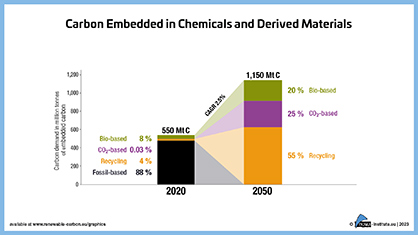
Although experts project lower growth rates for the chemical and plastics industries in the coming decades, global demand for embedded carbon – the carbon in molecules – is expected to increase significantly to 1.15 Gt of carbon per year by 2050. Today, approximately 88% of embedded carbon comes from fossil feedstocks, including oil, natural gas and coal. To achieve a fully defossilised economy, this demand must be met exclusively by renewable carbon sources. And there only are three sources of renewable carbon: biomass, the direct use of CO2 and the recycling of carbon already in our technosphere.

Renewable Materials Conference 2023

Set to take place from 23-25 May 2023, the Renewable Materials Conference brings together the brightest stars of the renewable materials sector in Siegburg/Cologne (Germany). More than 500 participants are expected to attend the meeting point for global leaders in industry, science, and politics. With the unique concept of uniting all renewable materials solutions at one event hits the mark: “The Renewable Materials Conference has established itself as one of the most important conferences for renewable materials worldwide,” says Michael Carus, CEO of nova-Institute and spokesperson for the event. “We are proud to bring together global leaders in industry, science, and politics to shape the future of renewable materials and create a more sustainable world for generations to come.”
© 2023 nova institute


All information and registration for the event is available at: http://www.renewable-materials.eu

Top speakers from world-renowned companies, pioneering start-ups, high-profile research and politics will present and discuss a diverse range of innovative solutions based on biomass, CO2 and recycling in 80 presentations (main and parallel sessions), 20 panel discussions and several expert workshops. Attendees will gain valuable insights into the innovative technologies and solutions that are driving progress in renewable materials, and will learn about the latest trends and emerging opportunities.

More than 40 top-class exhibitors are expected at a new and perfectly suited location – the conference center “Rhein Sieg Forum” in Siegburg near Bonn and Cologne (Germany), easily accessible by high-speed train (ICI) from Brussels or Frankfurt, for example. A matchmaking area throughout the three days, long lunch breaks and three evening meeting points guarantee comprehensive and effective networking. Online networking starts two weeks before the event.

With a focus on collaborative efforts and knowledge-sharing, the conference will provide a platform for attendees to engage in productive discussions and forge new partnerships. Participants will leave with a better understanding of the current state of renewable materials and a clear sense of the exciting possibilities that lie ahead.

Join us at the Renewable Materials Conference in Siegburg/Cologne, Germany from May 23-25, 2023, and be a part of the movement towards a more sustainable chemical, material and plastics industry.

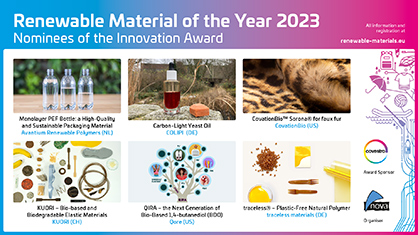
Six Materials Nominated for the Innovation Award “Renewable Material of the Year 2023”

New materials will enable sustainable products in areas such as textiles, cosmetics, packaging, as well as elastic and biodegradable materials for a variety of applications. Participants will vote for the winners.

One way to overcome the industry’s dependence on fossil carbon is to replace crude oil and natural gas with renewable carbon within the existing structures of the chemical industry. Other ways require innovation, the development of new processes, building blocks and materials. This means a new way of thinking about chemistry and materials. Ready-to-use, fossil-free, sustainable material solutions with a low carbon footprint are in rapidly growing demand. Innovative brand owners are looking for such solutions, especially those that will soon become mainstream.


With the innovation award “Renewable Material of the Year 2023”, nova-Institute, as organiser, and Covestro, as sponsor, aim to recognise particularly exciting and promising solutions that contribute to replacing fossil carbon from the ground. The call for submissions was answered by 30 companies. The advisory board and the nova experts had a hard time selecting the six most exciting and nominating them for the award.

On the second day of the conference, the nominated companies will present their products and all 500+ conference participants will vote for the three winners on site and online. An exciting competition for you to be a part of.

All information here: https://renewable-materials.eu/award-application/

Sponsoring, Exhibition and Company Events

The innovation award is sponsored by Covestro (DE), Platinum Sponsor is UPM Biochemicals (FI). Many thanks to our Gold Sponsors Alfa Laval (SE), CovationBio (US), GS Biotech (CN), iff (US), NESTE (FI), Sappi (NL/ZA), TUEV Austria (AT), Sugar Energy (CN) as well as our Bronze sponsors BASF (DE), DIN CERTCO (DE), FKuR (DE), GEA (DE), Heraeus (DE) and Sulzer (CH). Finally, we thank Borealis (AT) as the conference beer-on-tap sponsor.
© 2023 nova institute


Partners

The Renewable Materials Conference is supported by industry and trade associations, non- profit organisations, research institutions and interest groups that are thematically linked to the conference: AVK (DE), BBIA (UK), BCNP Consultants (DE), C.A.R.M.E.N. (DE), CLIB – Cluster Industrial Biotechnology (DE), EEN - Enterprise Europe/Zenit (EU) European Bioplastics (EU), FNR – Fachagentur Nachwachsende Rohstoffe (DE), GO!PHA (International), In4Climate.NRW (DE), IBB – Industrielle Biotechnologie Bayern Netzwerk (DE), ITA – Institut für Textiltechnik of RWTH Aachen (DE), kunststoffland NRW (DE), ÖGUT – Österreichische Gesellschaft für Umwelt und Technik (AT), Plastics Europe (DE) and Renewable Carbon Initiative (International).




More News from TEXDATA International

#ITM 2026

ITM 2026: The new geography of textile production

New production hubs are emerging across North Africa and Central Asia, while Türkiye is accelerating its transformation toward higher-value, technology-driven and more sustainable textile manufacturing.

#Research & Development

“Production is a product”

From technical textiles and AI-driven robotics to the limitations of textile circularity: Professor Dr Thomas Gries looks back on more than two decades of development at ITA Aachen. In the interview, he explains why production technology remains a decisive success factor, discusses international collaborations and innovation ecosystems, and shares his views on the transformation of production landscapes and the challenges facing an increasingly regulated industry.

#Knitting & Hosiery

“We need to move away from the price trap and return to a value-driven mindset.”

With its new Textile Innovation Center, KARL MAYER is sending a strong signal for innovation, collaboration, and the future of textile applications. In this interview, Karl Josef Mayer discusses new opportunities in warp knitting, the processing of staple fibres, recycling, the changing role of machinery manufacturers, and why the textile industry must once again focus more strongly on the value of textiles. by Oliver Schmidt

#Associations

“Innovation, resilience and international experience remain the great strengths of the Swiss textile machinery industry”

Geopolitical uncertainty, growing competitive pressure from China, new free trade agreements and the shift towards a circular economy are currently reshaping the global textile industry. In this interview, Cornelia Buchwalder discusses the current mood within the Swiss textile machinery sector, the industry’s distinctive innovative strength, new market opportunities in India and Asia, and the technological trends that could shape the upcoming trade fair cycle leading up to ITMA 2027.

More News on Research & Development

#Research & Development

GenuTrace client advisory: Is your cotton supply chain UFLPA ready?

U.S. Customs and Border Protection has released updated operational guidance (CBP Publication No. 5560-0526) expanding its forced labor enforcement framework. The guidance supersedes the original 2022 UFLPA Operational Guidance and now covers all forced labor enforcement authorities — UFLPA, CAATSA, and WROs/Findings — in a single unified document. For cotton importers, the enforcement posture has not softened. It has become more structured, more documented, and more demanding. Learn more about UFLPA.

#Research & Development

TERNAfil wins first place at PitchMiUp Night 2026 in Minden

The RWTH spin-off TERNAfil has developed MAXCarbon, a new high-performance hybrid fibre that combines the mechanical performance of carbon with the temperature and corrosion resistance of ceramic materials. For this development, TERNAfil was awarded first prize at the PitchMiUp Night in Minden on 21 May 2026.

#Research & Development

Carbon-ceramic hybrid fibre proves its worth – NRW Minister for Science Mona Neubaur congratulates ITA start-up TERNAfil

MAXCarbon technology, a novel carbon-ceramic hybrid fibre developed by ITA spin-off TERNAfil, secured third place at the HIGH-TECH.NRW Demo Day on the TÜV NORD campus in Essen. The technology combines the strength of carbon fibres with the temperature and corrosion resistance of ceramic materials. Mona Neubaur, Minister for Science in North Rhine-Westphalia, congratulated the team on their success and on winning prize money of 4,000 euros.

#Research & Development

TCLF: Resilient value chains in times of crises

The textiles, clothing, leather and footwear (TCLF) industry was at the centre of the webinar “Resilient value chains in times of crises”, which took place on 28 April 2026. Global supply chains continue to face increasing pressure, raw material dependencies are growing and economic uncertainties are affecting the entire sector.

Latest News

#Carpets

DOMOTEX Hannover 2028 off to a strong start with expanded portfolio

Preparations for DOMOTEX 2028 are already gaining strong momentum. Following its successful repositioning as the Home of Flooring & Interior Finishing, around 100 international manufacturers have already secured their place during the initial registration phase.

#Knitting & Hosiery

STOLL: Agreement signed for the divestiture of selected assets

In early 2025, KARL MAYER announced its strategic decision to focus on its core business areas of WARP KNITTING, WARP PREPARATION, and TECHNICAL TEXTILES. As part of this move, the flat knitting machine business under the STOLL brand was discontinued and the production site in Reutlingen was closed in October 2025.

#Nonwovens

Lenzing Group highlights scalable, bio-based nonwovens solutions at leading global industry fairs

From CIDPEX in China to Techtextil in Frankfurt and INDEX in Geneva, the Lenzing Group showcases ready-for-market, bio-based nonwoven solutions and receives industry recognition for LENZING™ Nonwoven Technology.

#Digital Printing

DTF vs DTG Printing - The technologies shaping today’s custom merchandise market

From sportswear to branded tote bags, custom merchandise continues to grow in popularity across sectors, driving print shops to cater to short runs, personalisation, and rapid turnaround. As print providers look to this market, two printing technologies often stand out: Direct‑to‑Film (DTF) and Direct‑to‑Garment (DTG). Each offers its own benefits, and understanding these differences helps determine the most suitable production method for print service providers.

TOP