[pageLogInLogOut]

#Research & Development

New approaches to carbon fibre recycling, energy-efficient texturing and the use of microwaves in false-twist texturing

Walter Reiners Foundation Prize awarded to three ITA graduates
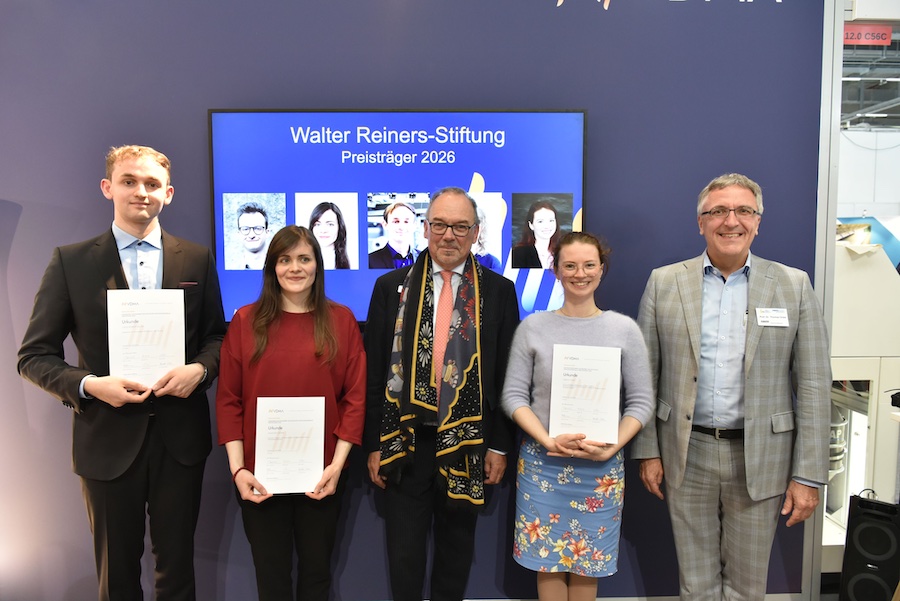
The proud award winners, from left to right: Lukas Balon, Annegret Storm, Peter D. Dornier, Sabina Dann, Professor Dr Thomas Gries. © 2026 Patrick Schibat, German Institutes for Textile and Fibre Research (DITF)
Sabina Dann, Lukas Balon and Annegret Storm from the Institut für Textiltechnik (ITA) of RWTH Aachen University were awarded the Walter Reiners Foundation Prize by the German Engineering Federation (VDMA) for their master’s and bachelor’s theses. Peter Dornier, Chairman of the Walter Reiners Foundation, presented the awards during Techtextil at the VDMA stand in Frankfurt am Main, Germany.

New Approaches in Carbon Fibre Recycling: VDMA Sustainability Award for Innovative Surface Treatment

ITA PhD-student Sabina Dann has been awarded the Master Sustainability Prize of the VDMA Walter Reiners Foundation 2026. The prize, endowed with EUR 3,500, recognises outstanding master’s theses that contribute to sustainable technologies in mechanical engineering.

At the centre of the award-winning thesis titled “Towards Sustainable Waste Management: Electrochemical Surface Treatment of Carbon Fibres for Improved Reclamation and Solvolysis Resistance” is a novel approach for the sustainable recovery of carbon fibres from composite materials. Carbon fibres are a key material in modern lightweight applications, particularly in aerospace, automotive engineering, and mechanical engineering. At the same time, their recycling poses a significant technological challenge due to the sensitive fibre surfaces and complex composite structures.

In the awarded master’s thesis an electrochemical surface treatment of carbon fibres is investigated that is specifically aimed at increasing their resistance to solvolytic recovery processes. Through the formation of stable covalent bonds on the fibre surface, it is ensured that the functional and mechanical properties of the fibres are not lost during the recycling process.

This creates a crucial basis for the reusability of high-performance carbon fibres: instead of a degradation of material properties, the method enables the preservation of performance throughout the entire recovery process.

The benefit of the work lies particularly in its contribution to a genuine circular economy for high-performance composite materials. The results show that carbon fibres can in future not only be recycled, but also specifically stabilised in quality and made available again for industrial applications. This opens up new possibilities for resource-efficient production chains in lightweight construction and mechanical engineering.

Energy-efficient texturing

Lukas Balon was awarded the ‘Master’s Scholarship’ for his Master’s thesis, ‘Development of a CFD model for simulating flow in die-texturing’, along with prize money of EUR 3,500. During texturing, smooth, melt-spun man-made fibre yarns are given a crimped structure to achieve a softer feel, greater elasticity and high heat retention. Textured yarns are therefore used in clothing, upholstery fabrics and carpets. In the compression chamber texturing process, yarns are crimped aerodynamically by a hot air stream. Although the compression chamber is highly productive compared to other processes, it has so far only been suitable for the production of coarse carpet yarns. An expansion into other markets, such as home textiles, has not yet taken place. The reason for this is the complex flow within the compression chamber, which has only been addressed in a rudimentary manner in previous developments. As part of this work, the flow field was therefore first investigated using simulation and subsequently the influence of key process parameters was systematically analysed.

The results provide the first detailed insight into which flow phenomena influence the texturing of the draw chamber and how these can be controlled by adjusting the process parameters. The findings open up a wide range of possibilities for the development of new draw chambers, for example in terms of energy efficiency or novel yarn structures.

Microwaves in false-twist texturing

False-twist texturing is a key component in the production chain for man-made fibres. However, production speed is limited by a phenomenon known as ‘surging’. This causes significant fluctuations in yarn tension, leading to the yarn breaking more readily. The shorter the heater length, the higher the production speeds that can be achieved. Innovative concepts for shorter heaters are therefore necessary for more efficient production.

To this end, in her bachelor’s thesis ‘Analytical Design and Evaluation of a Microwave Heating Technology in the False Twist Texturing Process’, Annegret Storm presented a creative concept for a novel heater that heats the yarn using microwaves rather than convection. To this end, she analytically designed a resonator in which the yarn is to be heated. Using the finite element method, the temperature profiles within the heater were determined numerically. Annegret Storm then compared the microwave heater with a high-temperature heater, which, at approximately 800 mm, is the shortest heater to date. It emerged that the microwave heater enabled a reduction in heater length of approximately 60%.

These results are promising and, if further implemented, could lead to increased production in false-twist texturing. For her bachelor’s thesis, Annegret Storm was awarded the Walter Reiners Foundation’s sponsorship prize and prize money of EUR 3,000.

More News from Institut für Textiltechnik of RWTH Aachen University (ITA)

#Research & Development

2026 general meeting of the Friends and Supporters of RWTH Aachen at ITA

The Friends and Supporters of RWTH Aachen e. V. (proRWTH) looked back on a successful year of support at their 2026 general meeting. The meeting took place at Institut für Textiltechnik (ITA) of RWTH Aachen and was combined with a joint session of the Executive Board and the Administrative Board. Before the general meeting began, participants were given a guided tour of ITA, providing them with fascinating insights into current research and development topics in textile engineering.

#Research & Development

TERNAfil wins first place at PitchMiUp Night 2026 in Minden

The RWTH spin-off TERNAfil has developed MAXCarbon, a new high-performance hybrid fibre that combines the mechanical performance of carbon with the temperature and corrosion resistance of ceramic materials. For this development, TERNAfil was awarded first prize at the PitchMiUp Night in Minden on 21 May 2026.

#Research & Development

Carbon-ceramic hybrid fibre proves its worth – NRW Minister for Science Mona Neubaur congratulates ITA start-up TERNAfil

MAXCarbon technology, a novel carbon-ceramic hybrid fibre developed by ITA spin-off TERNAfil, secured third place at the HIGH-TECH.NRW Demo Day on the TÜV NORD campus in Essen. The technology combines the strength of carbon fibres with the temperature and corrosion resistance of ceramic materials. Mona Neubaur, Minister for Science in North Rhine-Westphalia, congratulated the team on their success and on winning prize money of 4,000 euros.

#Research & Development

TCLF: Resilient value chains in times of crises

The textiles, clothing, leather and footwear (TCLF) industry was at the centre of the webinar “Resilient value chains in times of crises”, which took place on 28 April 2026. Global supply chains continue to face increasing pressure, raw material dependencies are growing and economic uncertainties are affecting the entire sector.

More News on Research & Development

#Research & Development

ALADIN paves the way for circular and demand-driven textile production in Europe

Textile production can be organized sustainably by utilizing short supply chains and preventing overproduction. This can already be achieved today by intelligently connecting and efficiently utilizing existing infrastructure. At the same time, production becomes circular when innovative technologies and materials are used that enable high-quality recycling. The ALADIN research project, launched in May 2026 and co-funded with five million euros under the EU Horizon Europe program, is creating the conditions for this.

#Research & Development

TERIS reaches milestone: Fraunhofer consortium develops new standards for tire analysis

In the “TERIS” project, the Fraunhofer institutes ICT, IGD, and IWM—led by the Fraunhofer Institute for Structural Durability and System Reliability LBF—have reached a decisive milestone. For the first time, the teams aim to generate, analyse, and predict tire wear in the laboratory in a standardized and practical manner. As part of this milestone, results are now available on reference abrasion, particle analysis, tribological models, AI-based surface analysis, a test bench concept, and methods for accelerated aging and VOC detection. The tire industry, testing services, and environmental agencies will in future benefit from reliable, rapid laboratory procedures for emissions assessment.

#Research & Development

Geotextiles made from recycled materials: GREEN leads the way into the industry

For the industry, recycled materials are creating new opportunities in geotextile production. In the GREEN project, the Fraunhofer Cluster of Excellence Circular Plastics Economy CCPE demonstrates that recycled polypro-pylene (PP), polyethylene terephthalate (PET), and high-density polyeth-ylene (HDPE) can be processed into nonwovens, fibers, and membranes that meet industrial requirements. This creates opportunities for use in existing production lines and new value chains in the geotextile market.

#Research & Development

GenuTrace client advisory: Is your cotton supply chain UFLPA ready?

U.S. Customs and Border Protection has released updated operational guidance (CBP Publication No. 5560-0526) expanding its forced labor enforcement framework. The guidance supersedes the original 2022 UFLPA Operational Guidance and now covers all forced labor enforcement authorities — UFLPA, CAATSA, and WROs/Findings — in a single unified document. For cotton importers, the enforcement posture has not softened. It has become more structured, more documented, and more demanding. Learn more about UFLPA.

Latest News

#Nonwovens

Katharina Obergruber appointed to the Management Board of Sandler AG

The Supervisory Board of Sandler AG has appointed Katharina Obergruber to the company’s Management Board. Effective September 1, 2026, the Board will consist of Philipp Ebbinghaus (CEO), Dr. Ulrich Hornfeck (currently CCO, future COO), and Katharina Obergruber (CCO). Katharina Obergruber, currently Chief Sales Officer Hygiene and member of the Management Team of Sandler AG, will assume responsibility for all sales activities as Chief Commercial Officer. She will assume this role from Dr. Ulrich Hornfeck, who will focus primarily on production and supply chain topics.

#Recycling / Circular Economy

Ence and ShareTex begin initial testing of the ATENEA innovation project to promote textile recycling in Spain

Ence and ShareTex are making progress on the Atenea R&D project, which aims to develop a complete value chain for textile recycling in Spain. Specifically, the goal of the ATENEA project—which is funded by the Center for Technological Development and Innovation (CDTI)—is to connect all the necessary stages for the recovery of textile waste, from collection and management, through recycling and transformation into new raw materials, to their incorporation into new textile products.

#Recycling / Circular Economy

DePoly Inaugurates its Showcase Plant in Monthey Switzerland

What if used plastic bottles, PET packaging material and polyester textiles could become raw materials just as high performing as virgin resources? That is the ambition of DePoly, a circular materials company based in Sion, Switzerland which inaugurated its Showcase Plant in Monthey on July 6th & 7th. The first depolymerization facility of its kind and scale in Switzerland, this industrial Showcase Plant represents a major milestone in the company's growth and its journey toward commercialization.

#Recycling / Circular Economy

Commission clarifies rules on plastic bottles recycling

The European Commission today adopted new rules on recycling of single-use plastic beverage bottles made primarily of polyethylene terephthalate (PET bottles). These rules establish, for the first time, a methodology to calculate, verify and report chemically recycled content. This is part of the Commission’s December 2025 plastics package.

TOP