[pageLogInLogOut]

#Research & Development

Carbon fibres from wood - DITF nomination for the "Cellulose Fibre Innovation of the Year" award

For the second time, the nova Institute for Ecology and Innovation is honouring outstanding scientific research that provides sustainable solutions for the cellulose fibre value chain as part of the "International Conference on Cellulose Fibres 2022". The DITF Denkendorf is one of the six nominees - and with the topic of "carbon fibres from wood" presents itself in the midst of a current research field that provides resource-saving alternatives to fossil-based fibres.

The conference, which will be held as a hybrid event in Cologne (Germany) from 2 to 3 February 2022, sees itself as an international forum for the development of new cellulose fibres and materials as well as their manufacturing processes. Exhibitors include leading fibre manufacturers; participants come from thirteen countries. The conference advisory board has nominated six products from among numerous submissions that are convincing due to their sustainable production processes and special application possibilities.
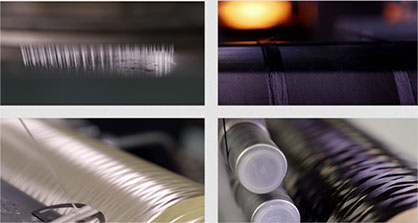
Cellulose- and Carbonfibres from Wood. Photo: DITF


The Competence Centre Biopolymer Materials at DITF Denkendorf took part in the competition with the presentation of carbon fibres, which are obtained from the raw material wood in a novel and sustainable process. The HighPerCellCarbon® technology describes a patented process that has been further developed under the leadership of Dr. Frank Hermanutz: As a result, carbon fibres based on biopolymers can be produced in a sustainable and particularly environmentally friendly process.

The HighPerCellCarbon® process involves the wet spinning of cellulose fibres using ionic liquids (IL) as direct solvents. The filament spinning process is the central technical part. It takes place in an environmentally friendly and closed system. The solvent (IL) is completely recycled. The cellulose fibres produced in this way are converted directly into carbon fibres in a further development step by a low-pressure stabilisation process, followed by a suitable carbonisation process. No waste gases or toxic by-products are produced during the entire process sequence.


The HighPerCellCarbon® process is thus convincing in terms of sustainability in several respects: in addition to the recyclability of the solvent used, the use of wood as a raw material in particular stands for resource conservation. Petroleum-based raw materials, which are usually used in the industrial production of carbon fibres, are substituted by renewable biopolymers. Carbon fibres are used in many lightweight construction applications. Global demand has been characterised by significant growth rates for years. An environmentally friendly production process like HighPerCellCarbon® is elementary for the sustainable management of an important industrial sector.



More News from TEXDATA International

#ITM 2026

ITM 2026: The new geography of textile production

New production hubs are emerging across North Africa and Central Asia, while Türkiye is accelerating its transformation toward higher-value, technology-driven and more sustainable textile manufacturing.

#Research & Development

“Production is a product”

From technical textiles and AI-driven robotics to the limitations of textile circularity: Professor Dr Thomas Gries looks back on more than two decades of development at ITA Aachen. In the interview, he explains why production technology remains a decisive success factor, discusses international collaborations and innovation ecosystems, and shares his views on the transformation of production landscapes and the challenges facing an increasingly regulated industry.

#Knitting & Hosiery

“We need to move away from the price trap and return to a value-driven mindset.”

With its new Textile Innovation Center, KARL MAYER is sending a strong signal for innovation, collaboration, and the future of textile applications. In this interview, Karl Josef Mayer discusses new opportunities in warp knitting, the processing of staple fibres, recycling, the changing role of machinery manufacturers, and why the textile industry must once again focus more strongly on the value of textiles. by Oliver Schmidt

#Associations

“Innovation, resilience and international experience remain the great strengths of the Swiss textile machinery industry”

Geopolitical uncertainty, growing competitive pressure from China, new free trade agreements and the shift towards a circular economy are currently reshaping the global textile industry. In this interview, Cornelia Buchwalder discusses the current mood within the Swiss textile machinery sector, the industry’s distinctive innovative strength, new market opportunities in India and Asia, and the technological trends that could shape the upcoming trade fair cycle leading up to ITMA 2027.

More News on Research & Development

#Research & Development

TCLF: Resilient value chains in times of crises

The textiles, clothing, leather and footwear (TCLF) industry was at the centre of the webinar “Resilient value chains in times of crises”, which took place on 28 April 2026. Global supply chains continue to face increasing pressure, raw material dependencies are growing and economic uncertainties are affecting the entire sector.

#Research & Development

Textile climate control system in workwear – exhibition at the 2026 SME Innovation Day!

Conventional protective workwear often reaches its limits during strenuous physical activity. In particular, the transport of sweat and excess body heat poses a problem. The German Institutes of Textile and Fiber Research (DITF) conducted research on flow-optimized, air-conducting textile structures that enable targeted climate control directly on the body. These structures can be integrated straight into protective work garments. The textile climate control system supports the body’s natural thermoregulation. This contributes to improved workplace safety and comfort.

#Research & Development

Elastic yarns to become more recyclable and environmentally friendly in future

On 29 April 2026, ITA student Tobias Dickmeiß was awarded a sponsorship prize by the Wilhelm Lorch-Stiftung for his innovative approach, to replacing conventional elastane with elastic yarns made from thermoplastic copolyester elastomers (TPC). Thanks to their thermoplastic nature and compatibility with typical polyesters used in the textile industry, elastic TPC yarns offer improved recyclability. Furthermore, the use of the melt-spinning process in yarn production eliminates the need for solvents that are harmful to the environment and human health.

#Research & Development

Walter Reiners Foundation Prize awarded to three ITA graduates

Sabina Dann, Lukas Balon and Annegret Storm from the Institut für Textiltechnik (ITA) of RWTH Aachen University were awarded the Walter Reiners Foundation Prize by the German Engineering Federation (VDMA) for their master’s and bachelor’s theses. Peter Dornier, Chairman of the Walter Reiners Foundation, presented the awards during Techtextil at the VDMA stand in Frankfurt am Main, Germany.

Latest News

TOP