[pageLogInLogOut]

#Denim

ISKO’s first Sustainability Impact Report is out.

Accountability, responsibility and a solid commitment to use less and do better by the planet: this is what leading denim ingredient brand ISKO sets out to deal with in its first Sustainability Impact Report. In line with consumers’ demands of transparency, this detailed overview of ISKO™’s workshares what has been done and continues to be done within the UN’s Sustainable Development Goals and ILO standardframeworks.

The Sustainability Impact Report provides in-depth information in relation to different targets across the supply chain, such as the management of environmental impacts, the oversight of supply chain processes, the use of raw materials, the achievements in research and innovation, the   advocating   for labour   rights and freedom   of   association,   the implementation  of  better health  and  safety standards. It serves  as  a  tool for brands  and designers, supporting every aspect of their collections’ responsible development.

Apart  of  the  report  is  dedicated to EPD®s (Environmental  Product  Declarations).  They provide quantifiable  impacts  evaluations,  from  water  use,  to  carbon  footprint  and  air pollution from the cotton fields to the customer. ISKO was the first manufacturer worldwide to obtain independently verified EPD®s for all of its more than 25,000 denim products, ensuring the replicability and validity of their Life-Cycle Assessments (LCAs) and enabling a one-to-one comparison among different products and fabrics. They provide a clear, detailed and easily understandable  pictureof the impact of the choices made when designing or purchasing a garment.

All data included in the report has been assured by Control Union Certifications, a third-party auditing body working to provide tailored options for supply chains that requiresustainable sourcing solutions. It is also aligned to the OECD Due Diligence Guidanceand the Global Reporting Initiative (GRI) methodology. By being open on its measuring methods, ISKO is effectively supporting improvement across the board whilst enabling like-for-like comparisons of performance.

“Our goal is to create fabrics that perform exceptionally and last longer whilst using fewer resources,” explained Ebru Ozkucuk Guler, Senior Sustainability & CSR Executive at ISKO. “We work hard every day to improve ourselves, to be better and do better – this is what Responsible Innovation™ means to us: never settle, but always strive for improvement.”


ISKO Sustainability Report 2020 Cover (c) 2020 ISKO


Watch report:

https://tinyurl.com/y8h9fj3p

More News from TEXDATA International

#Texprocess 2026

Texprocess 2026: Automation, digitalisation and AI redefine textile processing

Making investment decisions in textile processing has become significantly more demanding. Increasing energy costs, a shortage of skilled labour and ongoing geopolitical uncertainties are compelling companies to focus on technologies that deliver clear gains in efficiency and process reliability. This applies equally to apparel manufacturing and to the processing of technical textiles and high-performance materials. As a result, modernisation initiatives are assessed more carefully – even as the need to upgrade production systems continues to intensify.

#Techtextil 2026

Techtextil 2026: Between innovation pressure & market reality

From 21 to 24 April 2026, Techtextil in Frankfurt am Main will once again become the central meeting point for the international technical textiles and nonwovens industry. Running in parallel, Texprocess will focus on the industrial implementation of textile processing technologies as the leading platform in this field. Together, the two trade fairs form a closely integrated presentation and working platform along the entire textile value chain – from material development to finished applications.

#Techtextil 2026

Between geopolitical pressure and industrial resilience

In this interview, Dr. Janpeter Horn (VDMA) discusses the current challenges facing textile machinery manufacturers, shaped by geopolitical tensions, regulatory developments and subdued investment. He also outlines why innovation strength, integrated solutions and strategic positioning remain key to global competitiveness.

#Texprocess 2026

Between investment restraint and modernization pressure

Texprocess 2026 takes place in a complex market environment shaped by uncertainty and innovation pressure. In this interview, Elgar Straub (VDMA) explains why the trade fair is particularly relevant this year and which technologies are driving efficiency and competitiveness.

More News on Denim

#Denim

Jeanologia brings “Billy” to China, the AI transforming denim design

The denim industry is turning its attention to Hangzhou this week, where a new edition of Kingpins, the leading international trade show for the sector, takes place on May 21 and 22. There, the Spanish company Jeanologia, a global leader in sustainable technologies for the textile industry, is introducing its latest innovation to the Chinese market: “Billy”, the first artificial intelligence specifically developed for denim finishing design.

#ITM 2026

Uster FiberQ excels for recycled raw materials too

Uster FiberQ is a complete solution for raw material utilization, supporting spinners to achieve consistent quality and profitability every day, building further growth for the future. The Turkish company ORTA relies on FiberQ with recycled yarn for its denim production. Data-driven knowledge puts the producer in control of raw material utilization – ready to make the correct decisions for process efficiency, quality and productivity.

#Denim

SOKO presents low-impact denim finishing innovations at Denim PV Milan

SOKO will present a range of sustainable denim finishing technologies and collaborative projects at the upcoming Denim Première Vision Milan on 20–21 May in Milan. At booth G27 in Superstudio Più, the company will showcase new chemical solutions designed to combine fashionable denim effects with reduced environmental impact.

#Denim

Denim moves towards sustainability

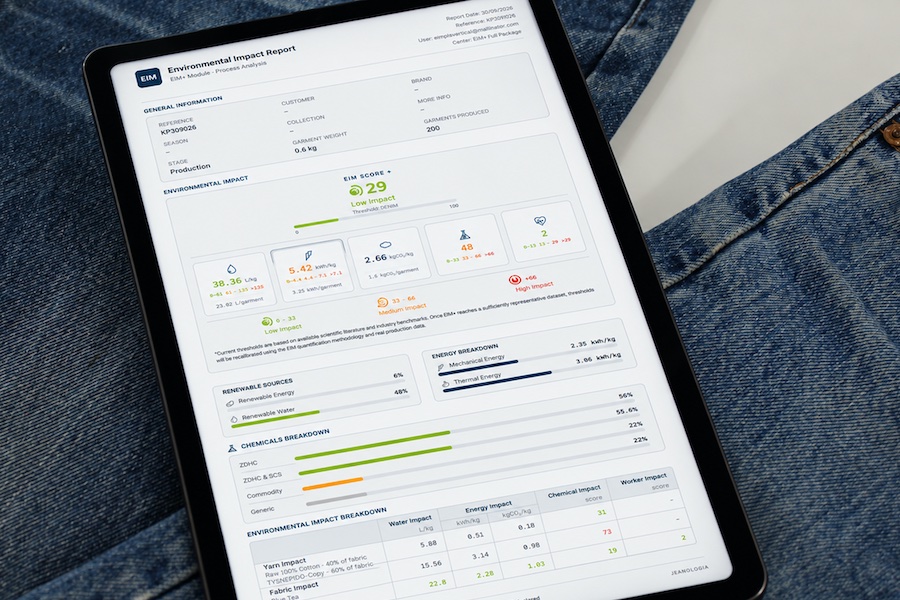
EIM (Environmental Impact Measurement), the global reference platform for measuring the environmental impact of garment finishing, presents the second edition of its annual report Denim Industry Progress & Insights 2025. The study analyses over 100,000 real denim finishing processes, providing an accurate and up-to-date view of the industry’s evolution towards more sustainable models.

Latest News

#ITM 2026

Groz-Beckert brings new knitting, weaving and nonwovens technologies to ITM 2026

From June 9 to 13, 2026, Groz-Beckert will present its latest innovations and solutions across the product areas of Knitting, Weaving and Nonwovens at ITM in Istanbul (Hall 3, Booth 304B).

#ITM 2026

Itema to showcase weaving excellence at ITM 2026

From June 9 to 13, Itema will exhibit at ITM 2026 in Istanbul (Hall 8 – Stand 806D), unveiling a distinctive exhibition concept designed to highlight the Company’s expertise across the entire weaving value chain. For this year’s edition, Itema will introduce an innovative stand experience built around two core areas: advanced weaving and spare parts solutions and an immersive textile gallery featuring fabrics produced by Itema Customers worldwide.

#Textiles & Apparel / Garment

Global size study for brands and retailers to optimize fit and market coverage

Hohenstein Apparel Fit Solutions, a global leader in apparel fit, sizing, and product development, today announces the launch of its Global Size Study, a new initiative designed to equip brands to better understand and serve their target consumers through more accurate, market-relevant sizing.

#ITMA 2027

Last chance to apply: ITMA 2027 Start-Up Valley closes tomorrow

Applications for the Start-Up Valley at ITMA 2027 close tomorrow, offering young technology companies the opportunity to follow in the footsteps of several successful participants from the 2023 edition. The initiative, organised under the CEMATEX Start-Up Grant programme, has already helped a number of textile start-ups accelerate their transition from early-stage concepts to industrial partnerships, funding rounds and commercial deployment.

TOP