[pageLogInLogOut]

#Associations

Mario Jorge Machado re-elected President of EURATEX
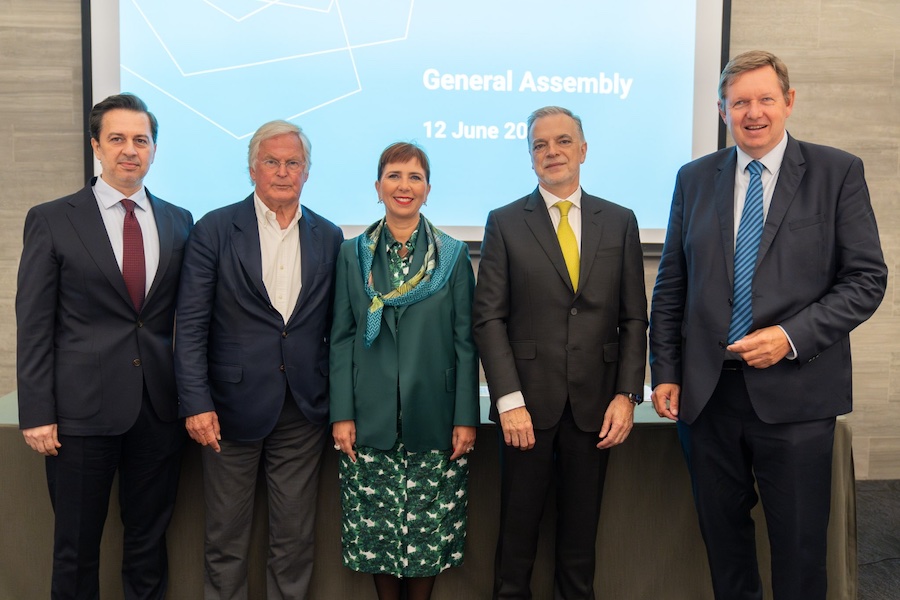
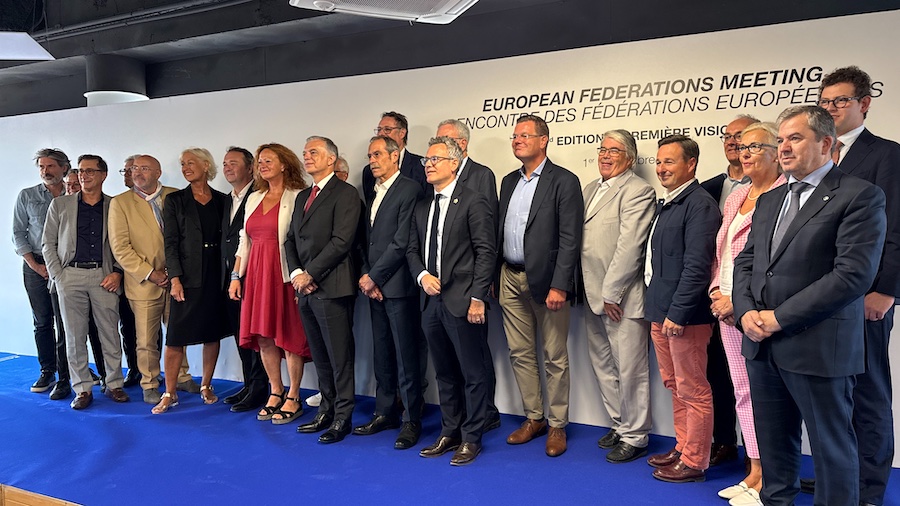
The EURATEX Presidency Team © 2026 EURATEX
The EURATEX General Assembly has re-elected Mario Jorge Machado as President of EURATEX, renewing its confidence in his leadership at a crucial moment for the European textile and clothing industry. The sector is facing rising costs, global competitive pressure and an increasingly challenging transition towards sustainability and digitalisation.

With a degree in Production Polymer Engineering from the University of Minho, Mario Jorge Machado brings extensive industrial experience and a strong commitment to innovation, competitiveness and sustainable transformation.

Upon his re-election, Mario Jorge Machado said: “My priority for this new mandate is clear: to strengthen the competitiveness of our industry, ensure that the same rules apply to all products sold in Europe, and support our companies through the green and digital transition. Europe must decarbonise its industry, not deindustrialise it.”

Three priorities for the new mandate

1. Competitiveness as the foundation

Mario Jorge Machado has made clear that competitiveness must be the starting point for any successful industrial policy. In his recent Brussels address, he stressed that without competitiveness there can be no investment, no innovation, no sustainability and no strategic autonomy. He will therefore continue to push for a stronger business environment for textile companies, with support for investment in automation, digitalisation, artificial intelligence, skills and innovation, especially for SMEs.

2. A genuine level playing field

A second key priority is to ensure that the same rules apply to everything sold in Europe, not only to what is made in Europe. Mario Jorge Machado has repeatedly called for stronger market surveillance, better border enforcement and more effective control of imports sold through digital platforms, so that European companies are not put at a disadvantage against products that bypass EU safety, environmental and consumer rules. EURATEX will continue to advocate for equal enforcement, fair competition and a market where compliance is rewarded.

3. Supporting industry through the transition

Mario Jorge Machado also wants to ensure that the green and digital transition strengthens European industry rather than weakening it. He has underlined that sustainability must become a source of competitiveness, not a burden, and that companies need realistic rules, affordable energy, workable implementation and targeted support to adapt successfully. He has also stressed the importance of stimulating demand for sustainable European-made textiles, including through public procurement and transparency tools that are feasible for companies.
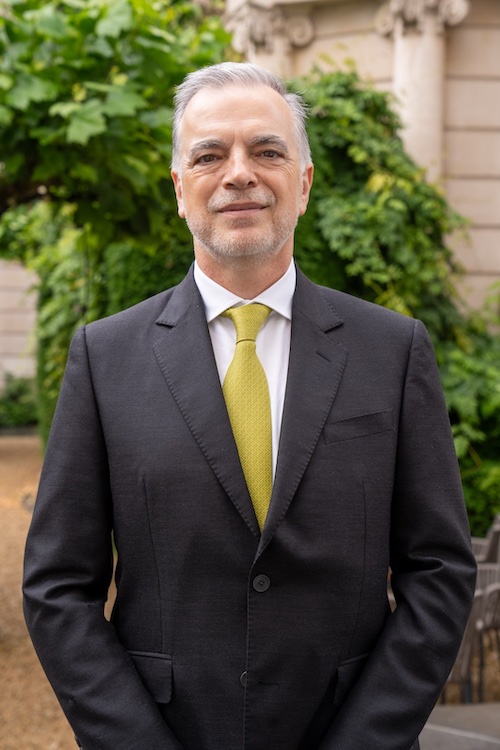
Mario Jorge Machado © 2026 EURATEX


Presidency Team

The General Assembly also confirmed the composition of the EURATEX Presidency Team, which will support the President in steering the organisation’s strategic direction:

Mr. Franz Peter Falke, T+M, Germany

Ms. Barbara Cimmino, Confindustria Moda, Italy

Mr. Ismail Kolunsag, IHKIB, Türkiye

Mr. Grégory Marchand, UIT, France


More News from European Apparel and Textile Confederation (EURATEX)

#Associations

Towards pragmatic and harmonised labelling in the EU

EDANA, alongside 14 European associations, urges the European Commission and Member States to adopt a pragmatic approach for the future harmonised packaging labels, in line with the EU’s agenda for the EU Single Market, simplification and competitiveness. The system should rely on text-free pictograms, available in achromatic or monochromatic versions matching the packaging palette, with the possibility of using digital labelling as a core element. Our associations represent manufacturers of consumer goods across Europe.

#Associations

Textile PRO Forum calls for greater harmonisation of textile EPR systems across Europe

The Textile PRO Forum has published a new analysis highlighting the need for greater harmonisation of textile Extended Producer Responsibility systems across Europe. The document, Toward harmonised Textile EPR Systems in Europe: analysis and recommendations, presents the results of work carried out by Workstream 1 of the Textile PRO Forum, led by Dr. Eng. Viola Corbellini, Strategic Development and Innovation Expert at Erion Textiles, and Eng. Luca Campadello, General Director at Erion Textiles. The workstream focused on reducing administrative burden for textile producers by identifying areas where procedures could be better aligned across countries.

#Associations

Europe is losing its textile industry

EURATEX has released its latest Economic Update on the performance of the European textile and apparel industry in 2025. For the third consecutive year, the sector recorded negative results across all key indicators — production, turnover and employment — confirming a continued erosion of competitiveness across Europe.

#Associations

European Business Coalition welcomes provisional application of EU–Mercosur Agreement and calls for Swift and full implementation

With the European Commission’s decision to provisionally apply the EU–Mercosur Interim Trade Agreement, a process spanning more than 25 years now moves decisively into its implementation phase.

More News on Associations

#Associations

Sustainability: European industry calls on EU to keep Single-Use Plastics Directive unchanged

A broad coalition of European industry associations, including EDANA, Euratex and Plastics Europe, has urged EU institutions to maintain the current legal framework of the Single-Use Plastics Directive (SUPD). In a joint statement, the organisations argue that reopening the Directive at this stage would create legal uncertainty, increase regulatory complexity and undermine investment, while its implementation across the European Union is still incomplete.

#Associations

Textile machinery: Italian technology charts the course for revival

Operating in a scenario characterized by geopolitical instability, slowing industrial investments, and new protectionist pressures. This is the main challenge for the Italian textile machinery industry that emerged during the General Assembly of ACIMIT (Association of Italian Textile Machinery Manufacturers), held today in Milan at the Shareholders’ Hall of Palazzo Edison.

#Recycling / Circular Economy

New skills for a circular textile economy

Based on the results of a comprehensive analysis, the Erasmus+ project Skills4Circularity is developing three practical training modules covering recycling technologies, eco-design for the circular economy and sustainable manufacturing. The content of the first module, Recycling Technologies, has now been developed and validated together with industry representatives. The module provides participants with knowledge of regulatory requirements, material sorting and the preparation of textile waste for recycling.

#Associations

Bangladesh: Italian textile machinery mission stops in Dhaka and Chittagong

Technological upgrading and the transition toward higher value-added production are driving the new Italian industrial mission to Bangladesh. This year, the mission will split between the country’s two main manufacturing hubs, where Italian manufacturers will meet the leaders of the local textile supply chain in two strategic stages: July 7th in Dhaka and July 9th in Chittagong.

Latest News

#Recycled Fibers

Recover™ and Ünteks Group partner to scale recycled cotton in knitwear

Recover(TM), a global producer of low‐impact, high‐quality recycled cotton fiber, announces a new partnership with Ünteks Group, a vertically integrated textile manufacturer based in Turkey. The collaboration focuses on the development of circular knit fabrics and garments, combining Recover’s recycled cotton fiber with Ünteks Group’s integrated capabilities across knitting, dyeing, printing, and garment production.

#Spinning

STEELTOP®: A new benchmark in flat tops for spinning preparation

Modern carding generations achieve higher production performance, placing significantly greater stress on flat tops. Higher cylinder speeds and increased fiber density, combined with tighter carding gaps, create more demanding operating conditions. At the same time, poorer raw material quality and the increased use of recycled materials further intensify these challenges. With STEELTOP®, Trützschler introduces a new full steel flat top series developed for these demanding modern carding processes.

#Textile processing

YKK develops concept EXCELLA® zipper tape using nonwoven fabric partially derived from used clothing

YKK Corporation has developed a concept version of its premium EXCELLA® zipper series made from nonwoven fabric sheets created by fiberizing used clothing and other textile materials. Based on a proposal by fashion designer Yuima Nakazato, this item was created as a result of collaboration between Nakazato, Seiko Epson Corporation and YKK. The concept zipper was incorporated as a material component for pieces in the newest YUIMA NAKAZATO Couture Collection, “INFERNO,” which was unveiled in Paris, France on July 8, 2026.

#Textiles & Apparel / Garment

Texworld Apparel Sourcing Paris highlights evolving global sourcing landscape

From 31 August to 2 September 2026, Texworld Apparel Sourcing Paris will bring together more than 1,000 international exhibitors at Paris-Le Bourget Exhibition Centre. This edition reflects the new global balance of textile and apparel sourcing, highlighting a strong diversity of sourcing countries — some unexpected.

TOP