[pageLogInLogOut]

#Textiles & Apparel / Garment

Inditex and IndustriALL reaffirm commitment with a new protocol
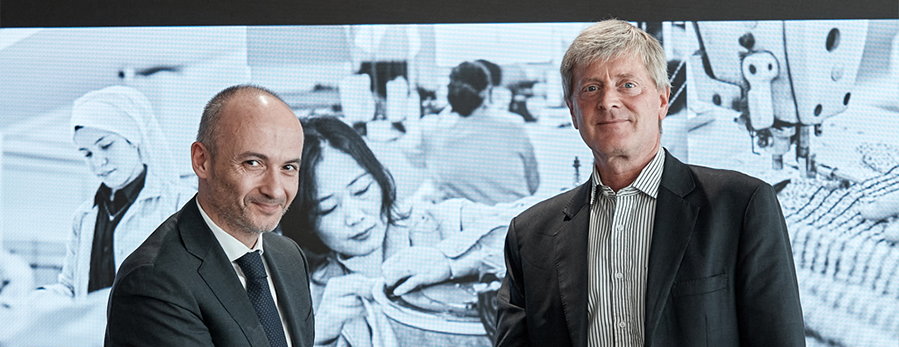
© 2022 Inditex
This morning, Oscar García Maceiras, CEO of Inditex, and Atle Høie, General Secretary of IndustriALL Global Union, signed a new protocol designed to further the Global Framework Agreement first signed by the two organisations in 2007, resulting in better working conditions in the textile supply chain.
  • / Over the past 15 years, almost 3 million people around the world have benefitted from better working conditions as a result of the Global Framework Agreement between Inditex and IndustriALL Global Union. A world first, the agreement is still a benchmark in the defence of decent work in global supply chains.
  • / Commemorating the 15th anniversary, both parties are signing a new protocol reinforcing their commitment to continue engaging in mature industrial relations safeguarding worker well being.

The new protocol furthers social dialogue by reinforcing the Global Union Committee and its coordinating bodies, specifically establishing new mechanisms for cementing the role of the local unions for a better understanding of what the workers making the clothes need. Under the new protocol, Inditex and IndustriALL will formulate a joint work plan which will focus on continued respect for the freedom of association, the right to collective bargaining and the provision of training to worker representatives, the textile group’s suppliers and its supply chain factory workers.

Inditex and IndustriALL are also making progress on a new workplace access protocol, which aims to learn about and monitor working conditions in the factories in Inditex’s supply chain, in order to understand the workers’ needs and to respond to them.

“The protocol signed today, commemorating the 15th anniversary of the Framework Agreement between Inditex and IndustriALL, evidences our determination to strengthen respect for fundamental labour rights across our production chain and marks a fresh milestone in both organisations’ ongoing mission of improving the lives of the women and men who populate it,” said Óscar García Maceiras, CEO of Inditex.


“Signing the Global Framework Agreement with Inditex was a breakthrough that has since lead the way for more responsible sourcing and proper industrial relations in the sector. It is fitting that we celebrate the first 15 years by signing a protocol that takes our relationship to a new level in terms of respect for fundamental trade union rights. The fact that we agree with Inditex to increase the role of our local and national unions and to firmly defend their right to organize and bargain collectively in the supply chains gives hope to many,” said Atle Høie, IndustriALL General Secretary.

Felix Peinado, Director for the International Labour Organization (ILO) in Spain, was present at the signing ceremony, said: “In the Tripartite Declaration of Principles concerning Multinational Enterprises and Social Policy, ILO urges companies, in collaboration with their workers’ representatives, to enter into international framework agreements to commit to applying principles of decent work along their supply chains all countries. Spanish unions Comisiones Obreras and UGT, together with Inditex, have been frontrunners in Spain with this agreement. I could not be prouder of this agreement or happier to celebrate its anniversary. The agreement is an example of how, with the combined commitment and hard work of companies and their workers’ representatives, it is possible to forge better working conditions around the world."

This agreement marks a new milestone in the relationship between Inditex and IndustriALL, which began 15 years ago, in 2007, with the signature of the Global Framework Agreement. The Agreement was a significant step forward for the industry, providing a major boost to its sustainability and a very real chance to improve working conditions for the nearly 3 million people who work in the factories producing for the Spanish multinational globally.



More News from TEXDATA International

#ITM 2026

ITM 2026: The new geography of textile production

New production hubs are emerging across North Africa and Central Asia, while Türkiye is accelerating its transformation toward higher-value, technology-driven and more sustainable textile manufacturing.

#Research & Development

“Production is a product”

From technical textiles and AI-driven robotics to the limitations of textile circularity: Professor Dr Thomas Gries looks back on more than two decades of development at ITA Aachen. In the interview, he explains why production technology remains a decisive success factor, discusses international collaborations and innovation ecosystems, and shares his views on the transformation of production landscapes and the challenges facing an increasingly regulated industry.

#Knitting & Hosiery

“We need to move away from the price trap and return to a value-driven mindset.”

With its new Textile Innovation Center, KARL MAYER is sending a strong signal for innovation, collaboration, and the future of textile applications. In this interview, Karl Josef Mayer discusses new opportunities in warp knitting, the processing of staple fibres, recycling, the changing role of machinery manufacturers, and why the textile industry must once again focus more strongly on the value of textiles. by Oliver Schmidt

#Associations

“Innovation, resilience and international experience remain the great strengths of the Swiss textile machinery industry”

Geopolitical uncertainty, growing competitive pressure from China, new free trade agreements and the shift towards a circular economy are currently reshaping the global textile industry. In this interview, Cornelia Buchwalder discusses the current mood within the Swiss textile machinery sector, the industry’s distinctive innovative strength, new market opportunities in India and Asia, and the technological trends that could shape the upcoming trade fair cycle leading up to ITMA 2027.

More News on Textiles & Apparel / Garment

#Textiles & Apparel / Garment

Catalyst Club launches in Florence: Where conversations become catalysts for change

The first chapter of Catalyst Club debuted in Florence, bringing together creative directors, entrepreneurs, manufacturers, journalists and innovators from across the fashion and textile industry for an evening of dialogue, exchange and connection.

#Associations

Mario Jorge Machado re-elected President of EURATEX

The EURATEX General Assembly has re-elected Mario Jorge Machado as President of EURATEX, renewing its confidence in his leadership at a crucial moment for the European textile and clothing industry. The sector is facing rising costs, global competitive pressure and an increasingly challenging transition towards sustainability and digitalisation.

#Textiles & Apparel / Garment

Autopsy, the new trend book by Texworld Apparel Sourcing Paris, deciphers the fractures of our time through 12 creative signals

Presented during Texworld Apparel Sourcing Paris, from August 31 to September 2, 2026, at the Paris-Le Bourget Exhibition Center, Autopsy offers a reinterpretation of the contours of fashion in a world undergoing profound transformation, balancing radical introspection and sensitive renewal.

#Yarn & Fiber

Next week’s focus: Intertextile Shenzhen & Yarn Expo Shenzhen fuse textile tradition with sustainable, digital trends

Fashion will not be left behind in one of the world’s undisputed tech and manufacturing capitals. Which is why next week, at Intertextile Shenzhen Apparel Fabrics and Yarn Expo Shenzhen 2026, the organisers have made special efforts to integrate textile topics such as materials innovation, holistic sustainability, digitalisation and AI. Yet, from 9 – 11 June at the Shenzhen Convention and Exhibition Center, the platform also includes timeless tradition and heritage-inspired evolution in equal measure. Across both shows, over 600 exhibitors from 11 countries and regions are set to showcase everything from Peruvian alpaca wool fabrics to tea-derived fibres, while their fringe programmes will explore diverse solutions along the entire value chain.

Latest News

#Spinning

Ibrahim Fibres and Trützschler: A strong partnership enters its next phase with the TC 30Si

For more than two decades, Ibrahim Fibres and Trützschler have grown side by side, driven by a shared ambition to continuously improve spinning performance, strengthen technology leadership and set new benchmarks in the textile industry. Today, Ibrahim Fibres is a leading yarn and polyester staple fiber manufacturer in Pakistan. The company operates the largest number of Trützschler cards in the country, with more than 200 machines running across its mills in Faisalabad, and plays an important role in one of Asia’s largest textile industries.

#Digital Printing

USColorworks expands digital platform with Kornit Atlas MATRIX and Atlas MAX PLUS solutions

Kornit Digital Ltd. (NASDAQ: KRNT), a global pioneer in sustainable, on-demand digital fashion and textile production, today announced that USColorworks, a North Carolina-based apparel decoration and fulfillment company specializing in custom and on-demand printing for retail and promotional markets, has expanded its Kornit digital production platform with the addition of Atlas MATRIX and Atlas MAX PLUS systems to deliver high-quality, on-demand apparel across cotton, blended fabrics and polyester.

#Functional Fabrics

CovationBio introduces two new bio-based innovations at Functional Fabric Fair New York

Covation Biomaterials LLC (“CovationBio®”) is showcasing its two new bio-based innovations, Xatryx® and Sorona® elasterell-p fiber, at this year’s Functional Fabric Fair in New York City, July 7–9, 2026. Attendees can visit CovationBio at Booth #404 to explore this next generation of bio-based performance materials.

#Research & Development

Geotextiles made from recycled materials: GREEN leads the way into the industry

For the industry, recycled materials are creating new opportunities in geotextile production. In the GREEN project, the Fraunhofer Cluster of Excellence Circular Plastics Economy CCPE demonstrates that recycled polypro-pylene (PP), polyethylene terephthalate (PET), and high-density polyeth-ylene (HDPE) can be processed into nonwovens, fibers, and membranes that meet industrial requirements. This creates opportunities for use in existing production lines and new value chains in the geotextile market.

TOP