[pageLogInLogOut]

#Recycling / Circular Economy

loopamid now commercially available: BASF starts up its first plant for recycled polyamide 6

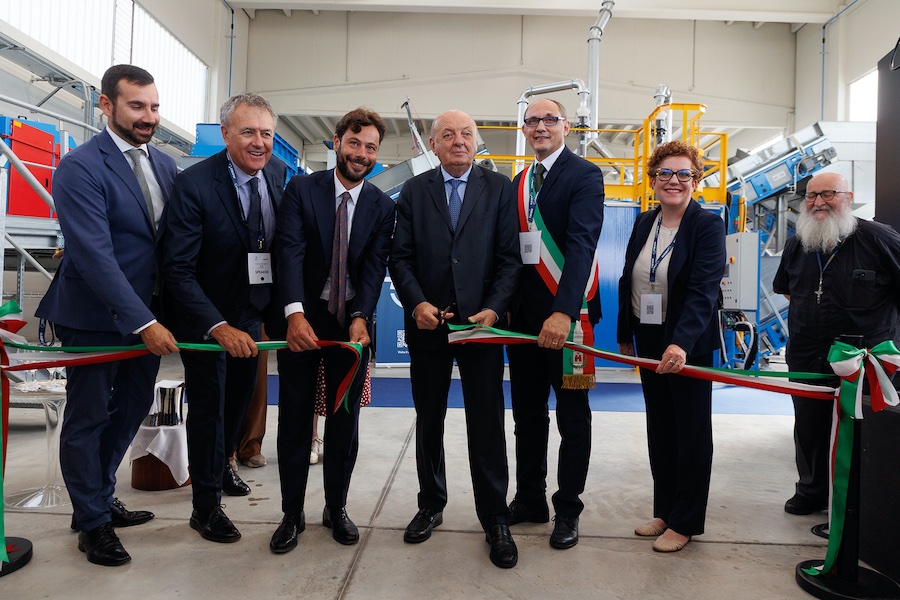
BASF announced the start-up of the world’s first commercial loopamid® plant. The production facility at the Caojing site in Shanghai, China, has an annual capacity of 500 metric tons and marks an important step in the supply of sustainable products for the textile industry. “The startup of this plant once again demonstrates BASF’s innovative strength,” said Stephan Kothrade, member of the Board of Executive Directors and Chief Technology Officer (CTO) of BASF SE.

Plant and products certified according to the Global Recycled Standard (GRS)

Production plant opens in Shanghai, China, with a capacity of 500 metric tons of loopamid per year

“As an integral part of our Winning Ways strategy, we utilize our chemistry to develop solutions for the biggest challenges of our time. loopamid transforms textile waste into a valuable resource, helps save raw materials and closes the textile loop.”

loopamid is a recycled polyamide 6 that is entirely based on textile waste. The new production facility supports the growing demand for sustainable polyamide 6 fibers in the textile industry. “I am proud of our team, which has worked with great passion and dedication to achieve the commercialization of loopamid,” said Ramkumar Dhruva, President of BASF’s Monomers division. “The technology behind loopamid allows textile-to-textile recycling for polyamide 6 in a wide variety of fabric blends, including those with elastane. I am convinced that loopamid not only makes a significant contribution to the textile circular economy, but also helps our customers achieve their sustainability goals.”

GRS certification for plant and loopamid products

The plant as well as the quantities of loopamid produced are certified according to the Global Recycled Standard (GRS). This certification guarantees to consumers and textile manufacturers that loopamid is made from recycled materials and that the production processes comply with specific environmental and social criteria. In addition, first yarn manufacturers are successfully using loopamid.

Post-industrial and post-consumer textile waste as basis for loopamid

To produce loopamid in its new plant, BASF currently utilizes industrial textile waste from textile manufacturing and will gradually increase the share of post-consumer waste. This feedstock includes cutting scraps, defective cuts, offcuts and other production textile waste from the textile industry. These materials are collected and provided to BASF by customers and partners. End-of-life garments made from polyamide 6 and other textile products can also be utilized for the production of loopamid. All these waste materials are challenging to recycle because they typically consist of a mixture of different fibers and materials as well as dyes and additives. Additionally, for post-consumer waste recycling, buttons, zippers and accessories must be removed in advance. BASF works closely with partners and customers to accelerate the development of collection and sorting systems.

More News from BASF Aktiengesellschaft
Performance Chemicals for Textiles Europe

#Recycling / Circular Economy

trinamiX with new management

BASF is examining strategic options for its subsidiary trinamiX GmbH. trinamiX specializes in biometric imaging and mobile material analysis. These activities are not part of BASF’s core business, on which the company is focusing as part of the implementation of its new strategy.

#Research & Development

How innovations drive BASF’s success

“Innovation has always been part of BASF’s DNA. Especially in these volatile times, it is crucial to leverage our innovative strength to develop competitive solutions that differentiate us as a company in our markets and give us a competitive edge,” said Dr. Stephan Kothrade, Member of the Board of Executive Directors of BASF and Chief Technology Officer, at the company’s Research Press Briefing held today. To achieve this, BASF implemented its “Winning Ways” strategy about a year ago with the clear goal of becoming the preferred chemical company to enable its customers’ green transformation.

#Nonwovens

Turning diaper waste into new value: BASF, Essity and TU Wien pioneer circular solutions

BASF, one of the world’s leading chemical companies and manufacturer of superabsorbent polymers (SAP), and Essity, a global leading hygiene and health company, joined forces together with the Technical University of Wien to revolutionize recycling of absorbent hygiene products (AHP).

#Textiles & Apparel / Garment

BASF at SIMAC 2025: Recycling meets Performance – PU solutions for the future of footwear

BASF is presenting new materials, concepts and recycling methods for polyurethanes in footwear at SIMAC Tanning Tech. The leading international trade fair will take place from September 23-25 in Milan, Italy. We will showcase our unique and integrated toolbox of Elastopan® (PU) and thermoplastic polyurethanes Elastollan® and Infinergy®. Together with our partners and customers we bring innovative products to the market offering utmost lightness paired with mechanical performance and automated processing.

More News on Recycling / Circular Economy

#Recycling / Circular Economy

Sahil Kaushik appointed CEO of Infinited Fiber as the company advances a phased path to commercial scale

Infinited Fiber has appointed Sahil Kaushik as Chief Executive Officer. Kaushik has served as Acting CEO alongside his role as Chief Operating Officer and will continue to oversee operations until a new COO is appointed.

#Recycling / Circular Economy

Reju announces site selection for first U.S. industrial sized facility regeneration hub in Rochester, New York

Reju, the textile-to-textile regeneration company, today announced it has selected the site for its first U.S.-based industrial facility marking a significant milestone in its efforts to scale globally. This future Regeneration Hub will be in Rochester, New York, reinforcing Reju’s commitment to the adoption of circular textile system across key regions worldwide.

#Business

Canopy introduces a first-of-its-kind $2 billion USD investment blueprint to decarbonize global materials supply chains

Today, the global, solutions-driven not-for-profit Canopy joined partners at Davos to introduce a new finance model designed to accelerate the growth of low-carbon materials and transform the paper, packaging, and textile supply chains. The event was anchored by a keynote speech from Sri A Revanth Reddy, Hon’ble Chief Minister of Telangana, with India set to host the first iteration of the new investment blueprint.

#Recycled_Fibers

Borealis invests EUR 49 million in Burghausen, Germany to accelerate design for circularity

Borealis announces a EUR 49 million strategic investment to scale up production of Borstar® Nextension polypropylene (PP) at its manufacturing site in Burghausen, Germany. This will expand commercial production of next-generation single-site polypropylene (ssPP) grades that deliver enhanced purity, processability, and performance - supporting customers in key sectors including packaging, healthcare, mobility, and fibers, to meet evolving market and regulatory demands.

Latest News

#Digital Printing

Epson launches SureColor G9000: high-production Direct-To-Film printer delivering greater productivity and reliability

Epson today announces the launch of the SureColor G9000, a new high-production Direct-To-Film (DTFilm) printer designed to meet growing global demand for flexible and efficient textile transfer printing. Expanding Epson’s DTFilm line-up alongside the SC-G6000, the SC-G9000 introduces enhanced speed, reliability and ease of maintenance for commercial garment decorators and textile producers.

#Nonwoven machines

Three ANDRITZ spunlace lines start operating at Alar Silk Road New Materials in China

Alar Silk Road New Materials and ANDRITZ have successfully commissioned three spunlace lines in crosslapped configuration at Alar’s facility in Aral City, Xinjiang, China.

#Raw Materials

Better Cotton Initiative opens enrollment in the US with promising opportunities for producers

Producer enrollment for the US Program of the Better Cotton Initiative (BCI) is open until May 15 for the 2026-2027 season. With over 2,600 members spanning the cotton supply chain and more than 11,000 users of its Better Cotton Platform (BCP) as of 2025, BCI’s standard is implemented in 15 countries and covers one fifth of global cotton production.

#Knitting & Hosiery

SHIMA SEIKI to exhibit at GMMSA Expo India

Leading Japanese computerized flat knitting technologist SHIMA SEIKI MFG., LTD. of Wakayama, Japan, together with its Indian sales representative Universal MEP Projects & Engineering Services, Ltd., will participate in the upcoming Garments Machinery Manufacturers & Suppliers Association (GMMSA) Expo India 2026 exhibition to be held in Ludhiana, India next month. Through its lineup at GMMSA, SHIMA SEIKI aims to further strengthen its presence within the Indian market with an exhibit that caters to diverse needs, consisting of seam-free WHOLEGARMENT® knitting technology as well as a brand-new shaping machine with high productivity and excellent cost performance.

TOP