#Man-Made Fibers
Dornbirn GFC 2026 expands conference program with new thematic sessions
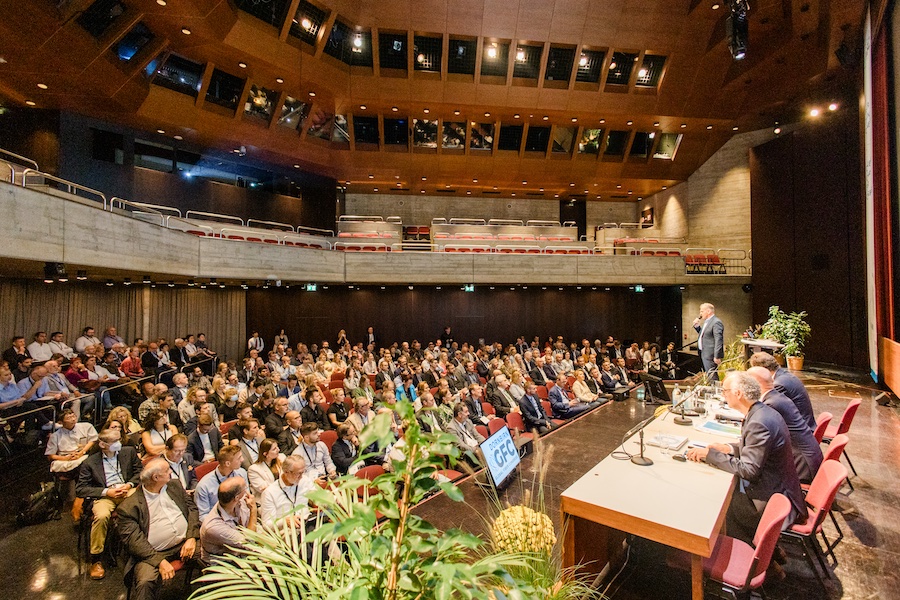
To mark its 65th anniversary, Dornbirn GFC is expanding its established conference program with additional presentation sessions focusing on the following topics:
- Cross-Industry Innovation – “Fiber & Textiles Meet Pulp & Paper”
- Natural Fibers: Innovative Materials Combining Sustainability and High Performance ✓ ReHubs: Industry Partners in Dialogue on the Future of Textile Circularity
- ReHubs: Protective Workwear
- RWTH Aachen Meets Industry
Cross-Industry innovation – “Fiber & Textiles meet Pulp & Paper”
The presentation session brings experts from both industries together and demonstrates how knowledge, technologies, and innovative approaches can be leveraged across sectors. The focus is on new materials, sustainable production processes, and collaborative solutions for the future of the fiber industry.
Presentations will be given by companies including ANDRITZ AG (AUT), CETI (POR), Gessner GmbH (GER), and Saubermacher Dienstleistungs AG (AUT). From the academic sector, TU Dresden (GER), RWTH Aachen University (GER), and Graz University of Technology (AUT) will also participate in the sessions.
Michael Waupotitsch from ANDRITZ AG will contribute to Dornbirn GFC with the presentation: “Utilization of cotton fibers from textile waste for packaging grade papers!” The presentation will provide insights into the potential of recycled cotton fibers for packaging papers, the required processing steps, and innovative approaches to closing material loops across the entire value chain.
CETI will present two contributions. The first, “From Waste Textiles to Thin Sustainable Papers: Unlocking Cellulosic Fibre Circularity through Mechanical Reprocessing” explores how textile waste can be transformed into sustainable paper products through innovative mechanical processing. The second presentation focuses on the development of sustainable man-made cellulosic fibers from Portuguese eucalyptus pulp. The **be@t project** combines innovative technologies such as ionic liquids, Lyocell recycling, and lignin-based functionalization. Together with 58 partners, the project aims to develop scalable solutions for a circular and climate-resilient fiber industry.
Natural Fibers: Innovative materials combining sustainability and high performance
The presentation session focuses on the development of multifunctional materials by combining natural, bio-based, and synthetic fibers. It showcases current innovations that set new standards in performance, durability, and sustainability – from wool-based composites and bio-based polymers to high-performance plastics. The session provides insights into innovative bio-based and high-performance polymers, functionalized natural fibers, and advances in synthetic fibers such as polyester, polyamide, aramid, and specialty fibers.
Elke Hortmeyer from BREMEN COTTON EXCHANGE (GER) will moderate this presentation session and will also participate as a Keynote Speaker during the opening morning of Dornbirn GFC with the presentation: “The Power of Methodology: How the Green Deal and PEF Are Shaping the Future of the Textile Industry”
The session showcases current innovations and developments in natural fibers and sustainable materials:
- “Traceability within the plant fibre supply chain: an examination of the challenges and opportunities
Wilhelm G. Clasen GmbH & Co. KG (GER)
- “Natural Fiber Nonwovens: Applications, Challenges and Solutions – The Path from Sustainability to Performance”
Polyvlies Group (GER)
- “Raw materials, qualities and processing potential for natural fibres in everyday products”
RWTH Aachen (GER)
- “Fibre Traceability: A Vehicle to Ensure Sustainability or Injustice?”
Discover Natural Fibres Initiative (USA)
ReHubs: Industry partners in dialogue on the future of textile circularity
“The momentum for the circular economy in the European textile sector has never been greater. What is still missing, however, is a system that makes it economically viable. As long as we do not overcome the supply-demand bottleneck, the circular economy will remain limited to pilot projects instead of becoming established at industrial scale”, says Robert van de Kerkhof, Interim CEO & Chairman of the Board of ReHubs.
ReHubs is a European industry alliance driving the transition towards a circular textile ecosystem. As a non-profit organization, it brings together stakeholders from across the entire textile value chain – from collection and recycling to fiber producers, brands, technology providers, investors, and policymakers. In response to growing textile waste and new regulatory requirements, ReHubs is creating the conditions for textile-to-textile recycling at industrial scale. Its focus is on coordinating value chains, mobilizing investment, and harmonizing standards to connect supply and demand and make recycled fibers competitive.
Dornbirn GFC provides an ideal platform for discussing the future of a circular textile economy. Leading stakeholders from industry, research, and technology will explore how textile-to-textile recycling can be implemented economically at industrial scale. In the ReHubs session, members will present current developments in mechanical and chemical textile recycling, new business models, and the conditions required to establish competitive circular value chains in Europe.
ReHubs: Protective workwear
ReHubs Workwear is one of the most compelling examples of how the circular economy is evolving from a vision into an industrial reality. “Nature has always operated in cycles. Our task is to transfer this principle to industry. Workwear provides one of the best opportunities to demonstrate that textile-to-textile recycling is no longer a concept for the future – it is becoming an industrial reality”, emphasizes Béatrice Moureaux, Managing Director of the Austrian Fibers Institute.
Why ReHubs and Workwear? Workwear is one of the most promising application areas for high-quality textile-to-textile recycling. Unlike many consumer textiles, workwear generates large, predictable, and comparatively homogeneous material streams. Fiber compositions and material specifications are known and standardized, enabling garments to be sorted and recycled efficiently.
Workwear is predominantly managed through closed B2B systems, creating transparent material loops with regular replacement cycles – ideal conditions for industrial recycling. At the same time, companies are under increasing pressure to meet sustainability targets and increase the use of recycled fibers. The ReHubs “Workwear” session uses practical examples to demonstrate how closed textile loops are already working today – from collection and sorting to recycling and the production of new workwear.
The presentation session includes, among others, the following contributions:
“From Professional Textile Waste to Spinnable Fibre: Measuring What Matters to Scale Mechanical Textile‐to‐Textile Recycling”
Norsk Tekstilgjenvinning AS and NTG AS (NOR) will demonstrate how mechanical textile-to-textile recycling for workwear and functional textiles can be implemented at industrial scale. Key factors for expanding recycling capacity include technological innovation, market demand, and close collaboration across the value chain.
Klopman International (GER) will present approaches to implementing mechanical textile-to-textile recycling for workwear and functional textiles at industrial scale. The presentation focuses on technological innovation, improving material quality, and collaboration across the entire value chain.
“Scaling Mechanical Recycling of EOL Workwear”: PurFi Belgium (BEL) will explore how intelligent recycling combined with innovative textile construction can enable new and forward-looking solutions for a sustainable circular economy.
RWTH AAchen meets industry
Two presentation blocks featuring seven presentations are scheduled for Friday morning in Room A. For the third time, Dornbirn GFC will host a dedicated presentation session by RWTH Aachen University. The session highlights the close and successful collaboration between RWTH Aachen and its industry partners, with the shared goal of combining scientific expertise with industrial know-how.
The continuous exchange between research and industry provides the foundation for developing innovative products, new technologies, and forward-looking projects. The presentation sessions offer a platform for showcasing current research findings, discussing industry challenges, and jointly developing new solutions.
The Institute of Textile Technology (ITA) at RWTH Aachen University presents current research and industry insights together with the following industry partners:
- “How Sugar Becomes a Raw Material for Textile Innovation”
Pfeifer & Langen GmbH & Co. KG (GER)
- “Advances in Energy Efficiency in False-Twist Texturing”
Barmag (GER)
- “High-quality spun-dyed polyester yarns made from thermo-mechanical recycled old textiles to close textile cycles” Technofibres S.A. (LUX)
- “Recyclable Elastic Yarns via Melt Spinning of Thermoplastic Copolyester Elastomers” Envalior (GER)
2026 Conference Program at a Glance:
- 65th Dornbirn GFC 2026
September 16–18, 2026 | Kulturhaus Dornbirn, Dornbirn, Austria
- 100 expert presentations covering key topics including:
✓ Strategies and policies in the textile industry, R&D, and market trends ✓ Artificial Intelligence (AI) in the textile sector
✓ Fiber innovations
✓ Circular economy and sustainability
✓ Functional and smart textiles
✓ Nonwovens and composite materials
✓Best practices from collaborative projects between academia and
industry
✓ Gala Evening
✓ Open to all participants, including a fashion show and buffet ✓
- Innovation Day & Forum September 17, 2026 | Hall A
- Exhibition area
20 international exhibitors will showcase their latest technologies, products, and solutions.
- Information & News: www.dornbirn-gfc.com