[pageLogInLogOut]

#Recycling / Circular Economy

Managed workwear services are providing a blueprint for the circular textile economy
Workwear services © 2026 TexData International
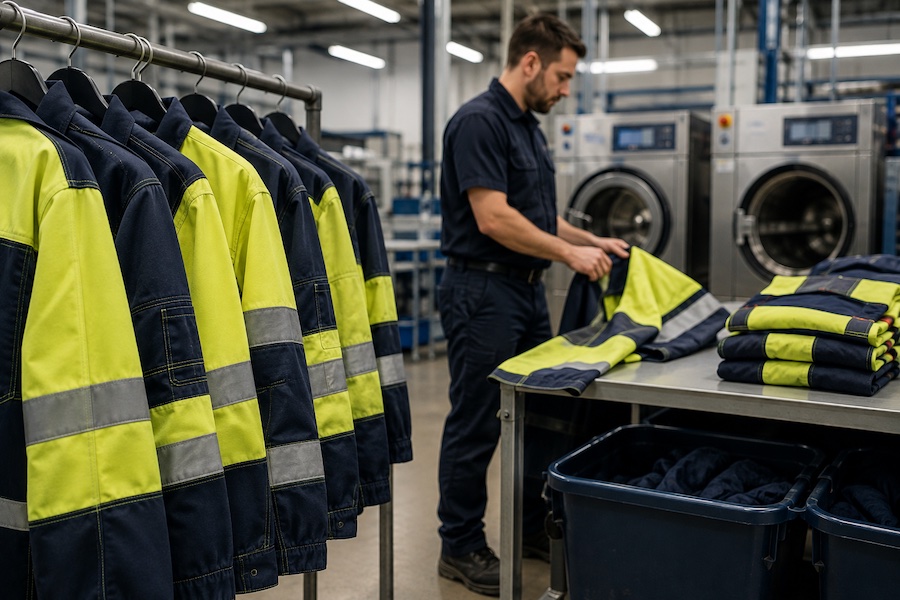
Managed workwear service providers are demonstrating how commercial success and circularity can go hand in hand by extending garment lifespans through repair, laundering, reuse and recycling, according to “Managed workwear services—a circular textile economy ahead of the game”, a new 14‑page report from the global business information company Textiles Intelligence.


Across Europe, a number of companies have transformed workwear from a manufacturing business into one based on managed services. Rather than just supplying garments, these companies retain ownership of the garments throughout their working lives, taking responsibility for tracking, laundering, repairing, replacing and, ultimately, recycling.

As a result, these companies have created one of the textile industry’s most mature examples of a circular business model.

Unlike conventional apparel manufacturers, managed workwear service providers generate value by extending the useful life of every garment for as long as possible. Consequently, garments are designed to withstand hundreds of industrial laundering cycles, to provide comfort, to maintain compliance with safety standards, and to be easy to repair.

At the same time, managed workwear service providers have evolved into highly sophisticated logistics businesses. Technologies such as radio frequency identification (RFID), automated sorting systems and digital inventory management enable garments to be tracked throughout their service lives, thereby helping to maximise garment longevity, reduce operating costs and minimise environmental impact.

By retaining ownership of garments from manufacture to end-of-life recovery, managed workwear service providers have developed a complete business model for traceability, maintenance and recycling in a form which much of the wider apparel industry is only just beginning to establish. Actively driving this business model are several leading European companies, including Alsico, CWS Workwear, Elis, Fristads, Lindström, Mascot and Mewa.

As a result, managed workwear services provide one of the clearest examples of how circularity can be achieved on a commercial scale. And while this business model is not directly applicable to every sector of the apparel industry, it demonstrates that retaining ownership of garments creates strong commercial incentives to maximise durability, facilitate repair and recover valuable materials.

“Managed workwear services—a circular textile economy ahead of the game” is available for purchase from the global business information company Textiles Intelligence and costs £198 (UK), Euro355 (Europe, Middle East or Africa) or US$465 (Americas or Asia Pacific). For further information or to purchase this report, visit https://bit.ly/4fFEEVT 


More News from Textiles Intelligence Ltd

More News on Recycling / Circular Economy

#Research & Development

Novel flame-retardant and recyclable fiber-reinforced composite

Airplanes and passenger trains must meet strict safety requirements, including fire safety standards. This calls for materials that are flame-retardant, lightweight, robust, and scalable. Empa researchers, in collaboration with their industry partner Elantas, have now succeeded for the first time in making such a material – a composite – fully recyclable.

#Recycling / Circular Economy

Indorama Ventures advances circular fashion through RECO Collective 2026

Indorama Ventures Public Company Limited (IVL), a global sustainable chemical company, is taking RECO Collective into its 12th year under the theme “The Next Original,” reinforcing its mission to promote recycling and upcycling knowledge while encouraging SMEs in the fashion industry to embrace recycled materials. The program focuses particularly on recycled polyester (rPET) yarns and fabrics made from post-consumer PET bottles, using these materials to create value-added products that combine distinctive design with consumer needs and market opportunities.

#Recycled Fibers

Circ expands global recycled polyester production with BHF offtake agreement

Circ®, a global leader in textile-to-textile recycling, today announced a new offtake agreement with BHF, a leading specialty polyester fiber innovator. This agreement significantly expands the company’s ability to bring recycled polyester into mainstream fiber production.

#Recycling / Circular Economy

Non-refundable grant issued for R&D project ReNaTe

matterr is pleased to announce that the ReNaTe project has received funding approval from the European Regional Development Fund (ERDF) and the State of Lower Saxony.

Latest News

#Weaving

Lindauer DORNIER GmbH welcomes new apprentices and dual-study students

For 22 new “DORNIER Talents”, these days mark the beginning of a new chapter at Lindauer DORNIER. For the family-owned company, in-house training is a key pillar in developing skilled professionals and retaining them within the company for the long term.

#Raw Materials

Cotton Brazil Dialogues 2026 concludes with 50 international participants immersed in Brazilian cotton production

The Cotton Brazil Dialogues concludes its 2026 edition after a series of technical visits to farms, cotton gins and reference centers, as well as workshops focused on Brazilian cotton production. A total of 50 participants from 14 countries took part in the field trips. The initiative is led by the Brazilian Association of Cotton Growers (Abrapa) and the National Association of Cotton Exporters (Anea), with support from the Brazilian Trade and Investment Promotion Agency (ApexBrasil).

#Composites

WHILL selects Teijin’s tough, lightweight Carbon Fiber Composite for new last-mile mobility

Teijin Limited announced today that WHILL Inc., a global leader in inclusive mobility technology, has selected Sereebo® P CFP series, a carbon fiber-reinforced thermoplastic (CFRTP) material, for key structural components of the upcoming WHILL Model C Lite. Sereebo® P CFP series provides high strength, light weight, design flexibility and system cost advantages to the Model C Lite, which is a battery powered, single-seat, last-mile device. This new model combines maneuverability with light weight and one-handed folding to ensure ease of handling and operation.

#Textile chemistry

ZymoChem secures $4 million in renewed federal funding to advance U.S. biomanufacturing of critical materials and their supply chains

ZymoChem, the specialty chemicals company dedicated to bringing decarbonization, sustainability, and supply chain resiliency to the chemical industry through innovative biological manufacturing, today announced the resumption and expansion of its federal research portfolio. The company has been notified that previously paused work under a $5 million U.S. Department of Energy (DOE) program is officially back on, to be joined by continuing collaborations with three of the nation's premier national laboratories.

TOP