[pageLogInLogOut]

#Textile chemistry

Borealis delivers positive second quarter financial result despite Covid-19 and a low oil price environment

Borealis CEO Alfred Stern (c) 2020 Borealis
Borealis announces a net profit of EUR 64 million for the second quarter of 2020, compared to EUR 328 million in the same quarter of 2019. The deterioration in profit compared to the second quarter of 2019 was mainly driven by the negative inventory value development due to the declining oil price, a decreased advantage from the use of light feedstock versus naphtha, and the unplanned outage of the steam cracker in Sweden.

The sales volume in the Polyolefins business remained relatively stable, even during the pandemic, and the contribution from the Fertilizer business was at the level as in the same period in 2019. However, Borouge recorded higher sales volumes year-on-year, but weaker polyolefin prices in Asia impacted the earnings negatively.

  • Lower Q2 profit versus 2019 mainly driven by the negative inventory value development due to the declining oil price, a decreased advantage from the use of light feedstock versus naphtha, and the unplanned outage of the steam cracker in Sweden
  • Relatively stable polyolefins sales volumes
  • Ongoing resilience programme helps maintain solid financial position in face of uncertain global market outlook
  • Increased net profit expected for the second half of 2020
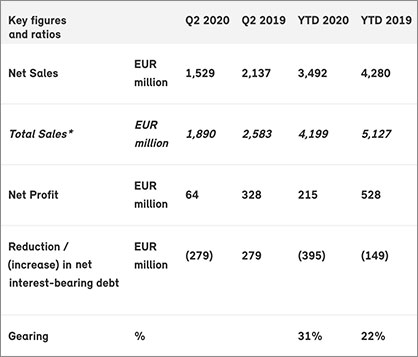
* Net sales of Borealis plus pro-rata sales of at equity consolidated companies


Outlook

“The European polyolefins industry environment has been impacted by Covid-19 and the deterioration of the oil price since the end of the first quarter of 2020. However, the crisis has demonstrated how important our products are for sustainable living during a pandemic. Certain segments of our diversified application portfolio are performing well: Healthcare, parts of Consumer Packaging, and Fertilizers, but our Automotive business has not been spared the challenges experienced by many players in this industry,” comments Alfred Stern, Borealis CEO.

“The resilience programme we launched with focus on reduction of cost and investments is helping to maintain positive results and strong cash flow even during the COVID-19 crisis. For the second half of the year, we expect net profit to increase again compared to the first half of 2020. Borealis is in a good position to successfully weather this challenging period and remain a strong partner for our customers and the value chain.”



More News from TEXDATA International

#ITM 2026

ITM 2026: The new geography of textile production

New production hubs are emerging across North Africa and Central Asia, while Türkiye is accelerating its transformation toward higher-value, technology-driven and more sustainable textile manufacturing.

#Research & Development

“Production is a product”

From technical textiles and AI-driven robotics to the limitations of textile circularity: Professor Dr Thomas Gries looks back on more than two decades of development at ITA Aachen. In the interview, he explains why production technology remains a decisive success factor, discusses international collaborations and innovation ecosystems, and shares his views on the transformation of production landscapes and the challenges facing an increasingly regulated industry.

#Knitting & Hosiery

“We need to move away from the price trap and return to a value-driven mindset.”

With its new Textile Innovation Center, KARL MAYER is sending a strong signal for innovation, collaboration, and the future of textile applications. In this interview, Karl Josef Mayer discusses new opportunities in warp knitting, the processing of staple fibres, recycling, the changing role of machinery manufacturers, and why the textile industry must once again focus more strongly on the value of textiles. by Oliver Schmidt

#Associations

“Innovation, resilience and international experience remain the great strengths of the Swiss textile machinery industry”

Geopolitical uncertainty, growing competitive pressure from China, new free trade agreements and the shift towards a circular economy are currently reshaping the global textile industry. In this interview, Cornelia Buchwalder discusses the current mood within the Swiss textile machinery sector, the industry’s distinctive innovative strength, new market opportunities in India and Asia, and the technological trends that could shape the upcoming trade fair cycle leading up to ITMA 2027.

More News on Textile chemistry

Latest News

#Associations

Keeping products moving with Swedish automation at FILTECH 2026

At FILTECH 2026, taking place in Cologne from June 30th to July 2nd, members of TMAS – the Swedish textile machinery association – will highlight how the country’s engineering expertise is enabling filtration manufacturers to increase productivity, improve traceability and reduce dependence on labour-intensive manual processes.

#ITM 2026

Global Mmeeting of textile technologies, ITM 2026, attracts great interest

ITM 2026, one of the world's most prestigious organizations in the field of textile technologies, opened its doors with the participation of over 1,000 companies and company representatives from 59 countries, as well as thousands of professional visitors from nearly 100 country. Attracting thousands of international visitors on its first day, ITM 2026 once again demonstrated its status as a global meeting point for the textile industry with its advanced technologies on display, newly established business connections, and record-breaking international participation.

#Recycling / Circular Economy

Countdown to Textiles Recycling Expo 2026: Brussels prepares for Europe’s textile recycling gathering

With only two weeks remaining until the start of the second edition of the Textiles Recycling Expo 2026, preparations are entering the final phase. The exhibition and conference, dedicated exclusively to textile recycling and circularity, will take place on 24–25 June 2026 at Brussels Expo and is expected to attract stakeholders from across the textile recycling value chain.

#Recycled Fibers

Indorama Ventures enables brands to scale circular textiles through proven, traceable supply chains

Indorama Ventures, a global leader in recycled polyester staple fibers and filament yarns, will exhibit at Textiles Recycling Expo in Brussels on June 24–25. At the event, the company will show how brands and textile manufacturers can build traceable, circular textile supply chains by working with proven partners who deliver recycled materials on an industrial scale.

TOP