[pageLogInLogOut]

#Raw Materials

Partnership for sustainable textiles recognizes U.S. Cotton Trust protocol as a standard for sustainable cotton

The U.S. Cotton Trust Protocol has been approved as a standard for sustainable cotton by Siegelklarheit, an initiative of the German Federal Government. By helping consumers to better understand environmental and social labels, Siegelklarheit wants to contribute to more sustainable purchasing decisions. U.S. Cotton Trust Protocol successfully passed Siegelklarheit´s assessment system. As a result, members of the Partnership for Sustainable Textiles (PST) can use the Trust Protocol as another standard to calculate their share of sustainable cotton.

The Partnership for Sustainable Textiles was founded in October 2014, with the mission to improve social and ecological conditions within global textile supply chains. The Textiles Partnership orientates its work on the OECD Due Diligence Guidance and on international agreements and guidelines that define the principles of social, environmental, and economic sustainability and the framework for corporate responsibility.
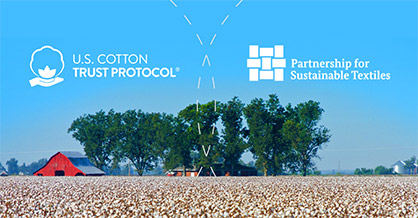
U.S. Cotton Trust Protocol (Photo: Business Wire)


“Members of the Partnership for Sustainable Textiles work together to achieve substantial social and ecological improvements in their global supply chains,” said Jürgen Janssen, head of the PST secretariat. “This also includes the production of raw materials and thus the cultivation and processing of cotton. In the Textiles Partnership, we advocate for transparent and traceable criteria in the certification of sustainable cotton. We are pleased that the Trust Protocol has successfully passed the audit by Siegelklarheit.”

The PST has developed an implementation framework and reporting format for corporate due diligence. In the context of this format PST member companies also indicate how much cotton they source and how much of it is sustainable or organic cotton, certified by recognized standards. Besides U.S. Cotton Trust Protocol, these include Better Cotton standard, the Australian myBMP standard, Cotton made in Africa, Fairtrade Cotton and CottonConnect. The following standards apply to purchasing of organic cotton: the Global Organic Textile Standard (GOTS), the International Association of Natural Textile Industry (NATURTEXTIL IVN) standard, the Textile Exchange Organic Content Standard (OCS), the bioRe Social & Environmental Standard, and all the organic standards forming part of the IFOAM Family of Standards.


The Trust Protocol is the only system that provides quantifiable, verifiable goals and measurement and drives continuous improvement in six key sustainability metrics - land use, soil carbon, water management, soil loss, greenhouse gas emissions, and energy efficiency. It is also the world’s first sustainable cotton fiber to offer its members article-level supply chain transparency through the Protocol Consumption Management Solution.

“We are thrilled to have received this recognition of being a sustainable cotton standard by the Partnership for Sustainable Textiles and proud to have passed Siegelklarheit’s rigorous assessment,” said Dr. Gary Adams, president of the U.S. Cotton Trust Protocol. “The Trust Protocol’s vision is to set a new standard in sustainable cotton production where full transparency is a reality and continuous improvement to reduce our environmental footprint is the central goal. We commit to ensuring the protection and preservation of the planet, using the most sustainable and responsible techniques.”

The U.S. Cotton Trust Protocol is aligned with the UN Sustainable Development Goals, recognized by Textile Exchange and Forum for the Future, and part of the Sustainable Apparel Coalition, Cotton 2025 Sustainable Cotton Challenge, Cotton 2040 and Cotton Up initiatives. It has also been recognized and published in the ITC Standards Map.




More News from TEXDATA International

#Recycling / Circular Economy

textile.4U publishes special edition “Top 100 Textile Recycling Companies 2025”

With a comprehensive 176-page special edition, textile.4U is dedicating its latest issue entirely to one of the most dynamic and influential topics in today’s textile industry: textile recycling. The new issue, published exclusively in high-quality print, presents the Top 100 textile recycling companies researched and selected by TexData – organizations that already play a key role in the transition to circular textiles or are expected to have a significant impact in the near future.

#Recycling / Circular Economy

Responsible Textile Recovery Act of 2024 signed by Governor

Senator Josh Newman (D-Fullerton) is proud to announce that Senate Bill 707 (SB 707), the Responsible Textile Recovery Act of 2024, has been signed into law by the Governor of California, Gavin Newsom. This groundbreaking legislation establishes the country’s first Extended Producer Responsibility (EPR) textile recycling program, marking a significant step forward in the state’s efforts to combat waste and promote sustainability.

#Textiles & Apparel / Garment

Modtissimo promotes sustainability with 28 coordinates in the Green Circle

Modtissimo is proving more and more to be a textile and clothing show that delivers the latest innovations in the area of sustainability, with the iTechStyle Green Circle being the main showcase for companies' creations. In this 60+4 edition, taking place on 12 and 13 September, 28 coordinates will be exhibited in a section organised by CITEVE and curated by Paulo Gomes.

#Europe

The EU and Egypt team up to mobilise private sector investments at Investment Conference and sign a Memorandum of Understanding underpinning €1 billion in macro-financial assistance for Egypt

At the EU-Egypt Investment Conference, co-organised by the EU and the Government of Egypt on 29-30 June, the EU and Egypt are teaming up to intensify private sector investments in Egypt. They are also signing a Memorandum of Understanding (MoU) for the disbursement to Egypt of up to €1 billion in Macro-Financial Assistance.

More News on Raw Materials

#Raw Materials

Esquel Group adds two new extra-long staple cotton varieties approved

Esquel Group’s Xinjiang Research & Development Center has successfully developed two new Sea Island cotton (Extra-Long-Staple cotton, ELS cotton) varieties named “Yuan Loong 37” and “Yuan Loong 42,” which have been officially approved and granted registration numbers. Both varieties have also obtained Plant Variety Rights certificates, marking another significant breakthrough for the Group in cotton breeding and commercial application.

#Raw Materials

Aid by Trade Foundation reaches new milestones in supply chain transparency

The Aid by Trade Foundation (AbTF) is reaching new milestones as it leads the way towards greater physical traceability for Cotton made in Africa® (CmiA) cotton. With around 700 suppliers and producers in a total of 25 countries, the Aid by Trade Foundation has reached a new record number of partners who can trace CmiA cotton from the product back to its origin. This is more than double the previous year’s figure.

#Raw Materials

Modern testing methods for raw cotton

The 38th International Cotton Conference Bremen will take place from 25 to 27 March 2026 at the Bremen Parliament. This conference has traditionally stood for in-depth expertise and international exchange. The program will focus on technical innovations, market trends, and regulatory frameworks across the entire value chain – from agriculture to the circular economy. With high-profile speakers, the conference is regarded as the key meeting point for the global cotton industry. Today’s focus: Cotton quality and testing methods.

#Raw Materials

2026 production plan set for a record 10 metric tons of recombinant spider silk cocoon per month

Kraig Biocraft Laboratories, Inc. (OTCQB: KBLB) (“the Company”, “Kraig Labs”, or “Kraig’s”), a world leader in spider silk technology*, today announced its 2026 production plan that will drive explosive growth and establish a new global benchmark for spider silk manufacturing.

Latest News

#Research & Development

Fabolose: Fabricating vegan and circular leather alternatives from bio-tech-derived cellulose

Fabulose is an EU funded project coordinated by the German Institutes of Textile and Fiber Research (DITF). Its consortium consists of leading research institutes, biotech innovators, and industry stakeholders who aim to create high-performance, biobased and recyclable leather-like fabrics, using efficient biotech production routes for bacterial cellulose, cyanophycin and bacterial pigments

#Textiles & Apparel / Garment

Connecting the ASEAN textile sector: sustainability, trends, and technology take centre stage at this week’s VIATT 2026

Opening this week Thursday, the Vietnam International Trade Fair for Apparel, Textiles, and Textile Technologies (VIATT) is set to welcome visitors from ASEAN’s dynamic textile market and beyond. From 26 to 28 February, VIATT 2026 – the fair’s third editions – will reinforce its strategic proposition with an integrated showcase of the three core sectors of the entire textile value chain. Beyond new sourcing opportunities in Apparel Fabrics & Fashion, Home & Contract Textiles, and Technical Textiles & Technologies, the fair will present an expanded fringe programme.

#Spinning

Measure and control the fiber – optimize yarn quality

Producing consistent yarn quality is an everyday challenge – and a very difficult one. Detailed knowledge and understanding of the fiber raw material is absolutely critical to achieving the best possible quality in the yarn. To help spinners, Uster experts have put together guidelines for avoiding yarn irregularity claims, in a special edition of the Uster News Bulletin.

#Software

Coats Digital appoints Himanshu Mehrotra as Managing Director to lead next phase of cloud and AI-driven innovation

Coats Digital is delighted to announce the appointment of Himanshu Mehrotra as Managing Director to lead the company’s strategic direction, innovation agenda, and global growth as it accelerates the development of its cloud-native, AI-powered software solutions for the global apparel and footwear supply chain.

TOP