[pageLogInLogOut]

#Research & Development

Digital platform: producing custom-fit orthoses quickly, resource-efficiently and cost-effectively
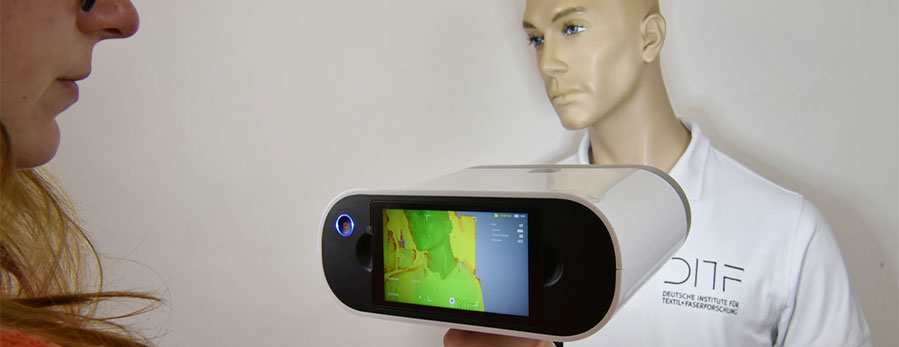
Hand-held 3D scanners can be used to digitize patient body parts as the basis for flexible textile orthoses. Photo: DITF
Resource efficiency, time and cost savings are essential topics in the textile and apparel industry. Conventional supply and production chains often reach their limits, as products need to individually be tailored and available in a short time. The trends of the future are therefore called "fast fashion" and "microfactory". The advantages of digital manufacturing apply not only to fashion, but also to medical textiles.

To this end, the German Institutes of Textile and Fiber Research Denkendorf (DITF) have developed a digital platform that can be used to produce precisely fitting flexible textile orthoses in a resource-, time- and cost-efficient manner. 

Carrying out a patient screening with digital measurement. Photo: DITF


Until now, orthoses have primarily been made manually, which leads to a high error rate. Digitally based manufacturing chains can significantly reduce this waste. For the digital platform, the body data of patients was analyzed and processed at the DITF, on the basis of which standardized orthoses can be developed. Therefore, various body scanning methods were investigated and methods were developed for taking precise body measurements. The information from the screenings was condensed and a digital basic pattern or pattern module database was created.


From this database, the individual model fitting to the patients is carried out. Therapeutic fit is verified using an avatar in 3D simulation software. The finished digital pattern designs are transferred to a cutter, where they are machine-cut to size from elastic fabrics. It is also possible to print the pattern on a plotter/printer as templates and then cut them manually.

The cuts are then processed into finished textile orthoses.

More News from Deutsche Institute für Textil- und Faserforschung Denkendorf

#Research & Development

Fabolose: Fabricating vegan and circular leather alternatives from bio-tech-derived cellulose

Fabulose is an EU funded project coordinated by the German Institutes of Textile and Fiber Research (DITF). Its consortium consists of leading research institutes, biotech innovators, and industry stakeholders who aim to create high-performance, biobased and recyclable leather-like fabrics, using efficient biotech production routes for bacterial cellulose, cyanophycin and bacterial pigments

#Research & Development

More safety and comfort for protective clothing thanks to auxetic fabrics

When everyday materials are pulled, they stretch or elongate in the direction of the pull and become narrower in cross-section. We can also observe this property in two-dimensional textiles. Auxetic structures behave differently here. They have the striking property of not changing under tensile stress or even increasing their width or thickness. These properties are advantageous, for example, in protective textiles or textile filter media. The DITF are researching auxetic fabrics for various applications.

#Research & Development

Panty liners prevent bacterial vaginosis

Worldwide, almost one third of women of childbearing age suffer from bacterial vaginosis. This is when the sensitive microbiome of the vagina becomes unbalanced. Such a disorder of the vaginal flora can cause urogenital infections, abscesses on the ovaries or fallopian tubes or premature births. This significantly increases the risk of infertility in women and of contracting a sexually transmitted disease or HIV.

#Research & Development

DITF send a signal for climate protection

The German Institutes of Textile and Fiber Research Denkendorf (DITF) have successfully implemented extensive investments in photovoltaic systems at their site in Denkendorf. The systems installed on the roofs of the buildings and covered parking lots have a total installed capacity of 840 kilowatt peak (kWp). The DITF invested 1.6 million euros in this with the support of the state of Baden-Württemberg. The system was ceremonially put into operation on September 17, 2025.

More News on Research & Development

#Research & Development

Pellet press enables thermomechanical textile recycling on a pilot scale at ITA

Since the end of 2025, the technical centre of the Institut für Textiltechnik (ITA) of RWTH Aachen University has been equipped with a pellet press from the manufacturer Amandus Kahl GmbH & Co. KG, Reinbek, Germany. This press can efficiently compact shredded synthetic textiles at a throughput of up to 25 kg/h and process them into pellets with a diameter of 4 mm.

#Composites

STFI at JEC

The Sächsisches Textilforschungsinstitut e.V. (STFI) will present composites for aviation made from recycled carbon fibres and natural fibres, as well as printed lightweight elements for surface heating in electric vehicles at JEC World in Paris.

#Research & Development

New DIN SPEC assesses environmental impact of textile fragments in soil

Textile products made from synthetic fibres, finished fabrics or dyed materials release fibre fragments into the environment at every stage of their life cycle. With the new DIN SPEC 19296, Hohenstein has developed a standardised testing method to analyse how these fragments behave in soil under natural conditions. Until now, little was known about their environmental behaviour or potential ecological effects once released.

#Research & Development

Solid Air Dynamics wins second place at RWTH Innovation Award

On 30 January, RWTH spin-off Solid Air Dynamics was awarded second place in the RWTH Innovation Awards for its research in the field of aerogel fibres. Manufactured from renewable raw materials, aerogel fibres offer outstanding thermal insulation, are extremely lightweight and completely biodegradable, and can consist of over 90 per cent air.

Latest News

#Techtextil 2026

Monforts to showcase advanced coating solutions at Techtextil 2026

Over the past few years Monforts has significantly advanced its technologies for coating, with the successive introductions of the MontexCoat, coaTTex and VertiDry systems combining flexibility, precision and energy efficiency for the technical textiles market.

#Composites

JEC World 2026 returns with an unprecedented content program

Recognized worldwide as the leading trade exhibition for composite materials and their applications, JEC World returns on March 10-12, 2026, at Paris Nord Villepinte as the most ambitious edition to date, in line with its motto “Pushing the limits”. As the must-attend event for the composites industry, JEC World will offer an unprecedented program, blending conferences, markets insights, technical sessions, awards, and above all, a unique experience and invaluable connections.

#Raw Materials

Beyond the wardrobe – innovative cotton takes the spotlight

Cotton can do more – a lot more. Cutting-edge textiles and high-tech products made from 100% cotton prove just how powerfully performance and sustainability can come together. That very surge of innovation is front and centre at the 38th Bremen Cotton Conference, taking place March 25–27, 2026, at Bremen’s Parliament on the historic market square – culminating in a bold and dedicated closing session on Friday. In the spotlight: performance upgrades for pure cotton, smart strategies for circular textile waste solutions, and pioneering concepts for demanding technical applications. From natural fibre–reinforced composites to highly effective flame-retardant solutions, cotton steps out of the closet and shows the future potential woven into every fibre.

#Digital Printing

Keeping print inclusive: Empowering women in the print industry

Across all industries, cultivating a diverse and inclusive workplace is increasingly recognised as valuable and essential to long-term success. However, despite the print industry’s significant advancements in technology and innovation, visible representation of women remains limited. As the sector grapples with low recruitment, it’s important to challenge outdated perceptions. Creating real change, however, requires collective effort - no single company can do it alone.

TOP