[pageLogInLogOut]

#Research & Development

Textile cascade filter for removing microplastics from wastewater
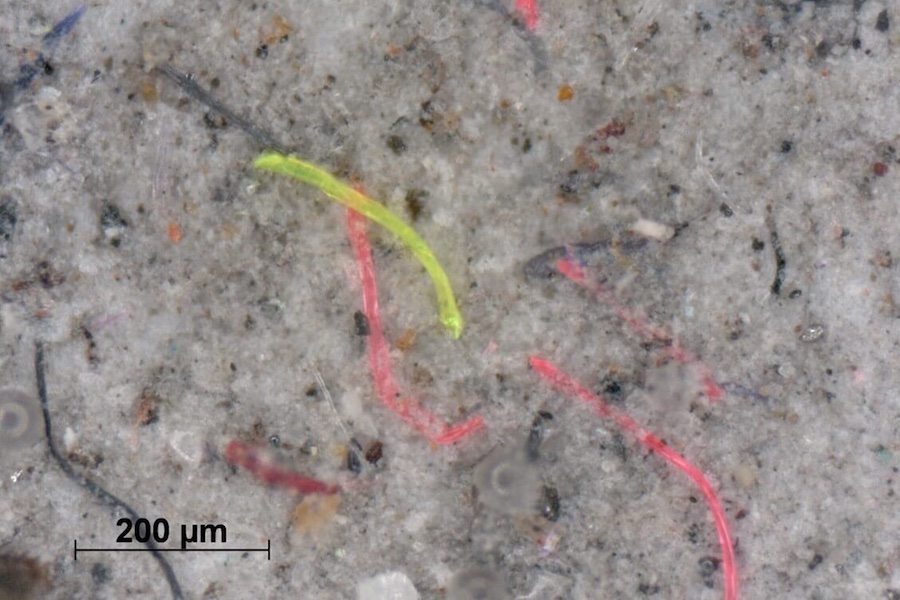
Exemplary picture of a filter cake with deposited microplastic fibers. Photo © 2026 DITF
Microplastics are now found almost everywhere, even in remote regions of Antarctica. They enter the human body through the food chain. Studies indicate that microplastics may have negative effects on the human health.

One important source of microplastic pollution is the washing of textiles made from synthetic fibers. During washing, significant amounts of microplastics are released into wastewater and then enter aquatic ecosystems. To address this problem, the German Institutes of Textile and Fiber Research Denkendorf (DITF) have developed a textile-based cascade filter system.

The amount of microfibers released per wash cycle and per kilogram of textiles is estimated to range from 12 and 1,400 milligrams. Wastewater treatment plants are already able to remove a large portion of microplastic particles from wastewater, with removal rates of up to 99 percent. However, because of the high volume of wastewater discharged every day, these plants can still contribute significantly to microplastic pollution in the environment.

To date, various mechanical and chemical technologies have been used in wastewater treatment. Filter cascades, on the other hand, have mainly been applied for the analysis and characterization of microplastic particles. In their study, the DITF researchers demonstrated that specialized textile-based filter cascades are also capable of effectively removing microplastics from rinse water in industrial laundries. This is possible even at low water pressure. In addition, the system has a simplified design and requires little maintenance.

The cascade microfilter developed by the Denkendorf research team consists of three filtration stages. Each stage uses a three-dimensional textile sandwich composite made of polypropylene fabric and a 3D spacer knit. The stages have progressively smaller pore sizes, allowing the removal of microplastic particles down to 1.5 μm.
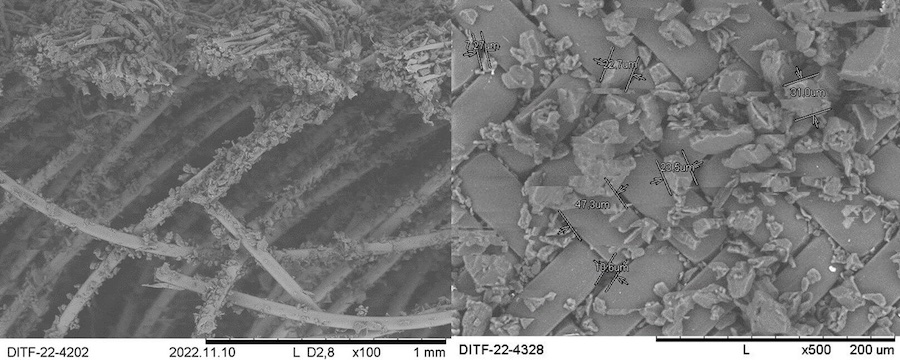
Left: Filter cake structure on 3D warp-knitted fabric cross-section, upstream side. Right: Microplastic particles on filter-woven fabric, upstream side. Images © 2026 DITF


A compressed-air backwashing system is integrated to clean the filter and restore its performance. Because the filter cake moves from the fabric to the spacer layer, backwashing is needed less often, and the operating time can be increased by up to 155 percent.

Field trials at an industrial laundry and a municipal wastewater treatment plant confirmed a separation efficiency of 89.7 percent and 98.5 percent for the microfilter cascade. It can thus make a significant contribution to reducing microplastic pollution.

The high microplastic separation efficiency and the long service life of the filter medium make the system a promising solution for wastewater treatment. It is cost-effective, space-saving, and can be adapted to different applications and scales.

The textile composite medium developed at the DITF can be tailored to meet a variety of filtration requirements beyond its application in microplastic filtration.
More News from Deutsche Institute für Textil- und Faserforschung Denkendorf

#Techtextil 2026

Stylish design made from sustainable materials – two DITF research projects receive Techtextil Innovation Awards

Materials made from domestic, renewable raw materials reduce CO₂ emissions, prevent microplastics from entering the environment, and close the material cycle. The German Institutes for Textile and Fiber Research Denkendorf (DITF) are developing nature-based alternatives to synthetically produced and predominantly petroleum-based materials. Two research projects have received a prestigious Techtextil Innovation Award. NUO Flexholz and the lignin-coated material FormLig demonstrate that sustainable concepts can meet high standards of functionality and design. Both projects were carried out in close collaboration with industry.

#Research & Development

Fabolose: Fabricating vegan and circular leather alternatives from bio-tech-derived cellulose

Fabulose is an EU funded project coordinated by the German Institutes of Textile and Fiber Research (DITF). Its consortium consists of leading research institutes, biotech innovators, and industry stakeholders who aim to create high-performance, biobased and recyclable leather-like fabrics, using efficient biotech production routes for bacterial cellulose, cyanophycin and bacterial pigments

#Research & Development

More safety and comfort for protective clothing thanks to auxetic fabrics

When everyday materials are pulled, they stretch or elongate in the direction of the pull and become narrower in cross-section. We can also observe this property in two-dimensional textiles. Auxetic structures behave differently here. They have the striking property of not changing under tensile stress or even increasing their width or thickness. These properties are advantageous, for example, in protective textiles or textile filter media. The DITF are researching auxetic fabrics for various applications.

#Research & Development

Panty liners prevent bacterial vaginosis

Worldwide, almost one third of women of childbearing age suffer from bacterial vaginosis. This is when the sensitive microbiome of the vagina becomes unbalanced. Such a disorder of the vaginal flora can cause urogenital infections, abscesses on the ovaries or fallopian tubes or premature births. This significantly increases the risk of infertility in women and of contracting a sexually transmitted disease or HIV.

More News on Research & Development

#Techtextil 2026

Smart textiles can also be sustainable, eco-friendly and AI-powered – ITA at Techtextil 2026

Sports shoes made from algae, leggings made from mushrooms, filtering (diesel) oil from water, 4D textiles, recyclable, sustainable and featuring AI – this is what the ITA Group is presenting at three individual stands run by ITA Aachen, ITA Augsburg gGmbH and ITA Technologietransfer GmbH on the joint stand of Elmatex in hall 12.0 D05.

#Research & Development

Hohenstein publishes 2025 Sustainability Report

The testing and research service provider Hohenstein has published its latest sustainability report, outlining key progress and strategic initiatives. The report focuses on ambitious CO₂ reduction targets, the company’s new mission statement and the systematic expansion of sustainable services for customers worldwide.

#Techtextil 2026

ITM presents cutting-edge textile research at Techtextil

From April 21 to 24, 2026, the Chair of Textile Machinery and High Performance Material Technology (ITM) at TUD Dresden University of Technology will be presenting its current research at Techtextil, the leading international trade fair for technical textiles and nonwovens. In Hall 12.0, Stand D41, the team will be demonstrating how it combines high-performance fibers, AI-supported digital development tools and innovative machine technologies to develop textile solutions for lightweight construction, construction, medical technology and sustainable production from atom to product.

#Research & Development

Fraunhofer IAP paves the way for "Green" carbon fibers

A new pilot plant in Guben is set to enable the production of bio-based carbon fibers. The plant is part of the Carbon Lab Factory Lausitz and will make an important contribution to the transformation of the Lausitz region—from a traditionally raw material- and basic industry-oriented region to a hub for innovative high-performance materials. The German federal government and the state of Brandenburg are providing the Fraunhofer Institute for Applied Polymer Research IAP with 53.3 million euros for this purpose.

Latest News

#Techtextil 2026

RUDOLF is pioneering the future of technical textiles by developing innovative, functional solutions

At Techtextil 2026, RUDOLF presents its latest innovations for textile auxiliaries, textile care and construction chemicals. Based in Geretsried, Bavaria, the company draws on more than 100 years of experience and continues to position itself as a global technology partner focused on quality, innovation and sustainability.

#Denim

Eastman Naia™ debuts at Kingpins Amsterdam, transforming Denim from the inside out

At Kingpins Amsterdam (April 15–16, 2026), Naia™ by Eastman Chemical Company makes its debut, presenting its approach to circularity and comfort in denim at Stand 1, Ground Level (Blue Area). The brand also highlights its growing global ecosystem, connecting mill partners, designers and brands working to expand denim possibilities through fiber innovation.

#Denim

ISKO introduces a new chapter of denim innovation at Kingpins Amsterdam with FW 27/28

At Kingpins Amsterdam, ISKO presents its latest FW27/28 collection, a forward-looking exploration of denim that merges advanced color technologies, innovative fabric engineering, and contemporary finishing techniques. Designed to meet the evolving demands of the industry, the collection reflects ISKO’s commitment to pushing the boundaries of authenticity, performance, and responsible innovation, while also embracing a strong lifestyle perspective.

#Techtextil 2026

Asahi Kasei Advance to showcase high-performance non-woven and fibers at Techtextil 2026

Asahi Kasei Advance will present its portfolio of high-performance nonwovens, flame-retardant fabrics, and advanced textile and fiber solutions designed for various industries during its first-ever exhibition at Techtextil 2026. Techtextil is the leading international trade show for technical textiles and nonwovens, taking place from April 21-24, 2026, in Frankfurt, Germany. Asahi Kasei Advance will highlight 14 brands, with special focus on four key materials as its debut at the exhibition in Hall 12.1 at booth C35.

TOP