[pageLogInLogOut]

#Research & Development

Research on carbon fibers from wood rewarded again
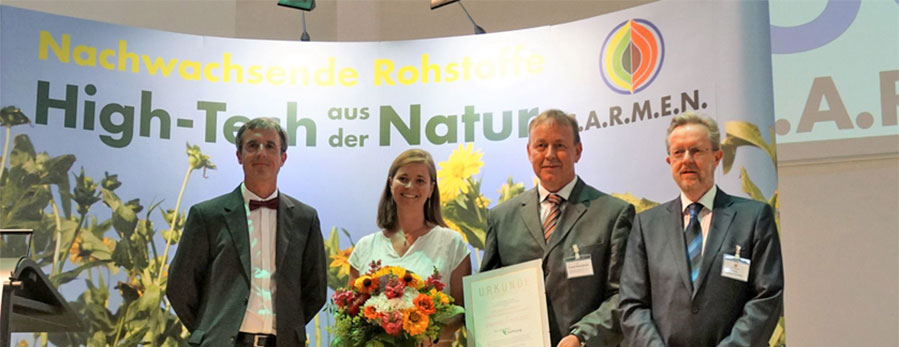
Ernst-Pelz-Award for Dr. Antje Ota and Dr. Frank Hermanutz. Photo: C.A.R.M.E.N. e.V. © 2022 DITF
Dr. Frank Hermanutz and Dr. Antje Ota have received the Ernst-Pelz-Award for Renewable Resources 2020 for the development of a sustainable manufacturing process for the production of carbon fibers based on wood. The award was presented only now because of the Corona pandemic.

IIonic liquids (IL) are the key to sustainable biobased fibers for a wide range of industrial applications. DITF, together with BASF SE, have discovered an innovative solvent for biopolymers (polymers made from renewable resources).

Compared to conventional carbon fibers that are not based on biopolymers, carbon fiber production based on cellulose would not only protect the environment but also reduce energy costs. Domestic beeches, for example, are a suitable material for obtaining cellulose.


The innovation has already won several awards.

The Ernst-Pelz-Award is awarded annually by C.A.R.M.E.N e.V.. The network, founded by the Free State of Bavaria, supports the implementation of the goals of the energy turnaround.

Further information on the prize (German):

https://www.carmen-ev.de/2022/07/07/ernst-pelz-preise-und-foerderpreise-nachwachsende-rohstoffe-2020-2021-verliehen-innovative-entwicklungen-praemiert/

More News from Deutsche Institute für Textil- und Faserforschung Denkendorf

#Research & Development

Textile cascade filter for removing microplastics from wastewater

Microplastics are now found almost everywhere, even in remote regions of Antarctica. They enter the human body through the food chain. Studies indicate that microplastics may have negative effects on the human health.

#Research & Development

Fabolose: Fabricating vegan and circular leather alternatives from bio-tech-derived cellulose

Fabulose is an EU funded project coordinated by the German Institutes of Textile and Fiber Research (DITF). Its consortium consists of leading research institutes, biotech innovators, and industry stakeholders who aim to create high-performance, biobased and recyclable leather-like fabrics, using efficient biotech production routes for bacterial cellulose, cyanophycin and bacterial pigments

#Research & Development

More safety and comfort for protective clothing thanks to auxetic fabrics

When everyday materials are pulled, they stretch or elongate in the direction of the pull and become narrower in cross-section. We can also observe this property in two-dimensional textiles. Auxetic structures behave differently here. They have the striking property of not changing under tensile stress or even increasing their width or thickness. These properties are advantageous, for example, in protective textiles or textile filter media. The DITF are researching auxetic fabrics for various applications.

#Research & Development

Panty liners prevent bacterial vaginosis

Worldwide, almost one third of women of childbearing age suffer from bacterial vaginosis. This is when the sensitive microbiome of the vagina becomes unbalanced. Such a disorder of the vaginal flora can cause urogenital infections, abscesses on the ovaries or fallopian tubes or premature births. This significantly increases the risk of infertility in women and of contracting a sexually transmitted disease or HIV.

More News on Research & Development

#Techtextil 2026

ITM presents cutting-edge textile research at Techtextil

From April 21 to 24, 2026, the Chair of Textile Machinery and High Performance Material Technology (ITM) at TUD Dresden University of Technology will be presenting its current research at Techtextil, the leading international trade fair for technical textiles and nonwovens. In Hall 12.0, Stand D41, the team will be demonstrating how it combines high-performance fibers, AI-supported digital development tools and innovative machine technologies to develop textile solutions for lightweight construction, construction, medical technology and sustainable production from atom to product.

#Research & Development

Fraunhofer IAP paves the way for "Green" carbon fibers

A new pilot plant in Guben is set to enable the production of bio-based carbon fibers. The plant is part of the Carbon Lab Factory Lausitz and will make an important contribution to the transformation of the Lausitz region—from a traditionally raw material- and basic industry-oriented region to a hub for innovative high-performance materials. The German federal government and the state of Brandenburg are providing the Fraunhofer Institute for Applied Polymer Research IAP with 53.3 million euros for this purpose.

#Research & Development

Hof University develops sustainable textile coating for the fashion of tomorrow from mushrooms

Clothing is often treated as disposable: T-shirts for events, general merchandise, or short-term campaigns frequently end up in the trash after only a few uses. This is particularly problematic given that their production still largely relies on fossil-based materials. This is precisely where a new research project at Hof University of Applied Sciences comes in.

#Research & Development

Textilfabrik 7.0 launched: Mönchengladbach becomes a real-world lab for sustainable textile production

With the official kick-off event of the Textilfabrik 7.0 (T7), a major transformation project for the German textile and apparel industry has been launched in the Monforts Quarter in Mönchengladbach. At the “Textile Roundtable,” an event format organized by the Zukunftsagentur Rheinisches Revier, representatives from industry, research, politics, and the regional economy came together to jointly lay the foundation for CO₂-neutral, circular, and economically viable textile production in Germany.

Latest News

#Techtextil 2026

BASF at Techtextil 2026: Helping to shape the future of the textile industry with tangible solutions

At the leading international trade fair for technical textiles and nonwovens from April 21 to 24, 2026 at the Messe Frankfurt, BASF will present numerous solutions and new projects in the textile sector to customers and partners at booth B 68 in hall 11.0. The focus is on product innovations and future-oriented technologies.

#Texprocess 2026

Durak Tekstil to drive innovation at Texprocess 2026 with its functional threads

Developing solutions for dozens of industries ranging from apparel and automotive to footwear, protective clothing, furniture, and mattress, Durak Tekstil will showcase its expertise in functional technical threads at Texprocess 2026. As one of the leading manufacturers of industrial sewing and embroidery threads, Durak Tekstil will take part in Texprocess 2026, the trade fair for garment and functional textile processing to be held in Frankfurt from April 21–24, presenting solutions developed through its R&D efforts.

#Nonwovens

2025 Nonwoven production in Greater Europe: European Nonwovens Industry remains strong amid challenging market conditions

EDANA, the international association serving the nonwovens and related industries, released today the European annual statistics for 2025, offering a comprehensive picture of the nonwovens industry in Greater Europe. This information shows an overview of the industry’s strength and resilience across the region. According to the figures collected and compiled by EDANA, overall nonwovens production in Europe declined by around 2.2% in 2025, reaching 2,919,000 tonnes.

#Recycled Fibers

RE&UP partners with Madewell and ISKO on textile-to-textile denim capsule

RE&UP Recycling Technologies is accelerating the shift toward a closed-loop textile economy through a collaboration with American denim brand Madewell and global fabric manufacturer ISKO. By transforming approximately 20,000 pairs of post-consumer jeans into recycled feedstock for a textile-to-textile denim capsule, RE&UP demonstrates the commercial viability of circular systems in the denim sector.

TOP