[pageLogInLogOut]

#Recycled Fibers

Driving circularity with Uster Recycled Fiber Matrix

The two-way street for assessing mechanically recycled materials
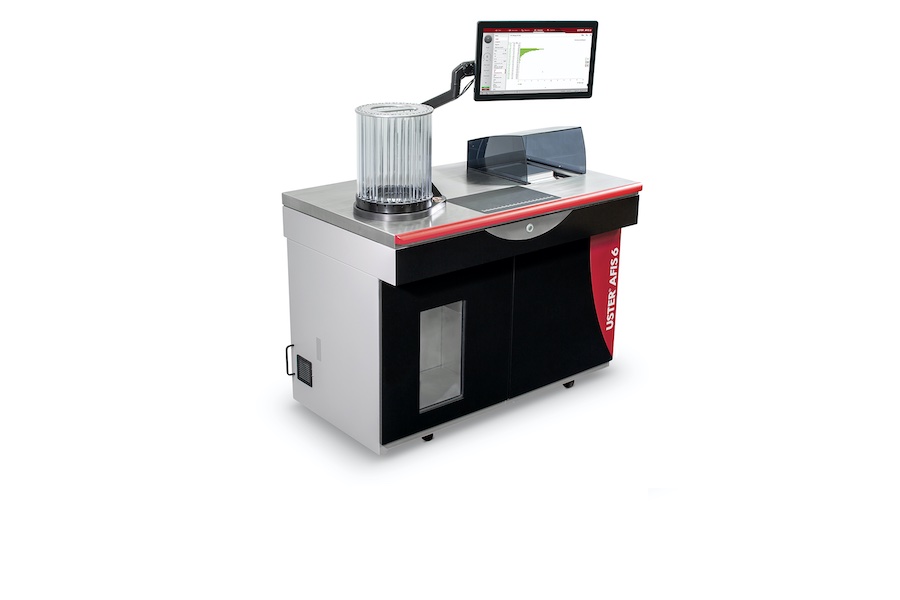
The Recycled Fiber Matrix is based on measured Uster AFIS 6 values © 2026 Uster Technologies
The textile industry’s commitment to circularity continues to accelerate, and mechanical recycling is viewed as a targeted approach to cutting textile waste and its environmental impact. At the forefront of this drive, Uster has developed the Recycled Fiber Matrix, a two-dimensional assessment of mechanically recycled fibers to guide optimum processing and end-uses.


Recycled cotton fibers are difficult to categorize because of their inconsistency and variability. How can the industry evaluate mechanically recycled material accurately – and match it to the most suitable spinning methods and product end-uses? Help is at hand from Uster, in the form of the Recycled Fiber Matrix. It provides an objective assessment of recycled cotton, so that recyclers, spinners and brands are guided towards what can be made from it, and how.

The concept fits perfectly with the industry’s need for greater circularity and transparency in recycling.

The facts that matter

Precise data about the physical characteristics of recycled fibers is essential to understand how they will behave in spinning and their end-use. The Uster Recycled Fiber Matrix focuses on the essential numbers – such as length of fibers (L(n)), of the longest 5% fibers (5% L(n)), and short fiber content (SFC(n)).

The background to the development of the Recycled Fiber Matrix involved testing of a significant number of 100% mechanically recycled cotton fiber samples from key recycling regions, including China, India and Europe. Samples included greige materials, as well as colored and bleached recycled fibers. Sources were categorized as post-industrial, pre-consumer or post-consumer waste, as evenly distributed as possible.
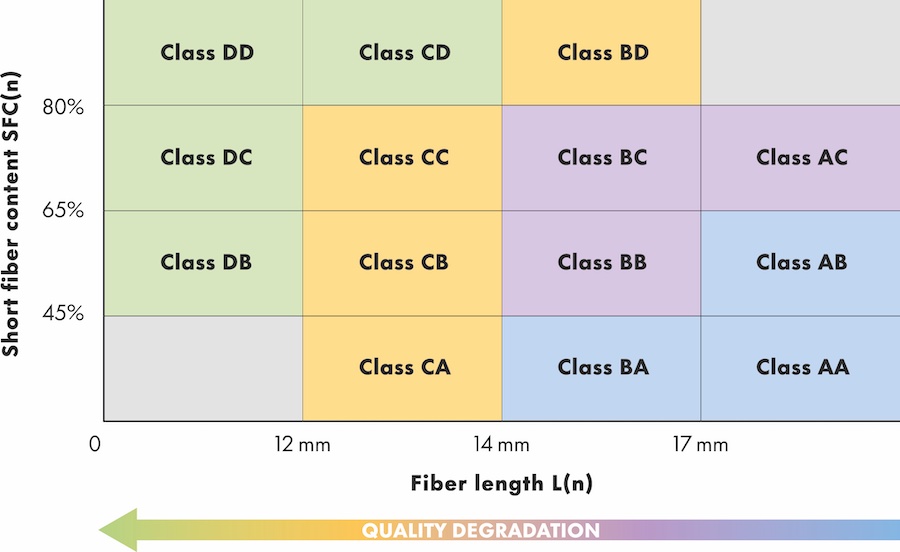
Uster Recycled Fiber Matrix for mechanically recycled cotton based on L(n) and SFC(n) © 2026 Uster Technologies


Measurements of the recycled samples with Uster AFIS 6 were the basis of trends used in the Recycled Fiber Matrix. From this, Uster developed its application report on the Recycled Fiber Matrix. It evaluates the current state and potential challenges of using different types of mechanically recycled cotton fibers in spinning.

The Uster Recycled Fiber Matrix is an ongoing and dynamic process, with more samples being collected and analyzed from global recycling hubs, to reflect variability as source materials and processing conditions evolve.
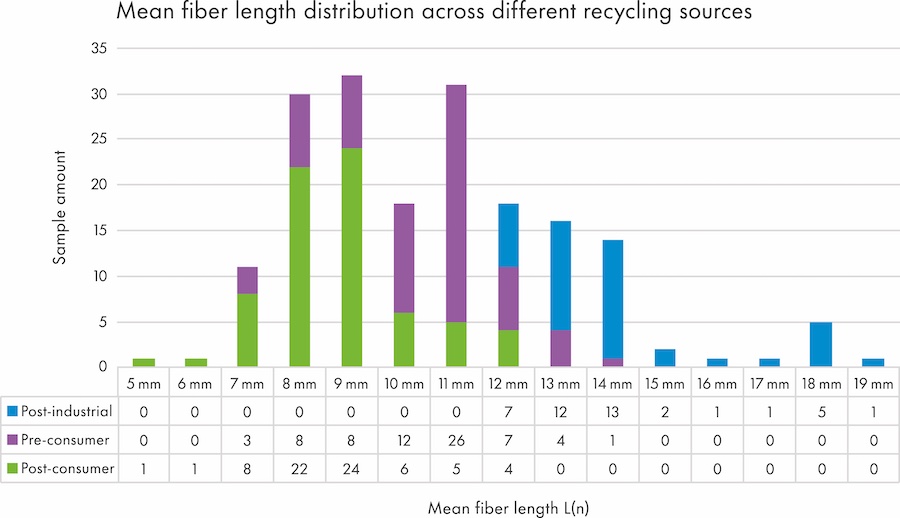
Mean fiber length distribution based on L(n) for different recycling waste types © 2026 Uster Technologies


How it works

Measured Uster AFIS 6 values are presented as clear and easy-to-understand quality levels, from A to D, color-coded for intuitive practical application. The color-coded regions correlate fiber parameters with their typical raw material sources, to provide a strategic guide for optimized yarn production.

Mechanically recycled cotton cannot be accurately classified by a single fiber parameter. So the Recycled Fiber Matrix uses two-dimensional evaluation. Only a combination of these two parameters can properly determine processing behavior and yarn quality.

For example, the x-axis might represent a length parameter, such as mean fiber length, while the y-axis could be a quality-limiting factor like short fiber content or nep count. Each position in the matrix thus reflects two interacting fiber properties simultaneously. In practice, this means that two fiber lots with the same mean fiber length could behave differently in spinning if one had high short fiber content and the other low. The two-dimensional matrix makes this visible and comparable.

Benefits in industrial application

The Recycled Fiber Matrix lets customers directly translate AFIS measurements into clear quality categories. This makes the quality level and the limitations of a lot transparent.

Based on Recycled Fiber Matrix, the class can be applied to bale management and machine settings. For optimum yarn performance, the class is useful to estimate the expected short-fiber load, and to define suitable blending ratios.

Uster experts generally advise users to enhance fiber sorting by separating bales according to length, source, and color, thus reducing variability. Effective bale management helps maintain consistency in key parameters, ensuring uniform quality throughout production. It’s also recommended to enhance the spinning process by adjusting draft settings, twist, and spinning speed to suit the specific quality of recycled fibers. Increasing maintenance and cleaning frequency would also help.

Mixing recycled cotton with virgin cotton or synthetic fibers is still regarded as the best blending strategy to compensate for quality deficiencies. Uster is currently working in this field to provide benchmarks for blend levels and their subsequent influence on yarn quality.

Free application report

The Uster Recycled Fiber Matrix provides a data-driven framework for objective classification of recycled fiber lots. The application report on the Recycled Fiber Matrix is a valuable educational document, with several graphs and illustrations. It is available as a free download under www.uster.com/recycledfibermatrix. It contains shared insights empowering spinning mills, recyclers, and brands to make informed decisions about fiber suitability. It helps expand the use of recycled cotton in textile products, while optimizing processing parameters.

As recycling technologies and fiber preparation methods continue to evolve, Uster is convinced that ongoing data collection and matrix updates play an important part, refining classification accuracy and supporting sustainable circularity goals in the textile industry.


More News from Uster Technologies AG

#ITM 2026

Uster’s new Recycling Opening Index guides spinners to the perfect blend

Uster AFIS 6 now offers the key data for better decisions when blending recycled fibers. Process control is decisive in determining the quality and economic outcome. The new R Recycling Module of AFIS 6 introduces the Recycling Opening Index (ROI), so spinners can optimize their circularity credentials. It was officially launched at ITM 2026 in Istanbul, Türkiye.

#Spinning

Measure and control the fiber – optimize yarn quality

Producing consistent yarn quality is an everyday challenge – and a very difficult one. Detailed knowledge and understanding of the fiber raw material is absolutely critical to achieving the best possible quality in the yarn. To help spinners, Uster experts have put together guidelines for avoiding yarn irregularity claims, in a special edition of the Uster News Bulletin.

#ITMA Asia + CITME Singapore 2025

Uster presents novelties at ITMA Asia + CITME 2025

There’s news from Uster Technologies to be announced for the industry’s upcoming event in Singapore. The Uster 360Q universe is growing with new products, solutions and services. Innovation developments can also be recorded in the fields of man-made fiber testing and fabric inspection. Uster innovations address the industry’s trending topics as mill management and process control, optimization of delivered fabric quality and yield.

#Spinning

Uster Technologies marks 150 years of empowering quality excellence

Uster Technologies marks 150 years of excellence – a milestone that reflects continuous adaptation to customer needs and industry change. Over the decades, Uster has evolved from manufacturing quality testing instruments into a trusted partner shaping the future of textile production.

More News on Recycled Fibers

#Recycled Fibers

RE&UP’s Next-Gen Cotton fibers power Zalando private label t-shirt collection crafted from innovative recycled textiles

RE&UP Recycling Technologies’ Next-Gen Cotton powers a new collection from Zalando’s private labels, marking a step forward in bringing textile-to-textile recycled fibers into commercial fashion production. Launching on Zalando in August, the collection comprises five t-shirts across YOURTURN by Zalando and Even&Odd by Zalando, made from a circular-knit fabric blending 80% organic cotton with 20% RE&UP Next-Gen Cotton — textile-to-textile recycled fiber produced from textile waste. This is the first time RE&UP's recycled fibers feature in Zalando's private label assortment.

#Recycled Fibers

Circ expands global recycled polyester production with BHF offtake agreement

Circ®, a global leader in textile-to-textile recycling, today announced a new offtake agreement with BHF, a leading specialty polyester fiber innovator. This agreement significantly expands the company’s ability to bring recycled polyester into mainstream fiber production.

#Recycled Fibers

Circ expands access to recycled fibers through partnership agreement with Shenghong

Circ®, a global leader in textile-to-textile recycling, has entered into a partnership agreement with Shenghong Chemical Fiber New Material Co., Ltd. to advance the commercial production of polyester filament yarn made with Circ’s textile-to-textile recycled materials.

#Yarn & Fiber

Expansive innovations converge in Shanghai as Yarn Expo Autumn 2026 opens doors next week

With just days to go, industry enthusiasm is building for the opening of Yarn Expo Autumn, Asia’s premier yarn and fibre trade fair, running from 25 – 27 August at the National Exhibition and Convention Center (Shanghai). Across 27,000 sqm in Hall 8.2, buyers will find nearly 600 exhibitors from 14 countries and regions, spread across seven specialised zones that range from cutting-edge man-made and regenerated fibres to time-honoured cashmere and silk. Beyond the extensive sourcing options, a fringe programme of trend showcases, presentations and product launches rounds out the three¬day event with design, innovation and market intelligence.

Latest News

#Heimtextil 2027

Heimtextil Trends 27/28: ‘Home-Maxxing’ between performance and respite

Sleep better, recover faster, live more efficiently: the desire for optimisation has long since reached our homes. Under the title ‘Home-Maxxing – The Performance of Everyday Living’, Heimtextil Trends 27/28 show how our relationship with efficiency-driven thinking and technology is influencing the design of spaces and textiles. The more sleep, wellness, routines, materials and spaces are optimised, the stronger the desire for a home that does not demand even more of us.

#Digital Printing

Mimaki advances DTF productivity and stability with new TxF330-800

Mimaki Europe, a leading manufacturer of industrial inkjet printers and cutting plotters, announces the TxF330-800, its new direct-to-film (DTF) printer. Designed to support stable, high-quality garment decoration in demanding print environments, the system combines automated maintenance, expanded white ink capacity and advanced production capabilities to streamline workflow.

#Home Textiles

Intertextile Shanghai Home Textiles – Autumn Edition 2026 concludes as Asia’s premier hub for trend-led innovation

Intertextile Shanghai Home Textiles – Autumn Edition 2026 wrapped up on 20 August having brought the global home textiles community together in Shanghai. Over 900 exhibitors from 19 countries and regions attracted nearly 36,000 visitors from 113 represented markets to the National Exhibition and Convention Center (Shanghai). This edition further strengthened the fair’s status as a strategic gateway to the wider Asian buyer market, with strongly represented regions including Greater China, Southeast Asia, and increasingly Central Asia.

#Raw Materials

ICAC’s 84th Plenary Meeting to be held March 24-26, 2027, in Alexandria, Egypt

Registration will soon be open for the International Cotton Advisory Committee’s 84th Plenary Meeting, to be held March 24-26, 2027, in Alexandria, Egypt. The local Organizing Committee in Egypt has chosen “Building a Resilient and Competitive Future for Cotton and Textiles” as the theme for the event, which will be held at the Rixos Montaza Alexandria Resort.

TOP