[pageLogInLogOut]

#Raw Materials

COTTON USA SOLUTIONS™ seminar in India shares fiber selection insights
© 2021 Cotton USA
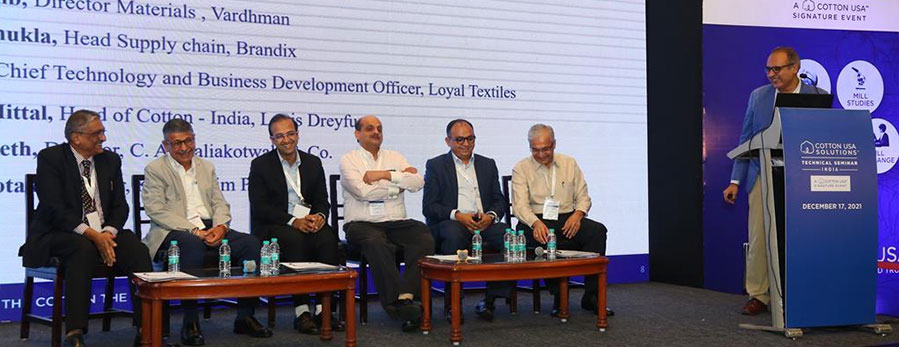
Cotton Council International (CCI) hosted a COTTON USA SOLUTIONS™ seminar in Coimbatore, India, on Dec. 17, the first in-person event there since September 2019. More than 65 participants representing 25 mills—including 14 COTTON USA™ licensees—attended the event. The mills attending the seminar have a cumulative annual cotton consumption of 3.3 million bales, of which more than 165,000 bales are U.S. cotton. A post-event survey showed that these mills are expected to buy an additional 64,000 bales of U.S. cotton as a result of attending the seminar.

Two CCI technical consultants gave COTTON USA SOLUTIONS™ presentations to the group regarding fiber selection insights from the COTTON USA MILL MASTERY™ courses. The presentation included an introduction to the the five COTTON USA SOLUTIONS™ offerings, plus the importance of fiber selection, which included a live demo. Another seminar outlined the importance of bale management, which included optimization of cotton processing and choosing the right selection for the right application.

Supima President and CEO Marc Lewkowitz presented updates on the Supima crop, prices, production and trade. India is the largest consumer of Supima fiber, and Supima is less than 0.5% of the global cotton production. Lewkowitz’s presentation also highlighted the importance of communication, collaboration and building better partnerships through responsible, authentic, fair, equitable and honest conversations based on facts and focused on positive outcomes.

CCI next presented updates on U.S. cotton’s sustainability record, the U.S. Cotton Trust Protocol® — the value proposition of the program and how the program’s verified trackable equivalency solution is providing a transparent supply chain in the textile business.


The leadership from the Indian and Sri Lankan textile industry also participated in a panel discussion to deliberate on what’s next for cotton in 2022. The panel consisted of leading mills and U.S. cotton merchants. Takeaways were:

• Indian mills are investing in additional spinning capacity in the coming 2 to 3 years.

• The importance of collaboration in the textile supply chains.

• Spinning mills have improved efficiencies during COVID while working remotely.

• Indian mills need to use tools like other South Asian counterparts to manage volatility.

• Data-driven programs like the U.S. Cotton Trust Protocol® will gain importance in the future.

• India will continue to drive cotton consumption.

• The perception and cost of stickiness and the High Volume Instrument (HVI) testing equipment for cotton stickiness.

Post-survey results showed that 94% of the attendees were satisfied with the COTTON USA SOLUTIONS™ seminar, 94% were familiar with COTTON USA SOLUTIONS™ and 48% were very likely to use COTTON USA SOLUTIONS™ services. Meanwhile, 94% of the attendees feel that U.S. cotton is better compared to cotton of other origins.




More News from TEXDATA International

#ITM 2026

ITM 2026: The new geography of textile production

New production hubs are emerging across North Africa and Central Asia, while Türkiye is accelerating its transformation toward higher-value, technology-driven and more sustainable textile manufacturing.

#Research & Development

“Production is a product”

From technical textiles and AI-driven robotics to the limitations of textile circularity: Professor Dr Thomas Gries looks back on more than two decades of development at ITA Aachen. In the interview, he explains why production technology remains a decisive success factor, discusses international collaborations and innovation ecosystems, and shares his views on the transformation of production landscapes and the challenges facing an increasingly regulated industry.

#Knitting & Hosiery

“We need to move away from the price trap and return to a value-driven mindset.”

With its new Textile Innovation Center, KARL MAYER is sending a strong signal for innovation, collaboration, and the future of textile applications. In this interview, Karl Josef Mayer discusses new opportunities in warp knitting, the processing of staple fibres, recycling, the changing role of machinery manufacturers, and why the textile industry must once again focus more strongly on the value of textiles. by Oliver Schmidt

#Associations

“Innovation, resilience and international experience remain the great strengths of the Swiss textile machinery industry”

Geopolitical uncertainty, growing competitive pressure from China, new free trade agreements and the shift towards a circular economy are currently reshaping the global textile industry. In this interview, Cornelia Buchwalder discusses the current mood within the Swiss textile machinery sector, the industry’s distinctive innovative strength, new market opportunities in India and Asia, and the technological trends that could shape the upcoming trade fair cycle leading up to ITMA 2027.

More News on Raw Materials

Latest News

#Research & Development

GenuTrace client advisory: Is your cotton supply chain UFLPA ready?

U.S. Customs and Border Protection has released updated operational guidance (CBP Publication No. 5560-0526) expanding its forced labor enforcement framework. The guidance supersedes the original 2022 UFLPA Operational Guidance and now covers all forced labor enforcement authorities — UFLPA, CAATSA, and WROs/Findings — in a single unified document. For cotton importers, the enforcement posture has not softened. It has become more structured, more documented, and more demanding. Learn more about UFLPA.

#Carpets

DOMOTEX Hannover 2028 off to a strong start with expanded portfolio

Preparations for DOMOTEX 2028 are already gaining strong momentum. Following its successful repositioning as the Home of Flooring & Interior Finishing, around 100 international manufacturers have already secured their place during the initial registration phase.

#Knitting & Hosiery

STOLL: Agreement signed for the divestiture of selected assets

In early 2025, KARL MAYER announced its strategic decision to focus on its core business areas of WARP KNITTING, WARP PREPARATION, and TECHNICAL TEXTILES. As part of this move, the flat knitting machine business under the STOLL brand was discontinued and the production site in Reutlingen was closed in October 2025.

#Research & Development

TERNAfil wins first place at PitchMiUp Night 2026 in Minden

The RWTH spin-off TERNAfil has developed MAXCarbon, a new high-performance hybrid fibre that combines the mechanical performance of carbon with the temperature and corrosion resistance of ceramic materials. For this development, TERNAfil was awarded first prize at the PitchMiUp Night in Minden on 21 May 2026.

TOP