[pageLogInLogOut]

#Techtextil 2024

Retech will present advantages of its leading godet rolls at Techtextil

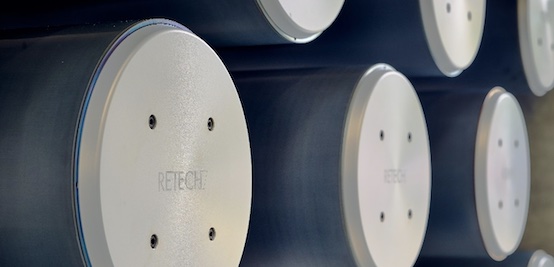
Godet rolls are essential components in the production of synthetic fibres. These heated, ambient or cooled rolls help achieve the perfect yarn quality for a range of materials and applications when it comes to heat treatment for filament fibre applications. Retech's heated godet rolls are designed to meet critical requirements: delivering precise temperature control tailored to each material and maintaining consistent temperature levels throughout the process.

Leveraging cutting-edge technology, including single-zone or multi-zone heating via induction, Retech’s designs guarantee accuracy and precision in temperature profiles, thereby ensuring constant yarn quality with every production run.

In addition to the energy-saving motors and energy-optimised heaters, a very important part of the Retech godet concept is the long service life and the associated permanent availability, thus reducing machine downtimes and customer claims. Therefore, Retech has equipped its godets with additional measuring elements in order to be able to react preventively to possible damage and subsequent failure.

Thanks to the sophisticated, innovative and proven temperature measuring transmission system - UTR-6A, which measures the temperatures in the rotating godet and transmits the data to the temperature controller UCR-6 for processing without contact, it is possible to take further measurements, collect data and evaluate them. To protect the godet, the bearing system, the induction heater, the ongoing production and ultimately the sustainability of the entire process and the godet itself.

Meet Retech at Stand B01 in Hall 12  at Techtextil Frankfurt.


Retech Godet Rolls  © 2024 Retech
Retech Godet Rolls © 2024 Retech


More News from Retech Aktiengesellschaft

More News on Techtextil 2024

Latest News

#Textile processing

Jeanologia combines digitalisation, laser and ozone technology to strengthen China’s textile competitiveness

At ITMA Asia + CITME 2026 in Shanghai, Jeanologia showcased how the combination of digitalisation, laser technology and G2 Ozone can help China’s textile industry improve productivity, speed, quality and efficiency. With its Compact Super Flash laser system and integrated production concepts, the Spanish technology specialist demonstrated how connecting product development and industrial production can enable faster, more automated and sustainable manufacturing processes.

#Textile chemistry

Flame protection and OEKO-TEX® certification: Gulec Chemicals clears an important hurdle

Three halogen-free flame retardants from German specialist Gulec Chemicals have been included in the OEKO-TEX® list of accepted Active Chemical Products (ACP). The listing opens up additional opportunities for textile finishers, coaters and manufacturers of technical textiles seeking to combine demanding fire protection requirements with certification according to OEKO-TEX® STANDARD 100.

#Dyeing, Drying, Finishing

PLEVA improves dyeing consistency with inline microwave measurement of liquor pick-up

Consistent shades are essential in continuous textile dyeing. Yet variations in fabric absorbency or uneven padder pressure can go unnoticed until the end of the line. By then, hundreds of metres of fabric may already be affected and may become second-choice or rejected.

#Recycling / Circular Economy

DITF establishes CYCLOTEXUM recycling center to advance mechanical and solvent-based textile recycling

As part of the CYCLOTEXUM research project, the German Institutes of Textile and Fiber Research Denkendorf (DITF) established the CYCLOTEXUM recycling center. There, in collaboration with industry partners, the center develops application-oriented solutions for mechanical and solvent-based recycling processes. The technologies developed make a significant contribution along the textile value chain toward the efficient use of textile resources in the future and the transition of production in the German textile sector to a circular economy. The project was funded by the Ministry for the Environment, Climate and Energy Sector of the State of Baden-Württemberg.

TOP