[pageLogInLogOut]

#Techtextil 2022

Mastering the heat in synthetic filament production

Threads made of polyamide, polyester, polypropylene, aramid, carbon, bio-based and many other polymers, categorized as technical yarns and high-performance fibers are a special field of Retech. The Swiss company is the expert in heat treatment and drawing man-made fibers of any material. They present their latest developments at Techtextil Germany 2022 in Hall 12.0, Booth B11.

Retech presents its latest innovations at Techtextil

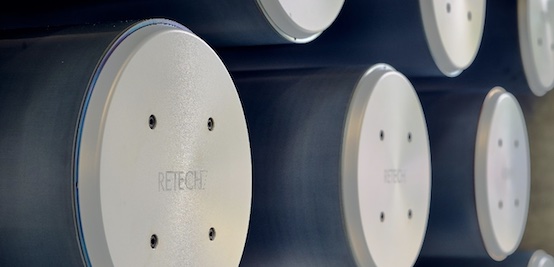
Identifying a strong demand for technical yarns with maximum strength, Retech addressed this with the newly-launched godet roll, with an ideal length of 420 mm to process eight or twelve threads at a time. Its extended diameter of 250 mm allows a significantly increased speed with the same dwell time. Additionally, the higher motor torque guarantees the very best results in yarn tenacity. Further technical parameters are as remarkable: speed can be ramped up to 6500 m/min and the temperature reaches 250°C with an excellent temperature profile of +/- 1.5 °C.

High-temperature godet rolls are invented for high-performance fibres. Some unique yarn characteristics are made possible by impressive temperatures. High-performance fibres require temperature at extremely high levels, since fibres such as para-aramids have high glass transition temperatures nearing 370 °C. Retech high-temperature godet rolls have a heating power of up to 400 °C. They also offer outstanding performance in terms of precision within 0.5°C – guaranteed by the established Retech temperature controller – and repeat accuracy from 1 to 100 godets.


Retech’s innovations for godet roll temperature management are precise, reliable, easy to handle, and durable. One of these innovations is the temperature transmitter which proves to operate in the harshest electromagnetic environment at highest precision. The system’s key part, the co-rotating sensor fork was recently revolutionized. Latest electronic and new materials compensate for disturbing influences which could tamper with the measuring signal.

Last but not least, the UTL monitoring device analyses the data and integrates it in the communication protocol for perfect data security. The UTL guides filament yarn producers toward Industry 4.0.

© 2022 Retch
© 2022 Retch


More News from Retech Aktiengesellschaft

#Techtextil 2026

RETECH showcases high-precision godets for high-performance fiber processing at Techtextil 2026

RETECH designs and manufactures godets and draw frames for heated, ambient and cooled processes, enabling precise heat treatment and consistently high yarn quality for a wide range of polymers and applications, with process temperatures of up to 400 °C for high-performance fibers. The company’s key competence lies in exact and stable temperature and speed control, individually adapted to the specific material and process requirements.

#ITMA Asia + CITME Singapore 2025

50 years of Swiss precision - Retech highlights latest technology to produce high-quality synthetic fibers

High-quality synthetic fiber production requires uncompromising precision and process stability. Godet rolls play a key role in ensuring exact temperature control and maximum reliability. As a Swiss pioneer in thermal treatment for filament fibers, Retech has been setting benchmarks for five decades – with technologies that make production processes smarter, more efficient, and more sustainable.

#Techtextil 2024

Retech will present advantages of its leading godet rolls at Techtextil

Godet rolls are essential components in the production of synthetic fibres. These heated, ambient or cooled rolls help achieve the perfect yarn quality for a range of materials and applications when it comes to heat treatment for filament fibre applications. Retech's heated godet rolls are designed to meet critical requirements: delivering precise temperature control tailored to each material and maintaining consistent temperature levels throughout the process.

More News on Techtextil 2022

Latest News

#Techtextil 2026

Performance Apparels: Functional textiles drive innovation at Techtextil 2026

From high-performance fibres and advanced membranes to smart textiles and sustainable material concepts – functional apparel is becoming one of the most dynamic innovation fields in technical textiles. At Techtextil 2026, exhibitors demonstrate how new materials, finishing technologies and digital functions are shaping the next generation of protective, workwear and outdoor systems.

#Textile chemistry

A flagship for chemical production: BASF inaugurates world-scale Verbund site in China

BASF today (March 26, 2026) celebrated the official inauguration of its newly built, world-scale Verbund site in Zhanjiang, Guangdong Province in southern China. Covering an area of around four square kilometers, it is more than a major BASF project in the chemical growth market of China. “Zhanjiang shows what the future of chemistry looks like: efficient, digital and sustainable by design. The site showcases a smart integrated Verbund structure on an industrial scale,” said Dr. Markus Kamieth, CEO of BASF, at the ceremony attended by representatives from government, customers, business partners and employees.

#Nonwovens

VEOCEL™ Lyocell production expands to Asia – Launching a new chapter for nonwovens in the region

VEOCEL™, Lenzing's flagship specialty nonwovens brand, expands production at its Thai plant in Prachinburi. This is the first-ever production of its nonwoven-grade lyocell fibers in Asia. Built in 2022 with a 100,000-ton annual production capacity, the facility - previously focused on fibers for textile applications - now can directly meet the demand for VEOCEL™’s biodegradable¹, wood-based lyocell fibers for nonwovens products. These fibers are an essential ingredient for high-quality nonwovens products, ranging from baby wipes to facial sheet masks and everyday personal hygiene items.

#Research & Development

Hof University develops sustainable textile coating for the fashion of tomorrow from mushrooms

Clothing is often treated as disposable: T-shirts for events, general merchandise, or short-term campaigns frequently end up in the trash after only a few uses. This is particularly problematic given that their production still largely relies on fossil-based materials. This is precisely where a new research project at Hof University of Applied Sciences comes in.

TOP