[pageLogInLogOut]

#Sustainability

ZDHC expands InCheck Solutions

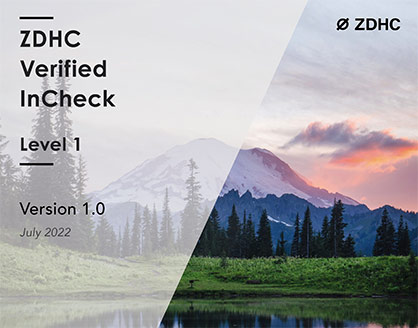
ZDHC releases ZDHC InCheck Solutions and ZDHC Verified InCheck – Level 1

ZDHC InCheck Solutions help suppliers show that they purchase and use chemical products which minimise risk to human health, improve worker safety, and have limited impact on the environment.

Via the ZDHC InCheck Solutions, suppliers can assess their chemical inventory conformance to ZDHC Manufacturing Restricted Substances List (ZDHC MRSL) and share the results with brand customers, without sharing details of the chemical inventory itself. 
© 2022 ZDHC
© 2022 ZDHC


ZDHC InCheck Solutions explains each solution and how it can be implemented. Now, ZDHC has added a verification component to enhance the credibility of the Performance InCheck Reports generated by suppliers. The Performance InCheck Report depends on the accuracy and completeness of the chemical inventory uploaded by the supplier.

"The Verified InCheck Solution will add credibility and confidence to the Performance InCheck Reports generated by suppliers to demonstrate their ZDHC MRSL conformance of input chemical inventory. Having this verification in two levels - Level 1 through on-site spot checks and Level 2 to create an accurate baseline of the inventory- will establish a journey of continuous improvement for Suppliers and help to add transparency to the implementation of sustainable chemical management by manufacturers." said Prasad Pant, South Asia Director at ZDHC Foundation.


The objective of a Verified InCheck – Level 1 is to:

  • Review the overall completeness and accuracy of the chemical products in a supplier’s chemical inventory that are published in the ZDHC Gateway – Chemical Module
  • Enhance confidence in the Performance InCheck Reports

Klaas Nuttbohm, Implementation Director at ZDHC, said: ”The ZDHC Verified InCheck is a further step towards convergence of industry practices. Over the years, the assessment of a supplier’s chemical inventory information has evolved as a key component in a couple of audit standards, specifically the verification of ZDHC MRSL conformance of the chemicals.”

He added: “Suppliers and brands asked how approach A was comparable to approach B, audit fatigue was becoming a topic instead of focus of actual continuous improvement of the chemical inventories. The ZDHC Verified InCheck will help the industry refocus on the real challenges.”

ZDHC InCheck Solutions and ZDHC Verified InCheck - Level 1 can be read and downloaded on the Roadmap to Zero website

http://www.roadmaptozero.com/process

From August 2022 onwards, organisations will be able to apply to become an approved verifier for ZDHC InCheck - Level 1, via the Implementation HUB.

Starting October 2022 ZDHC Verified InCheck - Level 1 can be implemented by brands and suppliers. Stay tuned on our events page for the announcement of webinars.



More News from TEXDATA International

#Texprocess 2026

Texprocess 2026: Automation, digitalisation and AI reshape textile processing

Investment decisions in textile processing have become increasingly complex. Rising energy prices, labour shortages and geopolitical uncertainties are forcing companies to prioritise technologies that deliver measurable improvements in efficiency and process stability. This applies not only to apparel production, but also to the processing of technical textiles and high-performance materials. Modernisation projects are therefore being evaluated more selectively – but the pressure to upgrade production systems continues to grow. Texprocess 2026 reflects this tension between cautious investment behaviour and increasing technological demand.

#Techtextil 2026

Textile Chemicals & Dyes: Innovation in Textile Chemistry moves into focus at Techtextil 2026

From PFAS-free finishes and water-saving dyeing technologies to advanced coatings and recycling-compatible formulations, innovation in textile chemistry is accelerating across the industry. Reflecting this development, Techtextil 2026 introduces Textile Chemicals & Dyes as a dedicated product segment, highlighting the growing role of chemical solutions in shaping the next generation of technical textiles.

#Recycling / Circular Economy

textile.4U publishes special edition “Top 100 Textile Recycling Companies 2025”

With a comprehensive 176-page special edition, textile.4U is dedicating its latest issue entirely to one of the most dynamic and influential topics in today’s textile industry: textile recycling. The new issue, published exclusively in high-quality print, presents the Top 100 textile recycling companies researched and selected by TexData – organizations that already play a key role in the transition to circular textiles or are expected to have a significant impact in the near future.

#Recycling / Circular Economy

Responsible Textile Recovery Act of 2024 signed by Governor

Senator Josh Newman (D-Fullerton) is proud to announce that Senate Bill 707 (SB 707), the Responsible Textile Recovery Act of 2024, has been signed into law by the Governor of California, Gavin Newsom. This groundbreaking legislation establishes the country’s first Extended Producer Responsibility (EPR) textile recycling program, marking a significant step forward in the state’s efforts to combat waste and promote sustainability.

More News on Sustainability

#Sustainability

Experts publish APAC policy priorities

Cascale today announced the publication of its APAC Policy Priorities Paper, developed by the Asia-Pacific (APAC) Policy Member Expert Team (MET) to identify key regional sustainability challenges and provide practical, aligned recommendations for policymakers and industry stakeholders across Asia-Pacific.

#Sustainability

GOTS version 8.0 released: advanced supply chain accountability, from fibre to finished product

Global Standard is pleased to announce the release of GOTS Version 8.0, the latest update to the world's leading processing standard for organic textiles. The updated Standard strengthens requirements for air emissions and waste management, as well as criteria for product safety. It introduces new provisions on circularity, microfibre management and updates in residue testing. Version 8.0 also elevates due diligence obligations and formalises governance requirements, including ESG disclosure, anti-corruption policies and conflict-of-interest safeguards, to support credible, responsible business conduct.

#Sustainability

The nova-Institute establishes new Renewable Feedstock Department to lay the groundwork for industrial defossilisation

The transition from fossil-based to renewable carbon – sourced from biomass, CO₂ utilisation and recycling – is the cornerstone of a climate-neutral chemical industry. The nova-Institute’s new department is dedicated to providing the essential data, analyses and strategic roadmaps required to secure a reliable future feedstock supply and make this transition a commercial and ecological reality.

#Sustainability

Textile Exchange unveils commitment-based pathway for members to accelerate responsible raw material production

Textile Exchange has unveiled further details about its new membership structure, designed to guide the fashion, textile, and apparel industry in a collective course of action toward preferred production systems for raw materials and fibers.

Latest News

#Textile chemistry

A flagship for chemical production: BASF inaugurates world-scale Verbund site in China

BASF today (March 26, 2026) celebrated the official inauguration of its newly built, world-scale Verbund site in Zhanjiang, Guangdong Province in southern China. Covering an area of around four square kilometers, it is more than a major BASF project in the chemical growth market of China. “Zhanjiang shows what the future of chemistry looks like: efficient, digital and sustainable by design. The site showcases a smart integrated Verbund structure on an industrial scale,” said Dr. Markus Kamieth, CEO of BASF, at the ceremony attended by representatives from government, customers, business partners and employees.

#Nonwovens

VEOCEL™ Lyocell production expands to Asia – Launching a new chapter for nonwovens in the region

VEOCEL™, Lenzing's flagship specialty nonwovens brand, expands production at its Thai plant in Prachinburi. This is the first-ever production of its nonwoven-grade lyocell fibers in Asia. Built in 2022 with a 100,000-ton annual production capacity, the facility - previously focused on fibers for textile applications - now can directly meet the demand for VEOCEL™’s biodegradable¹, wood-based lyocell fibers for nonwovens products. These fibers are an essential ingredient for high-quality nonwovens products, ranging from baby wipes to facial sheet masks and everyday personal hygiene items.

#Research & Development

Hof University develops sustainable textile coating for the fashion of tomorrow from mushrooms

Clothing is often treated as disposable: T-shirts for events, general merchandise, or short-term campaigns frequently end up in the trash after only a few uses. This is particularly problematic given that their production still largely relies on fossil-based materials. This is precisely where a new research project at Hof University of Applied Sciences comes in.

#Raw Materials

Fashion for Good mobilises industry to adopt mass balance attribution and accelerate decarbonisation

Fashion for Good launches today the Mass Balance Demonstrator project, a collaborative industry initiative to implement and scale the mass balance attribution (MBA) chain-of-custody model for biomass-attributed PET in textile applications. The project represents a concrete step toward accelerating brand-driven decarbonisation across the apparel value chain.

TOP