[pageLogInLogOut]

#Sustainability

Canada Goose achieves Responsible Down Certification

Today, Canada Goose announced that it has achieved certification under the Responsible Down Standard (RDS). With this accreditation, the brand joins other Responsible Down Certified global manufacturers who embrace sustainability and animal welfare. The RDS is an international, voluntary program that monitors the chain of custody for certified materials and ensures that RDS down standards are maintained throughout the entire supply chain.

Lifestyle brand delivers against Sustainable Impact Strategy with new milestone

“We are driven by our purpose to keep the planet cold and the people on it warm,” said Dani Reiss, President & CEO, Canada Goose. “With today’s announcement, we have reached yet another milestone in the journey to deliver on our purpose, months ahead of schedule.”

Recognized globally by consumers and across the textile industry, RDS provides a common set of expectations and aligns with Canada Goose’s focus on manufacturing best-in-class products that epitomize sustainable innovation. As a certified member, Canada Goose will continue to actively participate in the RDS Global Working Group, governed by the Textile Exchange, to ensure that the RDS continues to evolve and reflect best practices in the industry.

“The Responsible Down Standard is a global standard for best practice in down production,” said La Rhea Pepper, CEO, Textile Exchange. “The RDS helps ensure duck and goose welfare is protected at the farm level and then tracks that material all throughout the supply chain. We’re thrilled to see Canada Goose achieve this high standard.”


This accomplishment strengthens the brand’s dedication to sustainability, continually working toward and building upon its Sustainable Impact Strategy. Canada Goose reaffirms this through its purpose platform, HUMANATURE, which unites its sustainability and values-based initiatives, underscoring its commitment to keep the planet cold and the people on it warm. Canada Goose’s goals are ambitious with aggressive timelines in order to create impact and drive change. Those goals include achieving net-zero carbon emissions by 2025; aiming for 90 per cent of Canada Goose fabrics to receive bluesign® approval for responsible and sustainable practices by 2025; and transitioning 90 per cent of its materials to Preferred Fibres and Materials (PFMs), which are sustainable alternatives to conventional materials, by 2025.

To read the full report, visit: canadagoose.com/sustainability.


More News from TEXDATA International

#Texprocess 2026

Texprocess 2026: Automation, digitalisation and AI redefine textile processing

Making investment decisions in textile processing has become significantly more demanding. Increasing energy costs, a shortage of skilled labour and ongoing geopolitical uncertainties are compelling companies to focus on technologies that deliver clear gains in efficiency and process reliability. This applies equally to apparel manufacturing and to the processing of technical textiles and high-performance materials. As a result, modernisation initiatives are assessed more carefully – even as the need to upgrade production systems continues to intensify.

#Techtextil 2026

Techtextil 2026: Between innovation pressure & market reality

From 21 to 24 April 2026, Techtextil in Frankfurt am Main will once again become the central meeting point for the international technical textiles and nonwovens industry. Running in parallel, Texprocess will focus on the industrial implementation of textile processing technologies as the leading platform in this field. Together, the two trade fairs form a closely integrated presentation and working platform along the entire textile value chain – from material development to finished applications.

#Techtextil 2026

Between geopolitical pressure and industrial resilience

In this interview, Dr. Janpeter Horn (VDMA) discusses the current challenges facing textile machinery manufacturers, shaped by geopolitical tensions, regulatory developments and subdued investment. He also outlines why innovation strength, integrated solutions and strategic positioning remain key to global competitiveness.

#Texprocess 2026

Between investment restraint and modernization pressure

Texprocess 2026 takes place in a complex market environment shaped by uncertainty and innovation pressure. In this interview, Elgar Straub (VDMA) explains why the trade fair is particularly relevant this year and which technologies are driving efficiency and competitiveness.

More News on Sustainability

#Sustainability

A new standard to combat plastic waste in forests

With DIN SPEC 35808 “Tree Shelter for Forestry Applications,” the testing and research service provider Hohenstein, in collaboration with Rottenburg University of Forestry, as well as forestry authorities and industry partners, has established a clear framework for bio-based and fully biodegradable tree shelters. The pre-standard defines requirements and practical testing methods designed to reduce plastic waste in forests and strengthen the long-term protection of soil and the environment.

#Denim

Denim moves towards sustainability

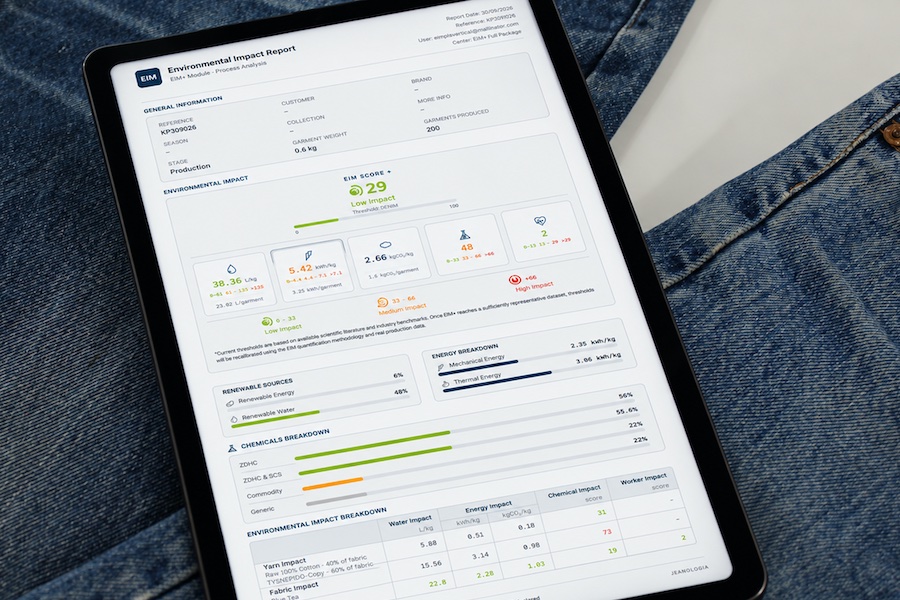
EIM (Environmental Impact Measurement), the global reference platform for measuring the environmental impact of garment finishing, presents the second edition of its annual report Denim Industry Progress & Insights 2025. The study analyses over 100,000 real denim finishing processes, providing an accurate and up-to-date view of the industry’s evolution towards more sustainable models.

#Recycling / Circular Economy

Europe’s textile future at a turning point: New 2030 Circularity Blueprint aims to scale recycling and unlock investment opportunities

The EU textile system is at a critical crossroads. Today, less than 1% of discarded garments are recycled into new garments, despite EU-wide obligations for separate collection. In response, Global Fashion Agenda (GFA) is launching the 2030 Circularity Blueprint, in partnership with ReHubs. This ambitious initiative is designed to support the transformation of the EU textile ecosystem to advance textile-to-textile recycling and drive the transition to a circular economy.

#Sustainability

Number of GOTS-certified facilities grow 15% globally as demand for credible sustainability standards continues to strengthen

Global Organic Textile Standard (GOTS) certification continued to grow in 2025, with nearly 18,000 certified facilities worldwide, despite ongoing geopolitical uncertainty and rapidly evolving regulatory requirements across global textile supply chains.

Latest News

#Nonwovens

Temafa Maschinenfabrik GmbH supplies a complete decortication plant for processing hemp straw to Hanffaser Geiseltal eG

Temafa Maschinenfabrik GmbH, a leading supplier of machinery and plants for fibre processing, has successfully secured an order to supply a complete plant for processing hemp straw to Hanffaser Geiseltal eG, based in Mücheln.

#Techtextil 2026

FET’s revolutionary gel spinning system wins Techtextil Innovation Award

FET has received the prestigious Techtextil Innovation Award 2026 in the New Production Technology category. The Techtextil Innovation Award honours outstanding ideas in textile technology, sustainability, AI and the creation of technical textiles, selected by an international jury of experts. Ranging from new materials to new production technologies, this award recognises progressive ideas that are driving forces for numerous industries, such as automotive, medical and construction.

#ITM 2026

Savio Macchine Tessili will exhibit at ITM Istanbul 2026 presenting its flagship technologies

Savio Macchine Tessili will participate in ITM Istanbul 2026 in a corporate booth of Vandewiele Group, showcasing a selection of its most advanced winding and spinning solutions designed to support textile mills in achieving higher efficiency, flexibility and yarn quality. The company will bring to the show three flagship solutions: Proxima Smartconer®, Lybra Smartspinner® and the Phoenix Assembly Winder.

#ITM 2026

Rieter at ITM 2026: Spinning Redefined with Automation and Intelligence

Spinning mills need solutions that deliver stability, efficiency and future-proof performance. Rieter has put together a powerful portfolio for ITM 2026 in Istanbul, Türkiye. These innovations give customers the tools to enhance cost efficiency, improve responsiveness and actively develop their competitive edge. Step-by-step, Rieter is moving closer to its Vision 2027 – the fully automated spinning mill. With each new technology, Rieter enables spinning mills worldwide to operate with greater precision and reliability, ensuring they remain at the forefront of an increasingly demanding global market.

TOP