[pageLogInLogOut]

#Sustainability

European bioeconomy robust as bio-based industry turnover jumps to 780 billion EUR
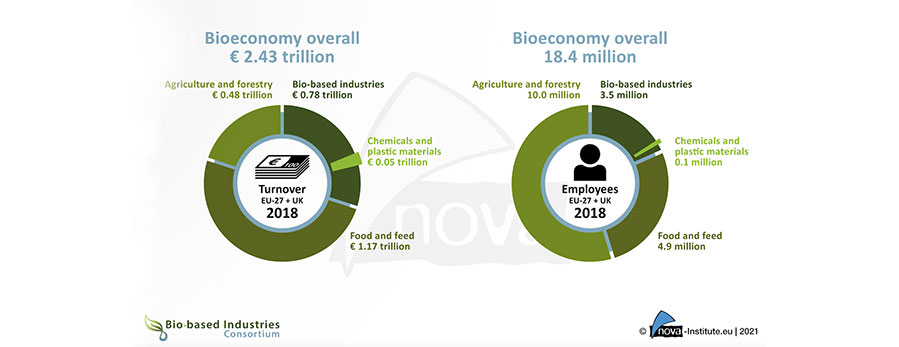
Graphic: Turnover and employees of the Bioeconomy 2018 Source: nova-Institut GmbH
The bio-based industries continue their ascent marking a total contribution of 780 billion EUR, a notable increase of 30 billion EUR (+ 4%) compared to 2017. This represents a more than 20% increase compared to 2008 which is the earliest data taken into account in this series of reports by nova-Institute. The first report of the series was first commissioned by the Bio-based Industries Consortium (BIC) in 2017. Figures for the bio-based chemical industry (including plastics) alone reveal a turnover of around 54 billion EUR with the bio-based share relatively stable at around 15%, up from 7.5% in 2008.

The analysis of the 2018 Eurostat data shows that the turnover of the total bioeconomy*, including food and beverages and the primary sectors of agriculture and forestry, amounts to just over 2.4 trillion EUR in the EU-27 and the United Kingdom, an increase of around 25% since 2008. The food and beverage sector accounts for about half of the turnover, the bio-based industries, such as chemicals and plastics, pharmaceuticals, paper and paper products, forest-based industries, textiles, biofuels and bioenergy account for roughly 30%, while almost another 20% are generated by the primary sectors of agriculture and forestry. 

In contrast to the rising turnover figures, employment in the European bioeconomy has declined slightly from 18.5 million people in 2017 to a total of 18.4 million people in 2018, largely due to efficiency increases in production. The primary biomass production, mainly agriculture, provides a majority of the entire employment (54%) but a comparatively low turnover (20%). 


The data also demonstrates clear differences between groups of Member States. For example, the Central and Eastern European countries of Poland, Romania and Bulgaria are more represented in the lower value-added sectors of the bio-based economy, which create many jobs. This indicates a strong agricultural sector that tends to be labour-intensive compared to the high value-added sectors. In comparison, Western and Northern European countries generate much higher turnover relative to employment, indicating a larger share of refining and value-added industries. The countries with the highest turnover-to-employment ratios are Finland, Belgium and Sweden.

The full report is free of charge and available here:

http://www.renewable-carbon.eu/publications/product/european-bioeconomy-in-figures-2008-2018-pdf/




More News from TEXDATA International

#Techtextil 2026

Performance Apparels: Functional textiles drive innovation at Techtextil 2026

From high-performance fibres and advanced membranes to smart textiles and sustainable material concepts – functional apparel is becoming one of the most dynamic innovation fields in technical textiles. At Techtextil 2026, exhibitors demonstrate how new materials, finishing technologies and digital functions are shaping the next generation of protective, workwear and outdoor systems.

#Texprocess 2026

Texprocess 2026: Automation, digitalisation and AI reshape textile processing

Investment decisions in textile processing have become increasingly complex. Rising energy prices, labour shortages and geopolitical uncertainties are forcing companies to prioritise technologies that deliver measurable improvements in efficiency and process stability. This applies not only to apparel production, but also to the processing of technical textiles and high-performance materials. Modernisation projects are therefore being evaluated more selectively – but the pressure to upgrade production systems continues to grow. Texprocess 2026 reflects this tension between cautious investment behaviour and increasing technological demand.

#Techtextil 2026

Textile Chemicals & Dyes: Innovation in Textile Chemistry moves into focus at Techtextil 2026

From PFAS-free finishes and water-saving dyeing technologies to advanced coatings and recycling-compatible formulations, innovation in textile chemistry is accelerating across the industry. Reflecting this development, Techtextil 2026 introduces Textile Chemicals & Dyes as a dedicated product segment, highlighting the growing role of chemical solutions in shaping the next generation of technical textiles.

#Recycling / Circular Economy

textile.4U publishes special edition “Top 100 Textile Recycling Companies 2025”

With a comprehensive 176-page special edition, textile.4U is dedicating its latest issue entirely to one of the most dynamic and influential topics in today’s textile industry: textile recycling. The new issue, published exclusively in high-quality print, presents the Top 100 textile recycling companies researched and selected by TexData – organizations that already play a key role in the transition to circular textiles or are expected to have a significant impact in the near future.

More News on Sustainability

#Sustainability

Practical toolkit to drive coordinated climate action launched

An open-access workshop toolkit enables brands, suppliers, policymakers and investors across the textile industry to apply the System Map in their own work, identifying leverage points to halve emissions and enable a just transition.

#Raw Materials

Textile Exchange publishes cotton Life Cycle Assessment study to strengthen impact data

Textile Exchange has published the first in a series of seven Life Cycle Assessment (LCA) studies designed to improve the quality and robustness of environmental impact data for raw material production across the fashion, textile, and apparel industry. The first LCA study focuses on cotton and addresses critical data gaps and methodology variability through new high-quality data across key producing countries. The study includes organic, regenerative, recycled, and country averages for conventional cotton production systems, providing a clearer picture of the associated environmental impact.

#Sustainability

Experts publish APAC policy priorities

Cascale today announced the publication of its APAC Policy Priorities Paper, developed by the Asia-Pacific (APAC) Policy Member Expert Team (MET) to identify key regional sustainability challenges and provide practical, aligned recommendations for policymakers and industry stakeholders across Asia-Pacific.

#Sustainability

GOTS version 8.0 released: advanced supply chain accountability, from fibre to finished product

Global Standard is pleased to announce the release of GOTS Version 8.0, the latest update to the world's leading processing standard for organic textiles. The updated Standard strengthens requirements for air emissions and waste management, as well as criteria for product safety. It introduces new provisions on circularity, microfibre management and updates in residue testing. Version 8.0 also elevates due diligence obligations and formalises governance requirements, including ESG disclosure, anti-corruption policies and conflict-of-interest safeguards, to support credible, responsible business conduct.

Latest News

#Techtextil 2026

LineONE – Smart performance, smart investment at Techtextil 2026

At Techtextil 2026 in Frankfurt (April 21–24, Hall 12, Booth C79), AUTEFA Solutions will present its LineONE concepts for cost-efficient nonwoven production. As a full-line supplier for nonwoven production lines, AUTEFA Solutions covers the entire process chain – from fibre opening through to web bonding. With its LineONE line concepts, the company combines proven technologies into well-balanced, cost-efficient turnkey solutions. These concepts are designed for capacity expansions, modernisation projects and new production lines, offering robust design and high flexibility for applications such as filtration, geotextiles and automotive.

#Europe

EU and Australia strengthen relations with Security and Defence Partnership and Trade Agreement

The EU and Australia have today announced the adoption of a groundbreaking Security and Defence Partnership. They have also concluded negotiations for an ambitious and balanced free trade agreement (FTA) and agreed to launch formal negotiations for the association of Australia to Horizon Europe, the world's largest funding programme for research and innovation. With these steps, the EU and Australia are delivering mutually beneficial outcomes and further reinforcing their already close relations in a time of geopolitical uncertainty.

#Technical Textiles

DuPont introduces Tyvek® APX™ 400 protective coverall, setting a new benchmark for extreme breathability

DuPont (NYSE:DD) announced the launch of the Tyvek® APX™ 400 protective coverall, the first in a new generation of extremely breathable disposable chemical protection garments. Manufactured using DuPont™ Tyvek® APX™ groundbreaking fabric, the new garment combines 360° protection and durability with extreme breathability, taking worker comfort and safety to a whole new level.

#Spinning

Graf at EXINTEX – Strengthening presence in Latin America

Graf successfully participated in EXINTEX, one of the leading textile exhibitions in Latin America, together with its local agent Eurotecnica. The exhibition provided an excellent platform to engage with customers, partners and industry experts across the region.

TOP