[pageLogInLogOut]

#Sustainability

Eastman ranked 27th on Barron’s list of 100 Most Sustainable Companies

Eastman (NYSE:EMN) ranks No. 27 on Barron's 2021 list of the Most Sustainable Companies in the United States. To arrive at its list of the 100 Most Sustainable Companies, Barron's analyzed performance by the 1,000 largest U.S. publicly traded companies on a wide range of indicators related to sustainability and environment, social and corporate governance (ESG).

"Eastman is a specialty materials company, but we don't exist to just make materials," said Mark Costa, Eastman Board Chair and CEO. "Eastman exists to live out our company purpose, which is to enhance the quality of life in a material way. We are focused on innovating material solutions that care for society, improving our environment, and making materials circularity a reality by specifically addressing the plastic waste problem. And Eastman is committed to engaging on social issues to build a better society for all."

Barron's collaborated on the list with Calvert Research and Management, which analyzed data in five categories: shareholders, employees, customers, community and planet.  An investment firm that specializes in sustainability and ESG investing, Calvert's data analysis included company scores on distinct topics within those five categories. Those topics included such areas as policies on greenhouse gas emissions, energy use and efficiency, workplace diversity, business ethics, product quality and product safety, lifecycle of products, workplace safety, and others.


In December, Eastman announced aggressive sustainability goals to address three critical impact areas: climate change, materials circularity and caring for society. Eastman plans to achieve carbon neutrality by 2050 to mitigate climate change and plans to reach approximately one-third of this goal by 2030. The company also plans to recycle more than 500 million pounds of plastic waste by 2030 through its molecular recycling technologies. To care for society, Eastman has committed to achieve gender parity in alignment with its commitment to Paradigm for Parity® and will be a leader for racial equity within its industry sector. Eastman's sustainability commitments and innovation strategy are illustrated in its 2020 sustainability report, A Better Circle.?

This is the second time in five months that a major financial publication has ranked Eastman high on a sustainability list. In October, The Wall Street Journal ranked Eastman on its 2020 list of Most Sustainably Managed Companies.

The Barron's list of Most Sustainable Companies is available through subscription at http://barrons.com.



More News from TEXDATA International

#ITM 2026

ITM 2026: The new geography of textile production

New production hubs are emerging across North Africa and Central Asia, while Türkiye is accelerating its transformation toward higher-value, technology-driven and more sustainable textile manufacturing.

#Research & Development

“Production is a product”

From technical textiles and AI-driven robotics to the limitations of textile circularity: Professor Dr Thomas Gries looks back on more than two decades of development at ITA Aachen. In the interview, he explains why production technology remains a decisive success factor, discusses international collaborations and innovation ecosystems, and shares his views on the transformation of production landscapes and the challenges facing an increasingly regulated industry.

#Knitting & Hosiery

“We need to move away from the price trap and return to a value-driven mindset.”

With its new Textile Innovation Center, KARL MAYER is sending a strong signal for innovation, collaboration, and the future of textile applications. In this interview, Karl Josef Mayer discusses new opportunities in warp knitting, the processing of staple fibres, recycling, the changing role of machinery manufacturers, and why the textile industry must once again focus more strongly on the value of textiles. by Oliver Schmidt

#Associations

“Innovation, resilience and international experience remain the great strengths of the Swiss textile machinery industry”

Geopolitical uncertainty, growing competitive pressure from China, new free trade agreements and the shift towards a circular economy are currently reshaping the global textile industry. In this interview, Cornelia Buchwalder discusses the current mood within the Swiss textile machinery sector, the industry’s distinctive innovative strength, new market opportunities in India and Asia, and the technological trends that could shape the upcoming trade fair cycle leading up to ITMA 2027.

More News on Sustainability

#Research & Development

180 years of TESTEX: From Zurich silk testing to global certification

For 180 years, TESTEX has developed alongside the textile industry while maintaining the same underlying purpose: creating trust through independent and reliable measurement. Founded in Zurich in 1846 as the Zurich Silk Conditioning Institute, TESTEX has grown from a local institution serving the silk trade into an international Swiss testing and certification institute for textiles and leather.

#Sustainability

Cascale launches member-led process to shape 2030 strategy

Cascale has launched a member-led process to define the industry alliance’s strategic direction for the next decade. At the Cascale Annual Meeting 2026 in Athens, CEO Ying McGuire announced that members will contribute to an industry system map that will inform Cascale’s 10-year vision, its 2030 strategy and priorities for 2027. The new strategy is scheduled to be finalized in December.

#Sustainability

Jeanologia Sustainability Report highlights environmental impact of textile technologies

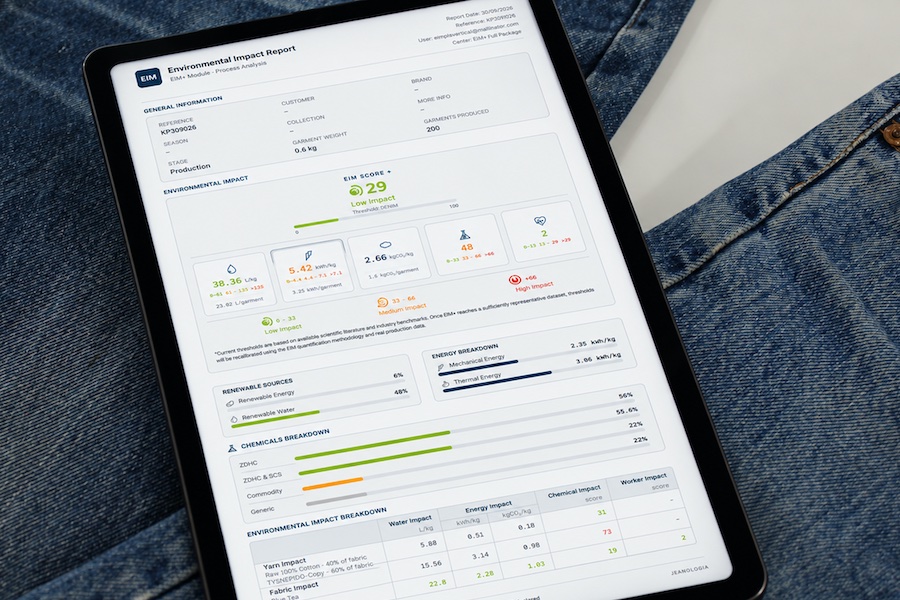
Jeanologia has published its Sustainability Report 2025, reporting a 13.64% reduction in its own carbon footprint and quantifying the environmental impact associated with the use of its technologies across the global textile industry. According to the company’s calculations, their use avoided the pollution of 21.52 million m³ of water and emissions of approximately 103,530 tonnes of CO₂ compared with conventional textile finishing processes.

#Sustainability

Global Standards announce launch of a new textile processing standard

The 14th September 2026 marks the public launch of the Global Responsible Textile Standard (GRTS), a new standard for the processing of textiles made from fibres certified to third-party standards recognised by GRTS and covering a broad range of plant, animal, synthetic, man-made cellulosic and recycled fibres.

Latest News

#Associations

HeiQ & Archroma and Lenzing & Armedangels win ITMF International Collaboration Awards 2026

The International Textile Manufacturers Federation (ITMF) has named two industry partnerships as winners of the ITMF International Collaboration Awards 2026. The awards go to collaborations between HeiQ and Archroma as well as Lenzing and Armedangels, highlighting joint approaches to innovation and sustainability across different parts of the textile value chain.

#Recycling / Circular Economy

Moving Advanced Recycling from Innovation to Implementation

The Advanced Recycling Conference 2026 explores technologies, markets, financing and scale-up of innovative recycling solutions for waste streams including mixed plastic waste, textiles and PVC. Europe’s chemical and materials sector faces growing pressure to close carbon loops, strengthen raw-material safety and resilience and meet increasingly ambitious EU recycling targets. Against this backdrop, the Advanced Recycling Conference (ARC) will bring together industry leaders, technology providers, researchers, innovators and policy-makers on 17–18 November 2026 in Cologne, Germany.

#Associations

German textile industry and retailers form alliance to shape textile EPR system

Germany’s textile and fashion industry and retail sector have joined forces to establish the “Alliance for Textile Circularity” (Allianz für textile Kreisläufe). Initiated by the German Textile and Fashion Industry Association (Gesamtverband textil+mode) and the German Retail Federation (HDE), the alliance aims to contribute industry expertise to the development of Germany’s future Extended Producer Responsibility (EPR) system for textiles and footwear.

#Functional Fabrics

PERFORMANCE DAYS introduces Digital Design Journey with CLO and VIZOO

PERFORMANCE DAYS will introduce a new Digital Design Journey at its upcoming edition in Munich, connecting physical fabric sourcing with 3D product development. Supported by CLO and VIZOO, the installation will demonstrate how real performance fabrics can be digitized and incorporated into virtual garment development workflows.

TOP