[pageLogInLogOut]

#Research & Development

Shorter and faster entry into the textile concrete market possible
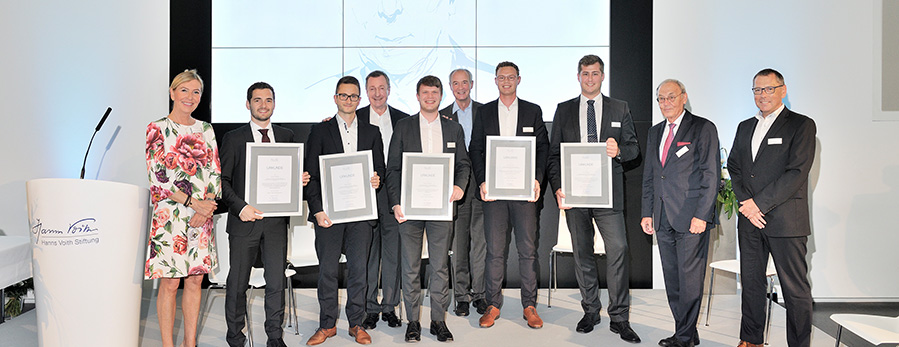
All award winners with congratulators, source: Hanns Voith Foundation
Faster and cheaper entry into the textile reinforced concrete market possible in the future – ITA-doctoral candidate Martin Scheurer wins Hanns Voith Foundation Prize 2019 in the "New Materials" category

ITA-doctoral candidate Martin Scheurer was awarded the Hanns Voith Foundation Prize 2019 in the "New Materials" category on June 28, 2019 in Heidenheim, Germany, with prize money of EURO 5,000. Mr Scheurer receives the prize for his master thesis "Development of a method for evaluating the suitability of textiles for use in textile reinforced concrete". 

In his thesis, Mr Scheurer investigates how textiles can be used in textile reinforced concrete. 

Shorter and faster entry into the textile concrete market possible

So far, testing the suitability of new textiles for use in textile reinforced concrete has been very time-consuming and expensive: The current approval process for textiles in textile concrete requires an intensive testing program of over 50 different tests. With the method developed by Mr Scheurer, only three different tests are necessary to make a good initial assessment of the suitability of textiles for use in textile reinforced concrete. Mr Scheurer now enables companies to find an initial assessment of the suitability of their textiles for use in textile reinforced concrete within a period of approximately one month, which is relatively inexpensive.

Target group for this newly developed method are textile manufacturers who want to enter the growing textile reinforced concrete market.

The use for the textile manufacturers is the lowering of market entrance barriers. An enterprise can find out now fast whether the entrance into the textile reinforced concrete market with existing textiles is possible.

Background

Textile reinforced concrete is a new material with the potential to revolutionize the construction industry. In textile reinforced concrete, the traditional steel reinforcement is replaced by high-performance textiles made of glass or carbon fibres. The use of textile reinforced concrete as a material makes thin concrete elements possible, since the textiles, unlike steel, do not rust and therefore much less concrete has to be used as protection against corrosion.


This saves material, weight and carbon dioxide. Since cement production for the production of concrete causes three times as much carbon dioxide as global aviation, at 6.5 percent of CO2-emissions (source: https://www.bauen-neu-denken.de/en/), the use of textile concrete is considered to be highly environmentally friendly.

In addition, the use of textile concrete allows greater freedom of design due to the simple formability of the textiles and thus offers new architectural possibilities.

Already in 2017 and 2016, the Hanns Voith Foundation Prize was awarded to ITA-doctoral- candidates in the category "New Materials". ITA-doctoral candidate Magdalena Kimm received the award in 2017, ITA-doctoral candidate Inga Noll in 2016.

Since 2013, the Hanns Voith Foundation has awarded the Hanns Voith Foundation Prizes annually to outstanding and innovative final theses of universities and part-time institutions awarding a Master's or Diplom degree. From the 23 master theses submitted, the jury chaired by Prof. Dr Dr e.h. Dr h.c. mult. Sigmar Wittig has awarded five prize winners for their outstanding work in the fields of drive technology, digital ventures, new materials, hydropower, and economics for the seventh time in a row in 2019.

The final thesis must demonstrate a thematic reference to the Group or functional areas of the Voith Group. The universities entitled to submit proposals must assess the thesis as worthy of an award.


More News from Institut für Textiltechnik of RWTH Aachen University (ITA)

#Research & Development

Pellet press enables thermomechanical textile recycling on a pilot scale at ITA

Since the end of 2025, the technical centre of the Institut für Textiltechnik (ITA) of RWTH Aachen University has been equipped with a pellet press from the manufacturer Amandus Kahl GmbH & Co. KG, Reinbek, Germany. This press can efficiently compact shredded synthetic textiles at a throughput of up to 25 kg/h and process them into pellets with a diameter of 4 mm.

#Research & Development

Solid Air Dynamics wins second place at RWTH Innovation Award

On 30 January, RWTH spin-off Solid Air Dynamics was awarded second place in the RWTH Innovation Awards for its research in the field of aerogel fibres. Manufactured from renewable raw materials, aerogel fibres offer outstanding thermal insulation, are extremely lightweight and completely biodegradable, and can consist of over 90 per cent air.

#Research & Development

Award-winning research for sustainable carbon fibre cycles

Sustainable recycling of carbon fibres is possible through targeted electrochemical surface modification, which makes the sizing of carbon fibres resistant to solvolysis. ITA PhD student Sabina Dann was awarded the MSW Award from RWTH Aachen University for her master's thesis on this development. The award ceremony took place on 12 November 2025 in Aachen.

#Research & Development

Kick-off for the Textile Production of the Future: Establishment of a Textile Technology and Development Centre in Mönchengladbach, Germany

The Institut für Textiltechnik (ITA) of RWTH Aachen University, together with its partners, is pleased to announce that it has received approval for its joint initiative, ‘Textile Factory 7.0’. The goal of the project is the establishment of a technology and development centre for the textile industry in Mönchengladbach.

More News on Research & Development

#Composites

STFI at JEC

The Sächsisches Textilforschungsinstitut e.V. (STFI) will present composites for aviation made from recycled carbon fibres and natural fibres, as well as printed lightweight elements for surface heating in electric vehicles at JEC World in Paris.

#Research & Development

Fabolose: Fabricating vegan and circular leather alternatives from bio-tech-derived cellulose

Fabulose is an EU funded project coordinated by the German Institutes of Textile and Fiber Research (DITF). Its consortium consists of leading research institutes, biotech innovators, and industry stakeholders who aim to create high-performance, biobased and recyclable leather-like fabrics, using efficient biotech production routes for bacterial cellulose, cyanophycin and bacterial pigments

#Research & Development

New DIN SPEC assesses environmental impact of textile fragments in soil

Textile products made from synthetic fibres, finished fabrics or dyed materials release fibre fragments into the environment at every stage of their life cycle. With the new DIN SPEC 19296, Hohenstein has developed a standardised testing method to analyse how these fragments behave in soil under natural conditions. Until now, little was known about their environmental behaviour or potential ecological effects once released.

#Research & Development

Testing and research laboratory ensures safe and more sustainable products worldwide

For 80 years, Hohenstein has stood for independent testing, scientific expertise and practical solutions. Today, the testing and research service provider supports manufacturers and brands worldwide in making textiles, hardlines and medical devices safe, more sustainable and market-ready – thereby building trust among consumers. With an international presence and interdisciplinary expertise, Hohenstein supports its customers from production through to market launch, helping them navigate an environment of growing regulatory and societal demands.

Latest News

#Recycled_Fibers

Selenis to double capacity in Portugal by Q3 2027 - Accelerating the Global transition to circular and low-carbon polyesters

Selenis, a global leader in high-performance specialty polyesters and part of the IMG Group, has announced a transformational expansion of its industrial headquarters in Portalegre, Portugal. This strategic investment is set to double the site’s production capacity by the third quarter of 2027, significantly accelerating the industrial scale-up of bio-based, medical-grade, and circular co-polyesters.

#Technical Textiles

Independent testing confirms no detectable PFAS in Milliken firefighter turnout gear fabrics

Independent laboratory testing has confirmed that Milliken fabrics used in the manufacturing of firefighter turnout gear contain no detectable PFAS, based on third-party analysis conducted by Forever Analytical, an independent laboratory specializing in screening products and environmental samples for the presence of per- and polyfluoroalkyl substances (PFAS).

#Home Textiles

Intertextile Shanghai Home Textiles returns in August as global sourcing hub and trend barometer for home textiles industry

Following the conclusion of Heimtextil last month, the flagship fair in Messe Frankfurt’s global home and contract textiles portfolio, Intertextile Shanghai Home Textiles – Autumn Edition will return 18 – 20 August 2026 at the National Exhibition and Convention Center (Shanghai). Building on the momentum generated in Frankfurt, the Shanghai fair will reinforce its position as the foremost home and contract textile platform in Asia – successfully bridging the gap between East and West, and connecting global product trends, supply-chain shifts, and buyer demand in one marketplace.

#Digital Printing

Express Print boosts production using an expanded fleet of Mimaki technologies

Express Print, a fast-growing Bulgarian provider of visual communication and soft signage solutions, has significantly enhanced its production workflow with a comprehensive portfolio of Mimaki digital printing systems. Based in Varna and active for more than 10 years, the company maintains a strong focus on the advertising sector. Over the years, it has steadily expanded its operations, driven by a clear vision to bring the full spectrum of large-format printing services in-house, avoiding outsourcing and ensuring complete control over production quality.

TOP