[pageLogInLogOut]

#Raw Materials

New study shows low environmental impact by Cotton made in Africa Organic Cotton from Tanzania
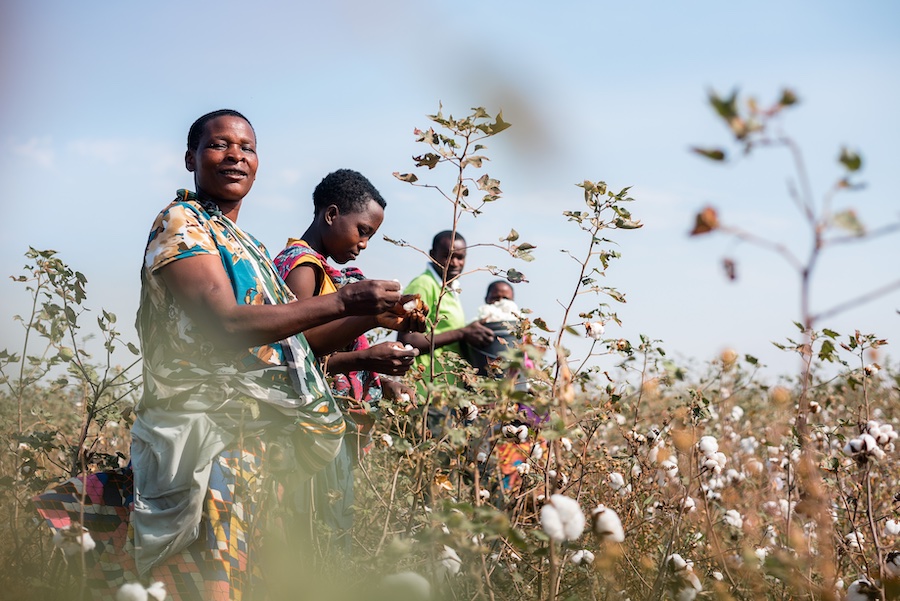
Cotton harvest in Tanzania; Credit_Malicky Stanley Boaz for CmiA
Today, the Aid by Trade Foundation (AbTF) is announcing the results of a comprehensive life-cycle analysis (LCA) for cotton produced in Tanzania under the Cotton made in Africa Organic (CmiA Organic) standard. The study emphasises the small ecological footprint of CmiA Organic verified cotton. This can largely be traced back to the absence of synthetic pesticides, artificial fertilisers, and artificial irrigation. Consequently, CmiA Organic cotton can help the textile industry meet regulatory requirements as well as science-based targets. The results also show that the consequences of climate change threaten the livelihoods of these cotton farmers, even though the type of agriculture they practise barely contributes to climate change.


Part of a larger, critically reviewed LCA from Textile Exchange, the study quantifies the environmental impact of CmiA cotton from Tanzania at all stages from cultivation to ginning, showing that the cotton is produced following an environmentally friendly, rainfed model. This approach is characterised by smallholders completely avoiding the use of mineral fertilisers and synthetic pesticides, only limited mechanisation, and no genetically modified seeds. As a result, ecological threats posed by industrial cotton-production systems—such as fertiliser production or the consumption of what is termed “blue water”[1]—are negligible for CmiA Organic cotton from Tanzania. For example, less than one kilogram of CO2 equivalents is emitted per kilogram of ginned cotton fibres. Biodiversity-promoting measures and natural methods, such as the use of biochar or bokashi, increase soil fertility while protecting groundwater.

CmiA Organic helps the textile industry meet regulatory requirements and science-based targets

Alexandra Perschau, the head of Standards & Outreach at the Aid by Trade Foundation, states, “The LCA provides valuable insights into the environmental performance of CmiA Organic cotton, reaffirming our commitment to transparency and to continuous improvement in environmental protection. Its results underline the inherent sustainability benefits of practising organic farming in accordance with the CmiA Organic standard, which prioritises ecological balance and the well-being of farmers. Fashion brands and textile companies that use CmiA Organic cotton have an opportunity to meet their science-based targets as well as the increasing regulatory requirements for transparency.” “Sourcing Cotton made in Africa Organic supports our transition from conventional cotton to organic cotton production with increased transparency. Collaborations like the one we have with Aid by Trade Foundation are essential in order for us to reach our organic cotton targets,” states Danique Lodewijks, Sustainable Raw Materials Manager at Bestseller.

Climate justice for African smallholders

The result of the LCA study also underlines the issue of climate justice for smallholders in cotton-growing areas. They suffer immensely from the effects of climate change, as droughts, unpredictable precipitation patterns, and torrential rainfall make it difficult to sow, grow, and harvest the cotton plants. The cotton plants are weakened and increasingly affected by pests. Consequently, cotton farmers are finding their livelihoods under existential threat—even though the type of agriculture they practise barely contributes to climate change, as the study now shows. This makes Cotton made in Africa’s holistic approach all the more important. It focusses on preserving biodiversity, maintaining soil health, and protecting natural resources. It also provides comprehensive training, which enables cotton producers to make their farms resilient to climate change, thereby creating a future for themselves, their families, and cotton cultivation as a whole.
More News from Cotton made in Africa (CmiA)

#Raw Materials

International Women’s Day: Cotton made in Africa strengthens equality for women through targeted investments

On the occasion of International Women’s Day—which will be observed on 8 March under the motto “Rights. Justice. Action. For ALL Women and Girls”—the Aid by Trade Foundation (AbTF), which is responsible for Cotton made in Africa® (CmiA), underlines its long-standing and ongoing commitment to the equality of women in African cotton production areas.

#Natural Fibers

Human Rights Day: Cotton made in Africa reinforces its commitment to ensuring respect for human rights in cotton production

The sustainable cotton standard Cotton made in Africa (CmiA) has always focussed on respect for human rights, including by prohibiting child labour and discrimination. With the new version of the CmiA standard coming into force, AbTF raises requirements for due diligence in the areas of human rights and risk management.

#Natural Fibers

Cotton made in Africa launches public consultation for standard revision

The Aid by Trade Foundation (AbTF) is opening public consultation on its Cotton made in Africa standard today. Interested parties will have 60 days to provide feedback, helping shape the future of one of the world’s largest standards for sustainable cotton. The latest update to the standard, Version 5.0, focusses on increasing Cotton made in Africa’s effectiveness and adapting its criteria and indicators to external factors, which currently include biodiversity loss and a growing set of reporting requirements for companies.

#Raw Materials

EUR 2.8 million project for climate-resilient agriculture in Africa

Healthy soils, responsible water use, and biodiversity conservation are central to the efforts of the Aid by Trade Foundation (AbTF) to make African cotton production more resilient to climate change. AbTF has opened new doors for small-scale farming families in Africa through a EUR 2.8 million project for climate-resilient cotton cultivation. Over the last three years, more than 100,000 farmers in Africa were involved in testing various soil improvement measures, with encouraging results: yields on demonstration sites increased significantly, despite the effects of climate change.

More News on Raw Materials

#Raw Materials

Better Cotton Initiative strengthens regenerative focus in standard update

The Better Cotton Initiative (BCI) has strengthened the regenerative focus of its field-level standard with the launch of a new version of its Principles & Criteria (P&C), which marks the next step in the organisation’s journey to becoming a regenerative standards system.

#Raw Materials

Global production expected to decline in 2026/27 as policy shifts and weak demand reshape trade

Early projections for the 2026/27 season indicate that global cotton lint production will decline by 4% to 24.9 million tonnes, while world consumption is expected to remain stable at approximately 25 million tonnes, according to the April 2026 issue of Cotton This Month.

#Raw Materials

Textile Exchange publishes cotton Life Cycle Assessment study to strengthen impact data

Textile Exchange has published the first in a series of seven Life Cycle Assessment (LCA) studies designed to improve the quality and robustness of environmental impact data for raw material production across the fashion, textile, and apparel industry. The first LCA study focuses on cotton and addresses critical data gaps and methodology variability through new high-quality data across key producing countries. The study includes organic, regenerative, recycled, and country averages for conventional cotton production systems, providing a clearer picture of the associated environmental impact.

#Raw Materials

Fashion for Good mobilises industry to adopt mass balance attribution and accelerate decarbonisation

Fashion for Good launches today the Mass Balance Demonstrator project, a collaborative industry initiative to implement and scale the mass balance attribution (MBA) chain-of-custody model for biomass-attributed PET in textile applications. The project represents a concrete step toward accelerating brand-driven decarbonisation across the apparel value chain.

Latest News

#Man-Made Fibers

Selenis and Kintra Fibers partner to scale 100% bio-based synthetic fiber technology

Selenis, a leading global specialty polyester manufacturer, today announced a strategic manufacturing partnership with materials science company Kintra Fibers to scale Kintra’s patented fiber-grade PBS resin - a 100% bio-based and biodegradable material designed for textile applications.

#Functional Fabrics

PERFORMANCE DAYS proves its relevance as the industry’s key meeting point

Held on March 18–19, 2026, PERFORMANCE DAYS once again confirmed its position as a leading international platform for functional textiles. A total of 3.366 trade visitors and around 560 exhibitors gathered in Munich, with the event already kicking off successfully on DAY 0, which received highly positive feedback for its interactive format. Despite challenging conditions caused by the public transport strike in Munich, the event saw strong attendance and a consistently high level of activity across both exhibition days.

#Recycling / Circular Economy

Reju secures €135 Million in Dutch NIKI Funding for industrial-scale textile-to-textile regeneration hub at Chemelot Industrial Park, the Netherlands

Reju™, the progressive textile-to-textile regeneration company, has been awarded €135 million in funding under the Netherlands’ Nationale Investeringsregeling Klimaatprojecten Industrie (NIKI) program. The funding will support Reju’s planned industrial-scale Regeneration Hub at Chemelot Industrial Park in Sittard-Geleen, covering both the investment phase and ongoing operations, and represents a critical milestone on the path toward final investment decision.

#Techtextil 2026

TTL showcases nonwoven and needlefelt solutions at Techtextil 2026

Technische Textilien Lörrach GmbH & Co. KG (TTL), part of the Yanpai Group, will present its latest nonwoven and needlefelt solutions for industrial applications at Techtextil 2026 in Frankfurt.

TOP