[pageLogInLogOut]

#Raw Materials

Better Cotton is mainstream: 10% of world cotton sourced as Better Cotton in 2021
© 2022 Better Cotton
Better Cotton launched its ambitious 2030 Strategy and the first of five impact targets at the end of 2021. Climate change mitigation and adaptation, smallholder livelihoods, soil health, women’s empowerment and pesticide use are critical focal areas where Better Cotton aims to deepen impact over the next decade.

Achieving measurable change at field level will require continued collaboration and commitment from all Better Cotton Members and Programme Partners from across the cotton sector. While all members play their part in contributing to more sustainable practices in cotton farming, Better Cotton Retailer and Brand Members drive progress through increased sourcing of more sustainable cotton.  

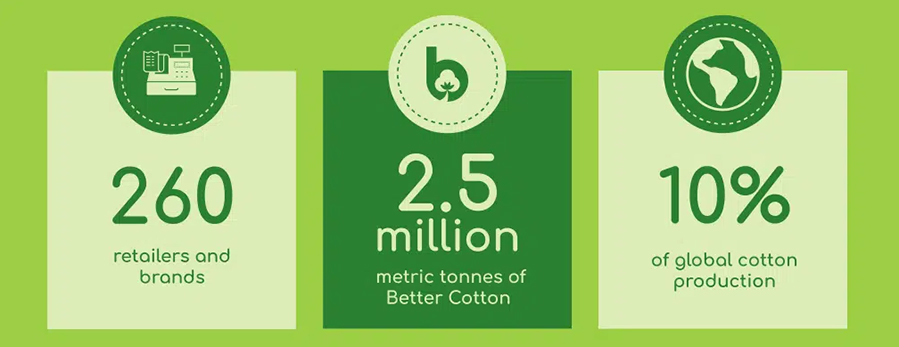
In 2021, 260 of the world’s best-known retailers and brands collectively sourced 2.5 million tonnes of Better Cotton – a record for Better Cotton and the industry. This accounts for 10% of global cotton production1 and represents a 47% increase on 2020 sourcing volumes. This result also marks the end of Better Cotton’s mainstreaming development phase, and transition to its transformation phase. 

Better Cotton’s demand driven funding model means that retailer and brand sourcing of Better Cotton directly translates into increased investment in training on better farming practices for more than 2.7 million cotton producers around the word. By integrating Better Cotton into their raw material sourcing strategies, Better Cotton Members are driving demand for more sustainable farming practices worldwide. 

"IKEA is one of the founding members of Better Cotton and has been investing in the Better Cotton programme since its inception in 2005. We were able to meet our goal of only sourcing cotton from what we classify as ‘more sustainable’ sources in 2015 mainly by sourcing cotton through the Better Cotton programme. We are pleased to continue to support Better Cotton as they aim to achieve deeper impact for cotton farmers and farming communities and seek to make more sustainable cotton the fiber of choice for growers and buyers. Together with other Better Cotton Members, we have been delivering on our sourcing commitments, and today with joint and concerted efforts of everyone, Better Cotton represents 10% of cotton sourced in supply chains, globally. This is a great launch pad for even bigger achievements by 2030, a journey we look forward to being a part of and helping develop even further."

Arvind Rewal, Global Cotton Development Manager, IKEA – Better Cotton Retailer and Brand Member

"Our commitment to better social and environmental practices, as well as demand from our customers, is driving us towards our goal of sourcing more sustainable raw materials for our products. Being a Better Cotton Member is helping us to achieve that goal, as through our membership we are contributing to reducing the environmental impact of cotton farming, as well as improving the safety and well-being of cotton farmers. In 2020, in our first year as a Better Cotton Member, 15% of our cotton came from more sustainable sources, in 2021, that figure was 60%, including Better Cotton."

Valesca Magalhaes, Executive, Sustainability, Riachuelo – Better Cotton Retailer and Brand Member


Whether new to the Better Cotton network, or long-standing members, thousands of organisations across the cotton sector, including retailers and brands, are contributing to transforming cotton: supporting cotton farming communities and driving sustainability in cotton farming. Find all Better Cotton Members.   

"Since 2010, we have been demonstrating the power of public-private partnerships to garner action towards achieving more sustainable development in the cotton sector. The results we see at Better Cotton strengthen our conviction that we, and our members and partners are well placed to continue supporting cotton communities to survive and thrive while protecting and restoring the environment."

Lena Staafgard, COO, Better Cotton

To learn more about the impact of the Better Cotton programme, please see our latest Impact Report. 

1 With global cotton production (ICAC) in 2020-21 cotton season at 24,303,000 MT, Better Cotton Retailer and Brand Member uptake is 10% of global production.
More News from TEXDATA International

#ITM 2026

ITM 2026: The new geography of textile production

New production hubs are emerging across North Africa and Central Asia, while Türkiye is accelerating its transformation toward higher-value, technology-driven and more sustainable textile manufacturing.

#Research & Development

“Production is a product”

From technical textiles and AI-driven robotics to the limitations of textile circularity: Professor Dr Thomas Gries looks back on more than two decades of development at ITA Aachen. In the interview, he explains why production technology remains a decisive success factor, discusses international collaborations and innovation ecosystems, and shares his views on the transformation of production landscapes and the challenges facing an increasingly regulated industry.

#Knitting & Hosiery

“We need to move away from the price trap and return to a value-driven mindset.”

With its new Textile Innovation Center, KARL MAYER is sending a strong signal for innovation, collaboration, and the future of textile applications. In this interview, Karl Josef Mayer discusses new opportunities in warp knitting, the processing of staple fibres, recycling, the changing role of machinery manufacturers, and why the textile industry must once again focus more strongly on the value of textiles. by Oliver Schmidt

#Associations

“Innovation, resilience and international experience remain the great strengths of the Swiss textile machinery industry”

Geopolitical uncertainty, growing competitive pressure from China, new free trade agreements and the shift towards a circular economy are currently reshaping the global textile industry. In this interview, Cornelia Buchwalder discusses the current mood within the Swiss textile machinery sector, the industry’s distinctive innovative strength, new market opportunities in India and Asia, and the technological trends that could shape the upcoming trade fair cycle leading up to ITMA 2027.

More News on Raw Materials

#Natural Fibers

Better Cotton Initiative multistakeholder event in US unpacks regenerative agriculture potential

The Better Cotton Initiative (BCI), in collaboration with Texas-based partner, Quarterway Cotton Growers, will expand upon its annual US field event to relay the vast potential of regenerative agriculture through an immersive experience of tours and demonstrations.

#Sustainability

The first widely accessible Life Cycle Assessment study for cashmere production published by Textile Exchange.

Crucial new data to better understand, measure, and address the impacts of cashmere production has been made available to the fashion, textile, and apparel industry through a new Life Cycle Assessment (LCA) published by Textile Exchange.

#Natural Fibers

"Review" examines the outlooks for seven major cotton producers

The newest issue of Cotton: Review of the World Situation provides an in-depth look at how seven important cotton-producing countries are responding to changing markets, rising production costs, climate pressures, evolving technologies, and growing demands for quality and sustainability.

#Raw Materials

AMSilk and Ajinomoto Foods Europe expand partnership to enable industrial-scale production of silk proteins

AMSilk GmbH (“AMSilk”), a global leader leader in biotech produced silk materials, today announced a significant expansion of its partnership with Ajinomoto Foods Europe (AFE), marking a key step in scaling the industrial production of its silk proteins. Building on the collaboration first established in 2023, the two companies have now entered into a long-term manufacturing and supply agreement, enabling the transition from industrial validation to dedicated, large-scale production.

Latest News

#Spinning

Rieter sees Barmag integration on track as orders and sales rise

The first half of 2026 was shaped by the successful completion of the largest acquisition in Rieter’s history. The Man-Made Fiber Division enables entry into the growth segment of man-made fibers and sustainably strengthens Rieter’s market position in the Asia region. The expanded Group is now the world’s leading system supplier for the processing of natural and man-made fibers. In the first half of the year, initial cost savings in material costs and operating expenses have already been realized. The targeted synergies are expected to amount to at least CHF 20 million by the end of the 2028 financial year. Due to the completion of the acquisition on February 2, 2026, the first half of the year for the Man-Made Fiber Division only amounts to five months.

#Knitting & Hosiery

Groz-Beckert at Igatex 2026

From October 15 to 18, 2026, Groz-Beckert will present its latest innovations and solutions across the product areas of Knitting, Weaving, Sewing and Spinning at Igatex in Pakistan (Hall 1, Booth A-1-08).

#Sustainability

bluesign appoints Hanane Taidi as CEO to lead next phase of global impact

bluesign, which partners with the textile industry to reduce adverse impact across the value chain, appoints Hanane Taidi as Chief Executive Officer, marking a pivotal moment as the company builds on its leadership amid rapid industry change.

#Textiles & Apparel / Garment

C&S strengthens its governance to support its evolution

C&S announces the appointment of Marco Lucietti to its Board of Directors. With extensive international experience across the textile and denim industries, Lucietti will work alongside CEO Federico Corneli, contributing to the company’s managerial development, organizational structure and long-term strategic direction.

TOP