[pageLogInLogOut]

#Sustainability

bluesign technologies introduces bluepass

A new certification mark designed to meet global standards for verified sustainability claims
© 2026 bluesign
bluesign technologies ag (www.bluesign.com) today announces the launch of bluepass, a new certification mark and product labeling system created to deliver clear, substantiated, and verifiable sustainability claims at scale.

Developed in close collaboration with bluesign System Partner companies and informed by emerging EU regulatory requirements, bluepass replaces the existing bluesign® PRODUCT and bluesign® APPROVED designations with a unified certification framework designed for both consumer-facing transparency and regulatory compliance.

“At a time when sustainability claims are under increasing scrutiny, the industry needs clarity, consistency, and proof,” said Barbara Oswald, Chief Commercial Officer at bluesign. “bluepass now provides our over 900 global System Partner companies a standardized way to communicate verified performance, grounded in real production processes and supported by accessible data.”


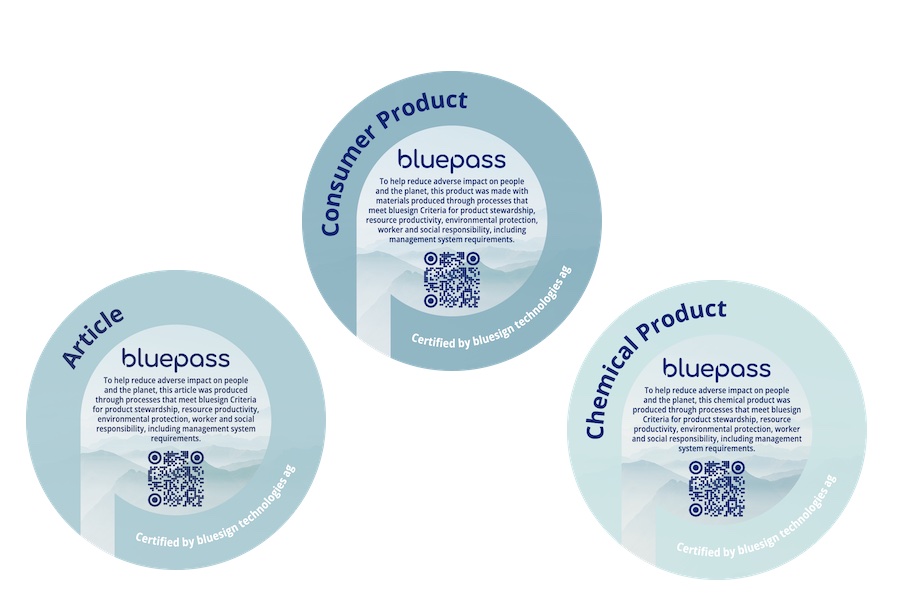
(bluesign's bluepass marks for articles, chemcial products and consumer products)


The launch comes as brands prepare for the Empowering Consumers for the Green Transition Directive (ECGT) , which introduces new requirements for environmental claims. Beginning September 27, 2026, all consumer-facing sustainability claims in the EU must be substantiated with accessible, verifiable evidence.

bluepass (www.bluesign.com/what-is-bluesign-approved) has been designed to meet these requirements through a standardized label structure that combines a certification mark, fixed claim language, and a QR code linking to a bluesign-controlled verification platform.

The directive places stricter requirements on environmental claims, including labels that are not based on independently verified certification.

bluepass responds directly to this shift, providing a globally consistent certification mark that separates verified performance from unsubstantiated or self-defined claims.

The bluepass system identifies products, materials, and chemical inputs produced through processes that meet the bluesign Criteria across six areas of responsibility, including environmental protection, resource productivity, and worker and social responsibility.

bluepass introduces three certification marks aligned to different stages of the value chain:

  • bluepass consumer product for finished goods
  • bluepass article for intermediate materials and components
  • bluepass chemical product for chemical inputs

Each label follows a standardized structure that may include the certification mark, a defined text claim, a QR code linking to verified data, and a unique certification ID, ensuring consistency and traceability across all applications.

“When a consumer recognizes and scans a bluepass label, they are not just seeing a claim, they are accessing the verified information behind it,” added Oswald. “That level of transparency is becoming the expectation, not the exception.”

When scanned, the QR code directs users to a bluesign-managed verification page that provides detailed certification information, including how the product meets bluesign Criteria and how the underlying processes have been assessed.

This approach connects on-product communication with deeper supply chain data, creating a direct link between what is claimed and what is verified.

bluepass will be implemented across bluesign’s global network of more than 900 System Partners, including brands, manufacturers, and chemical suppliers, enabling consistent use of verified claims across the textile value chain.

As adoption expands, bluepass is positioned to serve as a global standard for how sustainability is communicated, one that aligns with current regulatory requirements while preparing the industry for future frameworks, including digital product passports and enhanced claim verification.

For brands and manufacturers, bluepass provides a structured framework for substantiating environmental claims that aligns with both current and anticipated EU regulatory requirements. By using bluepass marks on products, materials, and chemical inputs, partners can demonstrate verified performance to consumers, supply chain partners, and regulators through a single, standardized system.

“The industry is moving toward evidence-based communication,” said Oswald. “bluepass gives brands the structure to meet that expectation with confidence, while maintaining the integrity of the data behind every claim.”

The introduction of bluepass reflects a broader transition across the sector, as sustainability moves from marketing-led narratives to systems grounded in verified, primary data.

bluepass is now available to bluesign System Partner companies. Brands and manufacturers can find more information about implementation timelines and certification requirements at bluesign.com/verify.


More News from bluesign technologies ag

#Sustainability

Storm Creek achieves bluesign® PRODUCT status

Storm Creek (ASI#/PPAI#) is proud to announce a meaningful sustainability milestone: the company has achieved bluesign® PRODUCT status: becoming the first US-based supplier in the promotional products industry to earn this globally respected certification. While this marks an industry first, for Storm Creek, it represents something far more important: a continuation of doing what they believe is right.

#Sustainability

bluesign® celebrates 25 years as a global leader in sustainable textile innovation

2025 marks a pivotal milestone for bluesign, the global authority in sustainable chemical and environmental management for the textile and fashion industry, as it celebrates 25 years of advancing cleaner, safer, and more responsible manufacturing practices across the global supply chain.

#Sustainability

bluesign releases 2025 revisions of its Chemical Reference Lists

Effective July 1, 2025, bluesign has published updated versions of its three core chemical reference lists: the bluesign® SYSTEM SUBSTANCES LIST (BSSL v16.0), the bluesign® SYSTEM BLACK LIMITS (BSBL v7.0), and the bluesign® RESTRICTED SUBSTANCES LIST (RSL v16.0). These updates reflect bluesign’s ongoing commitment to safe chemical management, environmental protection, and regulatory alignment.

#Sustainability

bluesign to showcase sustainable textile solutions at Intertextile Shenzhen and Shanghai 2025

The global authority on sustainable textile production and chemical management, bluesign is pleased to announce its participation as an exhibitor at both Intertextile Shenzhen (June 11 - 13, 2025) and Intertextile Shanghai Apparel Fabrics - Autumn Edition (September 2 - 4, 2025), marking the company's inaugural collaboration with these leading global textile trade fairs.

More News on Sustainability

#Sustainability

A new standard to combat plastic waste in forests

With DIN SPEC 35808 “Tree Shelter for Forestry Applications,” the testing and research service provider Hohenstein, in collaboration with Rottenburg University of Forestry, as well as forestry authorities and industry partners, has established a clear framework for bio-based and fully biodegradable tree shelters. The pre-standard defines requirements and practical testing methods designed to reduce plastic waste in forests and strengthen the long-term protection of soil and the environment.

#Denim

Denim moves towards sustainability

EIM (Environmental Impact Measurement), the global reference platform for measuring the environmental impact of garment finishing, presents the second edition of its annual report Denim Industry Progress & Insights 2025. The study analyses over 100,000 real denim finishing processes, providing an accurate and up-to-date view of the industry’s evolution towards more sustainable models.

#Recycling / Circular Economy

Europe’s textile future at a turning point: New 2030 Circularity Blueprint aims to scale recycling and unlock investment opportunities

The EU textile system is at a critical crossroads. Today, less than 1% of discarded garments are recycled into new garments, despite EU-wide obligations for separate collection. In response, Global Fashion Agenda (GFA) is launching the 2030 Circularity Blueprint, in partnership with ReHubs. This ambitious initiative is designed to support the transformation of the EU textile ecosystem to advance textile-to-textile recycling and drive the transition to a circular economy.

#Sustainability

Number of GOTS-certified facilities grow 15% globally as demand for credible sustainability standards continues to strengthen

Global Organic Textile Standard (GOTS) certification continued to grow in 2025, with nearly 18,000 certified facilities worldwide, despite ongoing geopolitical uncertainty and rapidly evolving regulatory requirements across global textile supply chains.

Latest News

#ITM 2026

Groz-Beckert brings new knitting, weaving and nonwovens technologies to ITM 2026

From June 9 to 13, 2026, Groz-Beckert will present its latest innovations and solutions across the product areas of Knitting, Weaving and Nonwovens at ITM in Istanbul (Hall 3, Booth 304B).

#ITM 2026

Itema to showcase weaving excellence at ITM 2026

From June 9 to 13, Itema will exhibit at ITM 2026 in Istanbul (Hall 8 – Stand 806D), unveiling a distinctive exhibition concept designed to highlight the Company’s expertise across the entire weaving value chain. For this year’s edition, Itema will introduce an innovative stand experience built around two core areas: advanced weaving and spare parts solutions and an immersive textile gallery featuring fabrics produced by Itema Customers worldwide.

#Textiles & Apparel / Garment

Global size study for brands and retailers to optimize fit and market coverage

Hohenstein Apparel Fit Solutions, a global leader in apparel fit, sizing, and product development, today announces the launch of its Global Size Study, a new initiative designed to equip brands to better understand and serve their target consumers through more accurate, market-relevant sizing.

#ITMA 2027

Last chance to apply: ITMA 2027 Start-Up Valley closes tomorrow

Applications for the Start-Up Valley at ITMA 2027 close tomorrow, offering young technology companies the opportunity to follow in the footsteps of several successful participants from the 2023 edition. The initiative, organised under the CEMATEX Start-Up Grant programme, has already helped a number of textile start-ups accelerate their transition from early-stage concepts to industrial partnerships, funding rounds and commercial deployment.

TOP