[pageLogInLogOut]

#Associations

Automation for Brazil: TMAS at Febratex

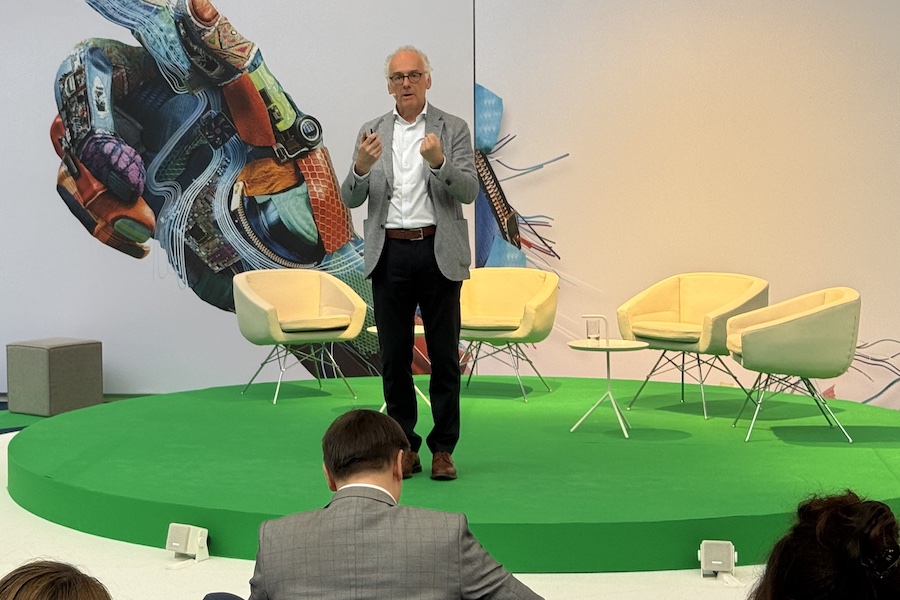
(c)2022 TMAS - Texo AB wide-width weaving machines for the production of paper machine clothing (PMC)
A delegation from TMAS, the Swedish textile machinery association, will participate in the forthcoming Febratex textile show which is being held in the German Village Park in Blumenau, in Santa Catarina, Brazil from August 23-26.

As the fourth largest textiles manufacturer in the world, Brazil’s annual revenues from textiles and apparel amount to an annual $48 billion and the industry employs around 1.5 million people directly.

“Brazil produces around 3.1 billion apparel items each year, largely based on its strong position in cotton, and there is a tremendous interest in new textile technologies that can enhance productivity,” says TMAS Secretary General Therese Premler-Andersson. “There are also over 100 textile schools and colleges, which illustrates the opportunities that are perceived in the industry’s future.”

Closer to customers

As with the USA and many European countries, product shortages resulting directly from the Covid-19 pandemic, and subsequent supply chain difficulties, have emphasised to Brazil’s industry the attractiveness of more diversified and shorter supply chains which are closer to customers wherever possible. In the past two years, there has been less reliance on imports from Asia to Brazil, and opportunities are arising again for local manufacturing.

Svegea of Sweden has supplied many automatic collarette cutters to Brazilian companies, which are used by garment manufacturers around the world for the production of tubular apparel components such as cuff and neck tapes and other seam reinforcements.

The company’s latest EC 300 machine has an output of around 20,000 metres per hour and is equipped with the latest E-Drive 2 system, providing the operator with a very user-friendly touchscreen, providing full control of the cutting process.

“A key function is the ability to ensure perfect synchronization of the tubular fabric between the machine’s turntable platform and its upper cutting body,” explains Svegea Managing Director Håkan Steene. “Advances in automation are only making the specialised, bespoke machines we engineer even more efficient. The garment components our collarette cutters produce make it logical for them to be integrated into the operations of making-up operations wherever they are, and at the moment we’re seeing a lot of interest in the reshoring of operations by our customers.”

Svegea supplies many other bespoke machines for applications in the production of both garment components and technical textiles, including rewinding, measuring, inspection and band knife machines.

Automated production

Eton Systems, the inventor and world’s leading provider of automated production systems for apparel and other textile-based processes, has supplied thousands of workstations to Brazilian companies over the years, and believes its newly-launched Opta system is good news for this market.

“When we started designing the Opta System, our main goal was to honour our roots,” explains Managing Director Jerker Krabbe, who knows the market well, having lived in Brazil for a number of years. “The Opta System is here to help businesses in the fashion industry to become more efficient and profitable.”

Producing garments for a fast-moving consumer market requires short throughput times and low cost of quality to maintain profitability, he adds.

Optmised software

The Opta system keeps all of the key features that garment manufacturers need.

“What we’ve added are more station types and optimised software,” Krabbe says. “With three kinds of stations, supporting dual transporting rails, connecting bridges between lines and buffer stations, Opta provides even greater flexibility for future extension. The software contains all the key features a garment manufacturer could need and our goal is that customers will have complete control throughout their value-adding chains. Transparency in operations is key.”

Industry transition

Automation is also high on the agenda of ACG Kinna Automatic, which specialises in automation solutions for filled products such as quilts, pillows and mattresses and also has extensive knowledge in areas such as bed linen and textile filters.

“It has become evident over the past few years that a higher level of automation across the entire textile and apparel supply chain is the key to higher efficiency, productivity and performance,” says CEO Christian Moore. “What we’re seeing now is the emergence of companies bringing back production to local factories which are closer to the consumer and eliminate many of the transportation costs which have rocketed recently, as well as being able to produce on demand. Everything is now about digitalisation and automation and ACG Kinna Automatic is well placed to assist in this industry transition.”

Looms build to last

Given Brazil’s extensive forestry sector, the country is a key market for Texo AB, one of the world’s leading manufacturers of weaving machines for the production of paper machine clothing (PMC).

All paper manufacturing machines require a regular supply of PMC, which as large continuous engineered fabrics, carry the paper stock through each stage of the paper production process. With technologically sophisticated designs, they employ fibres and other polymeric materials in complex structures and each paper machine has an average of ten separate fabrics installed on it. Although the PMC business represents just a small proportion of the total cost of manufacturing paper, it can have a significant impact on the quality of the paper, the efficiency of a machine and machine production rates.

“Brazil is the second largest pulp producer in the world after the United States, accounting for more than 11% of global production, and also among the ten largest paper-producing countries in the world,” says Texo President Anders Svensson. “Our looms are built to last, and in addition to supplying new machines, we are currently very active in the retrofitting of many existing machines out in the market. These machines are rigid and strong and we are still supporting many of them with mechanical spare parts. They can, however, also be equipped with the latest technology for automation. With new controls, drives and motors they can perform as well as the latest machines. We look forward to discussing the possibilities with customers old and new at Febratex.
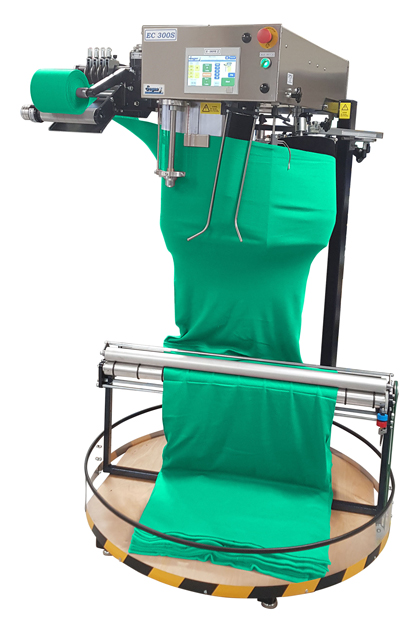







Svegea of Sweden’s latest EC 300 automatic collarette cutter has an output of around 20,000 metres per hour.


Eton Systems will introduce its latest Opta automation system for fast-moving apparel and other textile products.<br />
Eton Systems will introduce its latest Opta automation system for fast-moving apparel and other textile products.


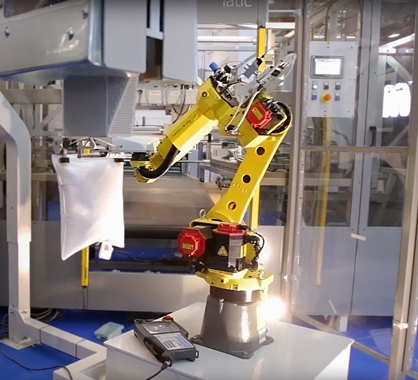
Robotic pillow-making system from ACG Kinna Automatic.


Texo AB wide-width weaving machines for the production of paper machine clothing (PMC).


More News from TEXDATA International

#Recycling / Circular Economy

textile.4U publishes special edition “Top 100 Textile Recycling Companies 2025”

With a comprehensive 176-page special edition, textile.4U is dedicating its latest issue entirely to one of the most dynamic and influential topics in today’s textile industry: textile recycling. The new issue, published exclusively in high-quality print, presents the Top 100 textile recycling companies researched and selected by TexData – organizations that already play a key role in the transition to circular textiles or are expected to have a significant impact in the near future.

#Recycling / Circular Economy

Responsible Textile Recovery Act of 2024 signed by Governor

Senator Josh Newman (D-Fullerton) is proud to announce that Senate Bill 707 (SB 707), the Responsible Textile Recovery Act of 2024, has been signed into law by the Governor of California, Gavin Newsom. This groundbreaking legislation establishes the country’s first Extended Producer Responsibility (EPR) textile recycling program, marking a significant step forward in the state’s efforts to combat waste and promote sustainability.

#Textiles & Apparel / Garment

Modtissimo promotes sustainability with 28 coordinates in the Green Circle

Modtissimo is proving more and more to be a textile and clothing show that delivers the latest innovations in the area of sustainability, with the iTechStyle Green Circle being the main showcase for companies' creations. In this 60+4 edition, taking place on 12 and 13 September, 28 coordinates will be exhibited in a section organised by CITEVE and curated by Paulo Gomes.

#Europe

The EU and Egypt team up to mobilise private sector investments at Investment Conference and sign a Memorandum of Understanding underpinning €1 billion in macro-financial assistance for Egypt

At the EU-Egypt Investment Conference, co-organised by the EU and the Government of Egypt on 29-30 June, the EU and Egypt are teaming up to intensify private sector investments in Egypt. They are also signing a Memorandum of Understanding (MoU) for the disbursement to Egypt of up to €1 billion in Macro-Financial Assistance.

More News on Associations

#Associations

Industry associations warn against state-run EPR models in the EU

European industry associations, led by Euratex, have raised concerns over a growing trend in several EU Member States to introduce state-run Producer Responsibility Organisations (PROs) within Extended Producer Responsibility (EPR) schemes.

#Associations

European business associations celebrate the signature of the EU-Mercosur FTA

The 17th January marks a historic milestone with the signing of the EU-Mercosur Trade Agreement, creating the biggest trading block in the world. European business – represented by more than 28 associations across a wide range of sectors – warmly welcomes this signature. It sends a strong and timely signal that the EU remains open and is committed to rules-based global trade. In a time of global uncertainty, this agreement is a key growth booster.

#Associations

INDA announces future dates and locations for FiltXPO™ and IDEA® events

INDA, the Association of the Nonwoven Fabrics Industry, announced the future dates and locations for its FiltXPO™ and IDEA® events, reaffirming its long-term commitment to serving the global filtration, nonwovens, and engineered materials communities.

#Associations

Latest news from Bremen: ICAC Plenary Meeting to take place right before the International Cotton Conference

The International Cotton Advisory Committee (ICAC) will hold its 83rd Plenary Meeting on 23–24 March 2026 at the Parliament building in Bremen. The meeting will take place immediately ahead of the 38th International Cotton Conference Bremen (25–27 March 2026) and marks a historic premiere: for the first time, the ICAC Plenary will be hosted in close cooperation with the Bremen Cotton Exchange and the Faserinstitut Bremen e.V. (FIBRE).

Latest News

#Digital Printing

Epson launches SureColor G9000: high-production Direct-To-Film printer delivering greater productivity and reliability

Epson today announces the launch of the SureColor G9000, a new high-production Direct-To-Film (DTFilm) printer designed to meet growing global demand for flexible and efficient textile transfer printing. Expanding Epson’s DTFilm line-up alongside the SC-G6000, the SC-G9000 introduces enhanced speed, reliability and ease of maintenance for commercial garment decorators and textile producers.

#Nonwoven machines

Three ANDRITZ spunlace lines start operating at Alar Silk Road New Materials in China

Alar Silk Road New Materials and ANDRITZ have successfully commissioned three spunlace lines in crosslapped configuration at Alar’s facility in Aral City, Xinjiang, China.

#Raw Materials

Better Cotton Initiative opens enrollment in the US with promising opportunities for producers

Producer enrollment for the US Program of the Better Cotton Initiative (BCI) is open until May 15 for the 2026-2027 season. With over 2,600 members spanning the cotton supply chain and more than 11,000 users of its Better Cotton Platform (BCP) as of 2025, BCI’s standard is implemented in 15 countries and covers one fifth of global cotton production.

#Knitting & Hosiery

SHIMA SEIKI to exhibit at GMMSA Expo India

Leading Japanese computerized flat knitting technologist SHIMA SEIKI MFG., LTD. of Wakayama, Japan, together with its Indian sales representative Universal MEP Projects & Engineering Services, Ltd., will participate in the upcoming Garments Machinery Manufacturers & Suppliers Association (GMMSA) Expo India 2026 exhibition to be held in Ludhiana, India next month. Through its lineup at GMMSA, SHIMA SEIKI aims to further strengthen its presence within the Indian market with an exhibit that caters to diverse needs, consisting of seam-free WHOLEGARMENT® knitting technology as well as a brand-new shaping machine with high productivity and excellent cost performance.

TOP