[pageLogInLogOut]

#Denim

Sustainable Denim: Itema brings its iSAVER® to the Denim Premiere Vision

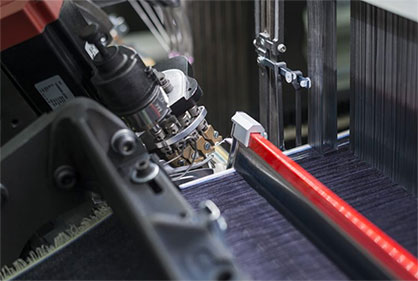
Itema, worldwide leading manufacturer of advanced weaving solutions, exhibits at Denim Première Vision (Milan, Superstudio Più, 13 and 14 October 2021, booth F6) the mechatronic device iSAVER® that, unique in the sector, allows to denim weavers to save up tp 1.000 Kg of cotton per loom per year thus avoiding to waste circa 20 million of liters of water. An innovation 100% made-in-Italy, iSAVER® is already present in the biggest denim weaving mills in China, Vietnam, Turkey, Egypt, Italy and South America.

Denim is one of the most popular fabrics in the world, with 3.5 billion garments produced every year. The denim manufacturing process, which absorbs about 35% of world cotton production and moves a global market that reached 21.8 billion dollars in 2020, has a strong environmental impact. In fact, it is estimated that 3,800 liters of water and 18.3 kWh of electricity are needed to make a single pair of jeans, generating emissions of 33.4 kg of CO2 during the entire life cycle of the product1. 
© 2021 Itema
© 2021 Itema


“The entire textile supply chain is constantly looking for ideas and solutions, to improve the sustainability of production processes, by innovating technologies and processing systems to reduce waste, water and electricity consumption ", stated Ugo Ghilardi, CEO Itema Group. “With iSAVER® we have brought an excellent solution to the market, which makes the difference because it allows denim weavers and fashion brands to offer a finished product with a much lower ecological footprint. We are the only textile machinery manufacturer to participate as an exhibitor at Denim Première Vision precisely by virtue of the uniqueness of our technology and the contribution it makes to the production of sustainable denim".


© 2021 Itema
© 2021 Itema


iSAVER® eliminates the waste selvedge on the fabric left-hand side by inserting the weft without the need of additional yarns, thus significantly reducing raw materials and water wastage. The device has been designed and developed by Itemalab®, the Itema Group company dedicated to product and process innovation for the whole industrial sector. Located inside the Kilometro Rosso Innovation District in Bergamo, the company employs around 70 engineers and specialists. 


More News from ITEMA S.p.A.

#Weaving

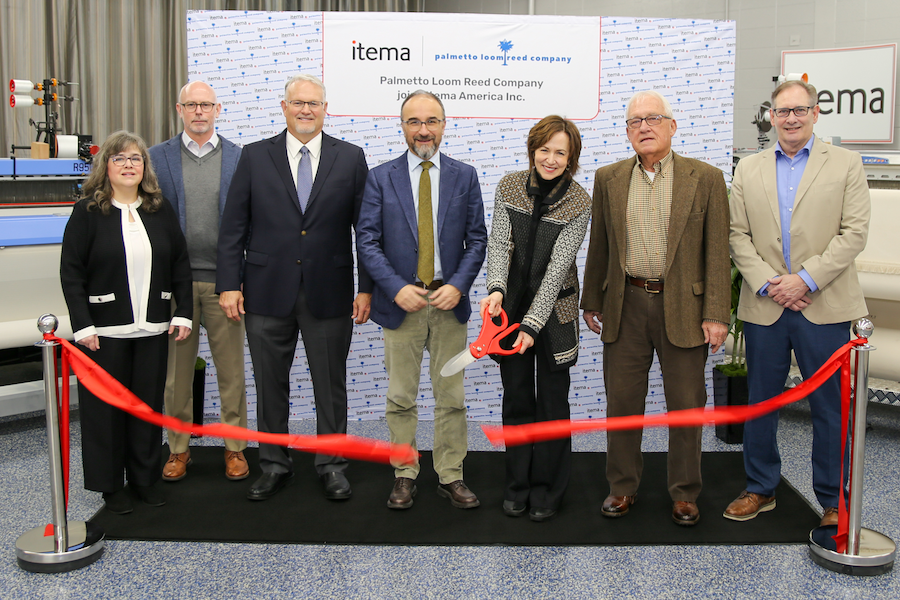
Itema America acquires Palmetto Loom Reed, strengthening local manufacturing and service in the U.S.

Itema America, the U.S. subsidiary of Italy-based Itema Group, has acquired – through an Assets Purchase Agreement – Palmetto Loom Reed, a Greenville, South Carolina-based manufacturer of weaving reeds and one of the last remaining domestic producers of these precision components in the United States.

#Weaving

Itema exhibits the two best-selling high-end rapier weaving machines of the Region, R9500EVO and Galileo-RX at SITEX 2026

Following the opening of its new Surat Service Center in November, Itema will exhibit at SITEX (Stand 286) from February 21st to 23rd at the Surat International Exhibition and Convention Centre (SIECC). Surat has long been one of Itema’s most strategic markets, a role further reinforced by the inauguration of the Surat Service Center last November. Equipped with an advanced electronic repair center, a weaving machine behavior simulator, and a local spare parts warehouse, the new facility strengthens Itema’s presence in the region while bringing the company even closer to its Customers.

#Weaving

Itema announces strategic partnership with Ivy Decarb to accelerate decarbonization in weaving process

Itema is pleased to announce the strategic partnership with Ivy Decarb, the digital platform helping textile companies measure and reduce their carbon footprint.

#Weaving

Itema opens Surat Service Center to strengthen support for Indian weavers

On November 26, Itema has officially inaugurated its new Surat Service Center during a ceremony attended by customers and partners from across the region.

More News on Denim

Latest News

#Composites

KARL MAYER strengthens partnerships in the composites industry at JEC World 2026

KARL MAYER further strengthened its role as a reliable and competent partner to the composites industry at JEC World 2026. The global market leader in textile machinery manufacturing used the trade show to meet key customers, establish numerous new contacts, and engage in in-depth technical discussions.

#Recycling / Circular Economy

ABB and Syre partner to explore technologies for industrial-scale textile recycling

ABB has signed a Memorandum of Understanding (MoU) with Swedish textile impact company Syre to jointly explore technologies to support the development of Syre’s first textile-to-textile recycling plant in Vietnam. The agreement establishes a framework for collaboration to investigate how ABB’s automation, electrification and digital technologies could contribute to safe, efficient and scalable operations. It will also explore how these capabilities could further optimize process and quality control performance as Syre advances its ambition to produce circular polyester at industrial scale.

#Techtextil 2026

From Nature Performance to Circular Economy: Techtextil 2026 focuses on the future market for technical textiles

Alternative materials and recycling technologies are one of the most important future segments and drivers of innovation in technical textiles. Sustainability goals and regulatory requirements increase their relevance, while advances in performance and economic viability enhance their market competitiveness. Taking place from 21 to 24 April 2026, Techtextil reflects this key industry trend with a growing number of specialised exhibitors. With the new “Nature Performance” label, the leading global trade fair bundles relevant market offerings and facilitates access to new solutions – from natural fibres and yarns to bio-based materials and circular approaches.

#Research & Development

Textile cascade filter for removing microplastics from wastewater

Microplastics are now found almost everywhere, even in remote regions of Antarctica. They enter the human body through the food chain. Studies indicate that microplastics may have negative effects on the human health.

TOP