[pageLogInLogOut]

#Yarn & Fiber

Inspiring Everyday: Learning new skills means growing with the company

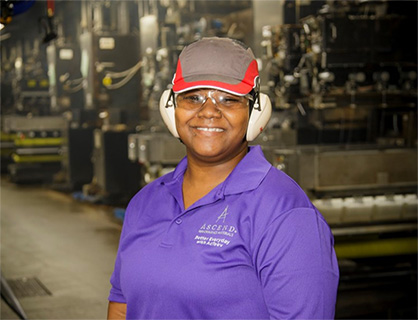
Focused and with clipboard in hand, Shalanda Palmore walks onto the Greenwood site to start her shift. On the way to the machine she operates, Shalanda notices a tool left out in another area. She takes a moment to put the tool in its proper place. Then she investigates further and writes down if the area needs any possible improvements. This is the no-nonsense approach to safety that Shalanda brings to work every day.

Shalanda, a spinning operator in the industrial fibers department, can be seen helping across the site. When Shalanda passes a machine, she checks for out-of-place tools and tripping hazards. 

“Shalanda has learned many different areas of the plant” says Michael Walters, senior site director at Greenwood. “When machines need to be fixed, Shalanda is able to get them up and running again. Shalanda does this not because she is asked, but because she wants to help others and the site.”

Recently, there was a loss of power in the draw jet area, where nylon polymer is turned into carpet fiber. With Shalanda’s experience in draw jet, she was able to help restring the lines and get the equipment running again.

“This is not just a job to me,” says Shalanda. “Ascend is a place where I want to grow. I continue to learn more so I can help where I can and be valuable to the site.”

Shalanda’s constant learning began as a kid. “My mom always wanted me to keep my mind active,” says Shalanda. “If I wasn’t reading a book, she had me doing crossword puzzles.”

For a recent maintenance overhaul, Shalanda was asked to help the maintenance staff stay safe. She led them in performing a Hazard Recognition Plus™ spider assessment to find hazards they might not have seen otherwise.

Shalanda walked every floor inspecting the equipment. She asked questions about the machines, then went back to each area. Shalanda conducted an HRP assessment for each area to improve safety.

This wasn’t just for maintenance, Shalanda regularly leads HRP assessments for multiple departments throughout the site. 

“When I conduct HRPs, it’s an opportunity to apply what I know and learn about what I don’t know,” said Shalanda. “HRPs allow me to understand and operate the equipment in a different department.”

“Shalanda continues to improve herself and others as she challenges the team to find ways to work safer,” says Greg Smith, manufacturing specialist at Greenwood. “She is an advocate of HRP and uses the assessment to keep her coworkers safe while they complete a project. Through her observations, many safety improvements have been made at the site.”

© 2020 Ascend
© 2020 Ascend

But it could be that Shalanda has been conducting safety assessments for years. Shalanda believes it’s important to have an orderly area to avoid accidents, including in her children’s playroom at home.

“My children were only allowed to play with two toys at a time,” says Shalanda. “If they took out three toys, I told them to put one back. My kids weren’t always happy about it, but that helped avoid a lot of accidents at home."

Now that Shalanda’s children are grown, the toy requirements might have changed for her grandchildren. But don’t expect her to lighten up at work.

“It only takes a second to look and make sure a tool is in the correct place,” says Shalanda. “Because it only takes a second for a person to have an accident.”



More News from TEXDATA International

#ITM 2026

ITM 2026: The new geography of textile production

New production hubs are emerging across North Africa and Central Asia, while Türkiye is accelerating its transformation toward higher-value, technology-driven and more sustainable textile manufacturing.

#Research & Development

“Production is a product”

From technical textiles and AI-driven robotics to the limitations of textile circularity: Professor Dr Thomas Gries looks back on more than two decades of development at ITA Aachen. In the interview, he explains why production technology remains a decisive success factor, discusses international collaborations and innovation ecosystems, and shares his views on the transformation of production landscapes and the challenges facing an increasingly regulated industry.

#Knitting & Hosiery

“We need to move away from the price trap and return to a value-driven mindset.”

With its new Textile Innovation Center, KARL MAYER is sending a strong signal for innovation, collaboration, and the future of textile applications. In this interview, Karl Josef Mayer discusses new opportunities in warp knitting, the processing of staple fibres, recycling, the changing role of machinery manufacturers, and why the textile industry must once again focus more strongly on the value of textiles. by Oliver Schmidt

#Associations

“Innovation, resilience and international experience remain the great strengths of the Swiss textile machinery industry”

Geopolitical uncertainty, growing competitive pressure from China, new free trade agreements and the shift towards a circular economy are currently reshaping the global textile industry. In this interview, Cornelia Buchwalder discusses the current mood within the Swiss textile machinery sector, the industry’s distinctive innovative strength, new market opportunities in India and Asia, and the technological trends that could shape the upcoming trade fair cycle leading up to ITMA 2027.

More News on Yarn & Fiber

#Man-Made Fibers

Ministry of Industry Delegation visits NatureWorks’ second global manufacturing site at Nakhon Sawan Biocomplex

NatureWorks Asia Pacific Limited welcomed a high-level delegation led by Mr. Varawut Silpa-archa, Minister of Industry, to its manufacturing site at the Nakhon Sawan Biocomplex (NBC). The visit follows the successful inauguration of the site on April 29, 2026, and highlights the role of public-private collaboration in advancing Thailand’s sustainable industrial development and bioeconomy ambitions.

#Man-Made Fibers

Sorona® and WGSN announce top bio-based material trends of 2027

Sorona®, the partially bio-based polymer from Covation Biomaterials (CovationBio™), and global trend forecasting authority WGSN today release the material trends shaping the textile industry through 2027 and beyond following a comprehensive examination of bio-based functional fiber applications and global data.

#Sustainability

The first widely accessible Life Cycle Assessment study for cashmere production published by Textile Exchange.

Crucial new data to better understand, measure, and address the impacts of cashmere production has been made available to the fashion, textile, and apparel industry through a new Life Cycle Assessment (LCA) published by Textile Exchange.

#Yarn & Fiber

R-Evenge chooses Q-NOVA® yarn by Fulgar for its line of technical socks dedicated to wellness

Q-NOVA®, Fulgar’s sustainable polyamide 6.6 yarn, has been selected by R-Evenge for the development of its collection of technical socks dedicated to wellness, fitness, and water-based activities.

Latest News

#Recycling / Circular Economy

Indorama Ventures advances circularity tthrough PETValue Philippines' “Zero Waste to Landfill Partnership” with Republic Cement

Indorama Ventures Public Company Limited, a global sustainable chemical company, is advancing the circular economy through a new Zero Waste to Landfill initiative at its recycling site PETValue Philippines, further demonstrating how collaboration across industries can maximize resource efficiency and reduce waste.

#Associations

IVGT membership: expertise that pays off

For energy-intensive textile companies, government compensation mechanisms are an important economic factor. The IVGT successfully supports its member companies in applying for state aid and thereby regularly contributes to significant financial relief.

#Research & Development

Networking Day 2026: Industry stakeholders unite around textile recycling

In 2026, the Industry Research Group (IRG) Polymer Recycling once again brought together some of the key stakeholders in textile recycling for its annual Networking Day. This year, the event took place at EREMA’s premises in Ansfelden, Austria. It brought together key players from across the textile recycling value chain for a day of structured exchange and in-depth discussions.

#Knitting & Hosiery

The new RDJ 7/3 defines the design footprint of modern athletic shoes

Stylish, functional, and efficient to produce – spacer fabrics are the all-arounders among textile materials. These versatile fabrics are particularly in demand in the sports and casual footwear sector, as they combine comfort, breathability, and design freedom. At the same time, this industry is trend-driven, dynamic, and price-sensitive like few others. Innovations are therefore a decisive factor for success. With the RDJ 7/3, KARL MAYER offers a solution specifically tailored to these requirements. The particular strength of the new double raschel machine: its exceptional flexibility, thanks to its three jacquard bars.

TOP