[pageLogInLogOut]

#Weaving

A radical leap in fabric inspection
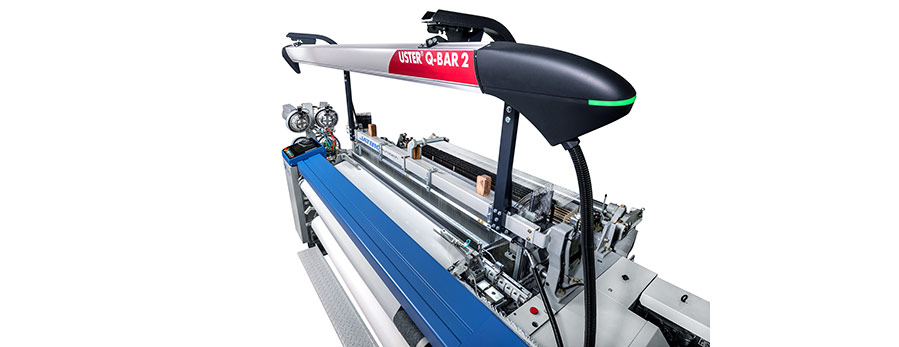
Q-Bar2 © 2021 Uster
The best way to avoid off-quality is simply not to make it. Uster Q-Bar 2 introduces a radical leap in fabric inspection. It monitors the fabric additionally at the earliest point – the critical stage in fabric formation – with automatic, in-line inspection. Identifying problems here brings enormous benefits, preventing defects and enabling weavers to deliver constant quality and stay competitive in the market.

Uster Q-Bar 2 becomes the unique formation monitoring system

Q-Bar 2 is best described as a formation monitoring system, because of its ingenious positioning directly at the interface of warp and weft threads. That allows rapid response as soon as a defect appears, avoiding long-running or repeating faults. Alarm and stop signals alert the operator to correct problems immediately – and early detection reduces second quality and material loss, as well as minimizing the need for post-production checks.

For weavers, these advantages represent genuine and long-awaited innovations with a positive impact on both productivity and quality.

Formation monitoring

Weaving defects can have various root causes, so Uster Q-Bar 2 provides different algorithms to identify specific defects and their causes. This inbuilt knowledge can prevent defects within the weft insertion cycle.

Its enhanced detection position in the fabric formation zone means the warp is monitored even before it is traversed by the weft – a truly unique benefit. It allows detection of incorrect warp positions, missing warp, loose warp ends and even pattern irregularities.

Another important innovation is the control of weft irregularities. By monitoring each inserted weft in the formation area, Q-Bar 2 primes users to react to weft irregularities at the earliest possible stage. At this point, it can detect weft-related defects such as double picks, broken weft or slubs and loops.

“Formation monitoring is the answer to market requests. Weavers demand zero defect standards, increased sustainability by waste reduction and they want to produce the fabric meeting specific quality requirements,” says Michelle Salg, Product Manager Fabric Inspection at Uster.

Total supervision

Defects that become visible only in the woven fabric are the nastiest threat. Often, it’s too late when defects such as reed marks, dirty yarns or floats are spotted – but it can’t happen with Uster Q-Bar 2. Its fabric inspection algorithms detect even ‘invisible’ defects in the fabric. It’s the simple solution to improving fabric yield by automated formation monitoring.

Q-Bar 2 also monitors critical machine units in the formation zone. If there is a problem here, the system makes it easy to identify and eliminate it, preventing further defects and again maximizing fabric yield.


Another element of the total supervision provided by the formation monitoring system is its special focus on the selvedge area. This is not only critical for an efficient weaving process, it is also important in further process steps. Specific algorithms detect irregularities in the selvedge, as well as broken leno – but also identify any pattern defects. Continuous pattern monitoring flags up incorrect patterns at the earliest stage, so the loom can be stopped and the problem fixed before many meters of fabric are wasted.
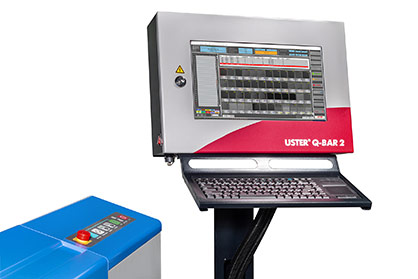
Q-Bar2 © 2021 Uster
Q-Bar2 © 2021 Uster


Last but not least, the system has a permanent eye on the fabric width, an essential factor for further processing. For this reason, Q-Bar 2 provides continuous width measurement of the woven fabric, from loom setup to full roll.

Designed for users

The technology in this new formation monitoring system is impressive, but Q-Bar 2 is highly developed in many other aspects too. Its attractive industrial design is also ergonomic, so users have easy access to all important parts. Weavers appreciate its simple installation on existing weaving machines. And operators like the integrated LEDs used by Q-Bar 2: system status is indicated and the positions of detected defects shown by red lights. The improved hardware platform is capable of handling high loom speeds and is ready for future innovations.

First-quality production, to customer specifications, is the overall goal. That is especially important in demanding applications such as industrial and safety textiles. In apparel and home textiles too, it is vital to avoid seconds and minimize waste fabric. “Independent of the fabric application, Uster Q-Bar 2 is a game-changer. For the first time, weavers can actually prevent weaving defects instead of only reacting to them,” says Salg.
More News from Uster Technologies AG

#ITMA Asia + CITME Singapore 2025

Uster presents novelties at ITMA Asia + CITME 2025

There’s news from Uster Technologies to be announced for the industry’s upcoming event in Singapore. The Uster 360Q universe is growing with new products, solutions and services. Innovation developments can also be recorded in the fields of man-made fiber testing and fabric inspection. Uster innovations address the industry’s trending topics as mill management and process control, optimization of delivered fabric quality and yield.

#Spinning

Uster Technologies marks 150 years of empowering quality excellence

Uster Technologies marks 150 years of excellence – a milestone that reflects continuous adaptation to customer needs and industry change. Over the decades, Uster has evolved from manufacturing quality testing instruments into a trusted partner shaping the future of textile production.

#Recycling / Circular Economy

Challenges of making yarn from recycled fibers

What does it take to spin quality yarn from recycled fibers? Uster Technologies brought textile industry leaders together to discuss the role of technology, data and automation – as well as the current challenges in using recycled raw material. Experts from Rieter, Säntis Textiles, Otto Yarns, and TVU commented on the current situation and looked into the future of spinning in a panel discussion organized at Uster headquarters.

#Spinning

Uster Technologies wins another infringement lawsuit

In a ‘victory for innovation in China’ Uster Technologies has secured a decisive judgment in a patent infringement lawsuit against a competitor. The final ruling by the Supreme People’s Court of PR China confirms that the competitor’s actions in copying the patented yarn feeder of the Uster Tester 6 constitute unlawful infringement.

More News on Weaving

#Weaving

Lindauer Dornier announces leadership transition in weaving machine business

After more than ten successful years at Lindauer DORNIER GmbH, Mr Wolfgang Schöffl will leave the family-owned company at the end of the year to enter well-deserved retirement.

#Research & Development

More safety and comfort for protective clothing thanks to auxetic fabrics

When everyday materials are pulled, they stretch or elongate in the direction of the pull and become narrower in cross-section. We can also observe this property in two-dimensional textiles. Auxetic structures behave differently here. They have the striking property of not changing under tensile stress or even increasing their width or thickness. These properties are advantageous, for example, in protective textiles or textile filter media. The DITF are researching auxetic fabrics for various applications.

#Weaving

Itema announces strategic partnership with Ivy Decarb to accelerate decarbonization in weaving process

Itema is pleased to announce the strategic partnership with Ivy Decarb, the digital platform helping textile companies measure and reduce their carbon footprint.

#Exhibitions & Events

Groz-Beckert showcases textile innovation at ShanghaiTex 2025

From December 16 to 19, 2025, the global textile industry will gather at ShanghaiTex at the Shanghai New International Expo Center (SNIEC), where Groz-Beckert will present its latest highlights and innovations across its five product areas – Knitting, Weaving, Nonwovens, Sewing, and Spinning – at Hall N3, Booth A05.

Latest News

#People

Happy Holidays!

Dear reader, the year 2025 is drawing to a close. We are entering what we hope will be a peaceful holiday season, spending time with our families and taking a moment to pause and reflect. We hope we have been able to support you once again this year with relevant news and articles, and we look forward to surprising you with many innovations in the coming year. Enjoy the festive season, stay healthy, and we wish you a happy and joyful holiday season.

#Heimtextil 2026

Texpertise Focus AI: Messe Frankfurt puts Artificial Intelligence centre stage at its international textile and apparel trade fairs

Under the banner 'Texpertise Focus AI, Messe Frankfurt will place a strong emphasis on Artificial Intelligence (AI) across its international textile and apparel trade fairs from 2026 onwards, setting a future-shaping signal for the industry. The initiative highlights the responsible use of AI along the entire textile value chain, from fibre production to the point of sale. The programme will launch at Heimtextil in Frankfurt in January 2026.

#Technical Textiles

Autoneum and Polestar set new benchmarks for passenger experience and sustainability

As the global market leader in sustainable acoustic and thermal management, Autoneum is a key supplier of interior and exterior components for the highly anticipated Polestar 5 model. The successful collaboration between Autoneum and Polestar marks a significant milestone in sustainable automotive engineering: the electric grand tourer sports car features several innovations in lightweight, fully recyclable polyester-based components that ensure a superior driving experience. Polestar 5 was revealed at the IAA Mobility 2025 in Munich and is available in 24 markets.

#Natural Fibers

Cashmere producers stress the importance of The Good Cashmere Standard®

At the invitation of the Aid by Trade Foundation (AbTF), over 70 experts from the cashmere production and supply chain, as well as other specialists, met at the GCS Unit Meeting in Shanghai, China to discuss the progress and new objectives of The Good Cashmere Standard (GCS). The meeting focused on implementation and verification of the standard, important aspects of animal welfare and the importance of the standard in the global textile market.

TOP