[pageLogInLogOut]

#Textiles & Apparel / Garment

Borealis and paper republic unite in sustainable face mask initiative
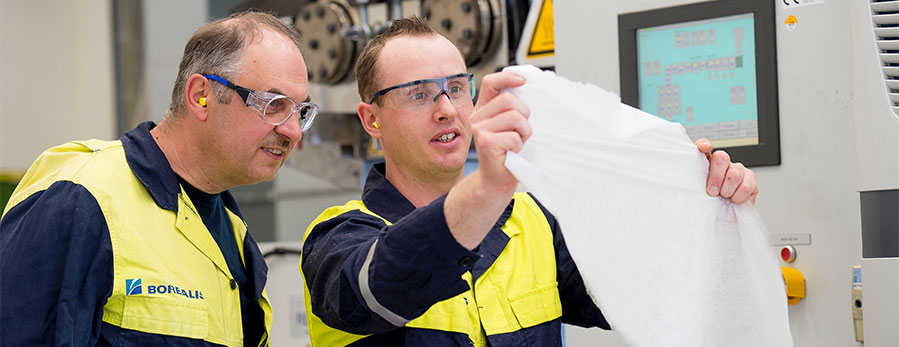
Meltblown fibres produced at Borealis’ pilot line in Linz, Austria Photo: © Borealis
Borealis, a leading provider of innovative plastics solution, and paper republic, a Vienna-based stationery brand, have teamed up in a social business initiative, named mask republic, for the production of sustainable, and reusable face masks.
  • mask republic collaboration offers high-quality reusable face masks assembled in Austria
  • The face masks feature a proprietary polypropylene resin from Borealis provided to this initiative through the Borealis Social Fund
  • Design, manufacturing and sales is organised by Vienna-based stationery brand paper republic
  • The face masks deliver up to four times better filtration than conventional hand-sewn alternatives

mask republic, which has been launched amid the COVID-19 pandemic, will supply face masks across Austria thanks to a reliable network of value chain partners, local and regional government organisations, and NGOs. Testing at Borealis laboratory facilities shows that the mask republic face masks provide up to four times more effective filtration than conventional hand-sewn face masks. Since washing the masks does not impact filtration effectiveness, they are perfectly washable and reusable without losing their filtration performance and therefore help to counter waste.

The mask republic partnership sees Borealis provide filtration media fabrics made using their new polypropylene (PP) resin for meltblown applications: Borealis HL912FB. Face mask design, manufacture and sales are being organised by paper republic. The initiative involves providing local and regional tailors, who would otherwise be unemployed or underemployed due to the coronavirus pandemic, with a custom-designed kit to assemble these masks from a light cotton fabric.

mask republic demonstrates how unlikely partners can come together to contribute to the communities in which they operate. “Some months ago it quickly became clear that Austria, like many other countries around the world, was facing one of the biggest health and safety challenges in nearly a century,” says Jérôme Bacquias, founder and Managing Director of paper republic. “We immediately knew that we had a mission to help the communities around us. These difficult times have brought us together with Borealis, in an extraordinary partnership that we are certain will benefit many.”

Demand for effective face masks has increased significantly amid the COVID-19 pandemic. Solutions are required that provide protection against the novel coronavirus, while at the same time enabling wearers to breathe easily. The need for face masks is expected to remain strong as European countries begin to loosen lockdowns and some introduce the mandatory wearing of face masks in public spaces.
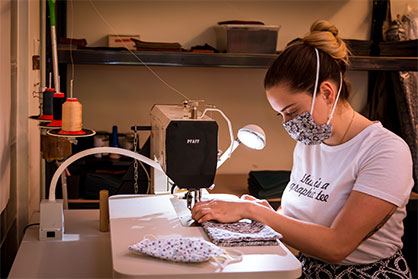
Seamstress sewing mask republic face mask Photo: © paper republic


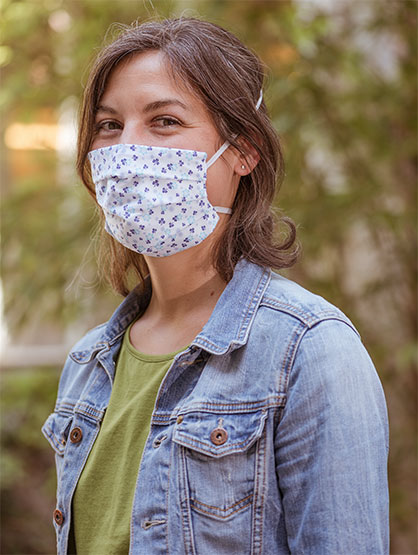
Woman wearing a mask republic face mask Photo: © paper republic

Borealis is the clear European market leader in PP resins for meltblown applications. These materials are particularly effective in hygiene applications, such as diapers and face masks, where micro- and nanofibre materials are required for barrier purposes. Due to the growing demand for face masks, Borealis recently converted a meltblown pilot line at its Linz, Austria, Innovation Headquarters for the small-scale production of fine fibre fabrics for these applications. The newly developed Borealis grade HL912FB is already being used on this line to produce meltblown fabrics for customised inlays in cotton-based mouth-nose masks, conventional mouth-nose masks, and possibly later on also for high-end face masks worn by medical professionals (FFP2, FFP3 and N95).

“We are very excited to be a part of an initiative through Borealis Social Fund, that benefits Austrian communities, while enabling us to provide our expertise and material solutions to improve people’s health, and safety, while being resource efficient and preventing waste,” explains Dorothea Wiplinger, Borealis Sustainability & Project STOP Manager. “The innovative Borealis material makes the masks more effective, while the design is not only fashionable but also sustainable, and safely reusable. Furthermore, we are also stimulating local employment. Borealis and paper republic demonstrate what reinventing for more sustainable living looks like.”

For more information: watch this and visit:

https://www.youtube.com/watch?v=EMpYZZ6-e0Q&feature=youtu.be

https://www.mask-republic.eu/

 

More News from TEXDATA International

#Texprocess 2026

Texprocess 2026: Automation, digitalisation and AI redefine textile processing

Making investment decisions in textile processing has become significantly more demanding. Increasing energy costs, a shortage of skilled labour and ongoing geopolitical uncertainties are compelling companies to focus on technologies that deliver clear gains in efficiency and process reliability. This applies equally to apparel manufacturing and to the processing of technical textiles and high-performance materials. As a result, modernisation initiatives are assessed more carefully – even as the need to upgrade production systems continues to intensify.

#Techtextil 2026

Techtextil 2026: Between innovation pressure & market reality

From 21 to 24 April 2026, Techtextil in Frankfurt am Main will once again become the central meeting point for the international technical textiles and nonwovens industry. Running in parallel, Texprocess will focus on the industrial implementation of textile processing technologies as the leading platform in this field. Together, the two trade fairs form a closely integrated presentation and working platform along the entire textile value chain – from material development to finished applications.

#Techtextil 2026

Between geopolitical pressure and industrial resilience

In this interview, Dr. Janpeter Horn (VDMA) discusses the current challenges facing textile machinery manufacturers, shaped by geopolitical tensions, regulatory developments and subdued investment. He also outlines why innovation strength, integrated solutions and strategic positioning remain key to global competitiveness.

#Texprocess 2026

Between investment restraint and modernization pressure

Texprocess 2026 takes place in a complex market environment shaped by uncertainty and innovation pressure. In this interview, Elgar Straub (VDMA) explains why the trade fair is particularly relevant this year and which technologies are driving efficiency and competitiveness.

More News on Textiles & Apparel / Garment

#Textiles & Apparel / Garment

Texhibition Istanbul signals stability and global connectivity

From 4 to 6 March 2026, Texhibition Istanbul once again brought together the international textile industry at the Istanbul Expo Center. Organized by İTKİB Fuarcılık A.Ş. in cooperation with the Istanbul Textile Exporters Association (İTHİB), the fair confirmed its role as one of the most important international sourcing platforms for fabrics and textile innovation. With 500+ exhibitors across 5 halls on 42,850 sqm, the trade fair attracted 19,325 visitors. Among them, 5.565 international visitors represented Europe, Asia, the Middle East, North Africa, North America, and other regions, underlining the show’s expanding global reach.

#Textiles & Apparel / Garment

Val:ue Milan unveiled – a curated boutique business hub for high-end apparel textiles

Messe Frankfurt continues to expand its international textile network with the announcement of Val:ue Milan. Moving beyond the traditional trade fair model, Val:ue Milan debuts as a prestigious, boutique-style business hub exclusively dedicated to elected fabrics and accessories for apparel. Taking place from February 3 to 5, 2027, at The Mall in Porta Nuova, the event breaks away from conventional formats through a strictly curated environment designed for strategic networking. By bridging the gap between high-end international manufacturers and top-tier segment buyers, Val:ue Milan further strengthens the Group’s global portfolio with a unique, high-impact concept built around a refined and carefully selected offering.

#Recycling / Circular Economy

Solving the Feedstock Gap: Unlocking Post-consumer Feedstocks for Textile-to-Textile Recycling in Europe

Fashion for Good launches Project FAE (Feedstock Activation Europe) to develop the sorting and pre-processing infrastructure needed to channel non-rewearable post-consumer textiles into textile-to-textile (T2T) recycling at scale. The project is a practical response to one of the most pressing problems in textile circularity: making post-consumer waste a viable, commercially competitive raw material for recyclers.

#Sustainability

Practical toolkit to drive coordinated climate action launched

An open-access workshop toolkit enables brands, suppliers, policymakers and investors across the textile industry to apply the System Map in their own work, identifying leverage points to halve emissions and enable a just transition.

Latest News

#Texprocess 2026

Kornit Digital expands digital production into footwear and technical textiles with Presto MAX PLUS

Kornit Digital (NASDAQ: KRNT) (“Kornit” or the “Company”), a global pioneer in sustainable, on-demand digital fashion and textile production, today unveiled the Kornit Presto MAX PLUS, a new roll-to-roll system expanding digital manufacturing into footwear, automotive interiors, military camouflage, high-performance sportswear, and high-end furnishings. Debuting at Texprocess 2026 in Frankfurt, Presto MAX PLUS enables entirely new applications for on-demand textile production.

#Textile processing

NATULON® zipper series surpasses 50% of YKK’s global zipper sales

YKK Corporation (Headquarters: Chiyoda-ku, Tokyo; President: Koichi Matsushima; hereafter, YKK) announces that the global sales share of its NATULON® zipper series—zippers that incorporate recycled materials—has exceeded 50%.

#Smart Textiles

Covestro, FILK Freiberg, and OUT e.V. develop flexible, conductive polymer smart textile system

As the smart textiles market continues to grow across healthcare, personal protection, sportswear, and automotive applications, developers are seeking new ways to integrate electronic functionality directly into textiles, without the rigidity and complexity of conventional wiring. To address this challenge, FILK Freiberg Institute, an independent research institution with expertise in polymer coatings for textile applications, collaborated with Optotransmitter-Umweltschutz-Technologie (OUT) e.V. The joint project, funded under the German Industrielle Gemeinschaftsforschung (IGF) program of the Bundesministerium für Wirtschaft und Energie (BMWE), focused on developing flexible, conductive polymer surfaces for next-generation smart textiles.

#HIGHTEX 2026

Global growth in the technical textile sector drives interest in HIGHTEX 2026 to its peak

The continued steady growth of the technical textiles and nonwoven sector worldwide is increasing interest every year in the HIGHTEX Exhibition, one of the sector’s most important meeting points. In this strong growth climate, HIGHTEX 2026 International Technical Textiles and Nonwoven Exhibition, which will bring together the sector’s leading manufacturers, technology providers, and international buyers, is preparing to open its doors at Tüyap Fair and Congress Center on June 9–13, 2026.

TOP