[pageLogInLogOut]

#Textile chemistry

SABIC CEO urges chemical industry to redefine, reshape and reinvent

Now is the time for the Middle East petrochemical and chemical industry to increase the pace of transformation to keep up with accelerated global trends.

That was the message from Yousef A. Al-Benyan, Vice Chairman and CEO of SABIC and Chairman of the Gulf Petrochemical and Chemical Association (GPCA) as he addressed the 15th Annual Forum of the GPCA in Dubai. 

Meeting physically for the first time since 2019, the three-day Forum brought together an audience of more than 2,100 industry leaders to address a forward-looking theme: ‘Redefine. Reshape. Reinvent. The chemical industry in a post-pandemic reality’. 

In the welcoming remarks Mr. Al-Benyan outlined how players are adapting quickly to the new normal but said more effort was needed to match global trends. 

He said, “We’ve been talking about transforming our industry for several years now. But the time has come to make use of the GPCA platform to redefine, reshape and reinvent various aspects of our industry so that it proceeds—much more quickly and surely—to future success.”

Mr. Al-Benyan also outlined the vital role that the chemicals and petrochemical industry must play in the delivery of national carbon neutrality strategies. He said, “A circular economy requires a framework for composing a nation’s development. Infrastructure, transportation, manufacturing and food production must all be orchestrated. Decarbonization and circularity are not just for one company or even for one industry. They are for the whole of society and the economy. The solution has to be generated through collaboration not only within the chemical industry but also across multiple industries in the value chain.”


Mr. Al-Benyan concluded by announcing the approval of the GPCA Board to rotate the GPCA annual forum among the capitals of GCC countries, starting with Riyadh next year. 
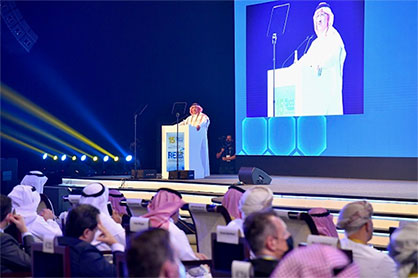
© 2021 Sabic
© 2021 Sabic


The GPCA Annual Forum also heard from Murhaf Al-Madani, Vice President of SABIC’s Corporate Digitalization Program and Hosam Al-Zamil, Vice President of SABIC’s Global Supply Chain. They joined GPCA masterclass panels and shared ideas aimed at leveraging technology, increasing supply chain resilience and achieving new growth in the post-pandemic world.

The GPCA represents the downstream hydrocarbon industry in the Arabian Gulf. Established in 2006, the association voices the common interests of more than 250 member companies from the chemical and allied industries, accounting for over 95 percent of chemical output in the Gulf region.



More News from TEXDATA International

#Texprocess 2026

Texprocess 2026: Automation, digitalisation and AI redefine textile processing

Making investment decisions in textile processing has become significantly more demanding. Increasing energy costs, a shortage of skilled labour and ongoing geopolitical uncertainties are compelling companies to focus on technologies that deliver clear gains in efficiency and process reliability. This applies equally to apparel manufacturing and to the processing of technical textiles and high-performance materials. As a result, modernisation initiatives are assessed more carefully – even as the need to upgrade production systems continues to intensify.

#Techtextil 2026

Techtextil 2026: Between innovation pressure & market reality

From 21 to 24 April 2026, Techtextil in Frankfurt am Main will once again become the central meeting point for the international technical textiles and nonwovens industry. Running in parallel, Texprocess will focus on the industrial implementation of textile processing technologies as the leading platform in this field. Together, the two trade fairs form a closely integrated presentation and working platform along the entire textile value chain – from material development to finished applications.

#Techtextil 2026

Between geopolitical pressure and industrial resilience

In this interview, Dr. Janpeter Horn (VDMA) discusses the current challenges facing textile machinery manufacturers, shaped by geopolitical tensions, regulatory developments and subdued investment. He also outlines why innovation strength, integrated solutions and strategic positioning remain key to global competitiveness.

#Texprocess 2026

Between investment restraint and modernization pressure

Texprocess 2026 takes place in a complex market environment shaped by uncertainty and innovation pressure. In this interview, Elgar Straub (VDMA) explains why the trade fair is particularly relevant this year and which technologies are driving efficiency and competitiveness.

More News on Textile chemistry

Latest News

#ITM 2026

New Monforts systems deliver round-the-clock production for Kipaş

As a valued Monforts customer for many years, Türkiye’s Kipaş Textile has just installed a new Thermex dyeing range and a Monfortex sanforizer at its new dyeing and finishing plant in Kahramanmaraş.

#ITM 2026

SHIMA SEIKI to show complete knitting and cutting workflow at ITM 2026

Leading computerized flat knitting technology provider SHIMA SEIKI MFG., LTD. of Wakayama, Japan, together with its Turkish representative TETAS IC VE DIS TICARET A.S., will participate in the ITM 2026 International Textile Machinery Exhibition in Istanbul, Türkiye this month with a full product lineup. In addition to flat knitting machines and design software, visitors will also have the opportunity to experience the full range of SHIMA SEIKI textile machinery with its automatic cutting machine exhibit, all geared toward the fashion apparel market as well as non-apparel related businesses.

#Raw Materials

Global Cotton area and production are projected to decline in the 2026/27 Season

The June 2026 issue of Cotton This Month projects a modest contraction in global cotton area, production, and trade during the 2026/27 season, reflecting weaker demand sentiment, rising production costs, and shifting environmental factors across major producing nations.

#Natural Fibers

European Flax-Linen & Hemp step into advanced manufacturing: Enabling filament winding, 3D printing and high-performance composite processes

The Alliance for European Flax-Linen & Hemp announces a new wave of technological advancements demonstrating how flax-linen and hemp fibres are now being successfully integrated into advanced composite manufacturing processes. These developments mark a transition beyond traditional hand lay-up techniques, positioning natural fibres as credible, scalable solutions for high-performance industrial applications.

TOP