[pageLogInLogOut]

#Sustainability

Practical toolkit to drive coordinated climate action launched
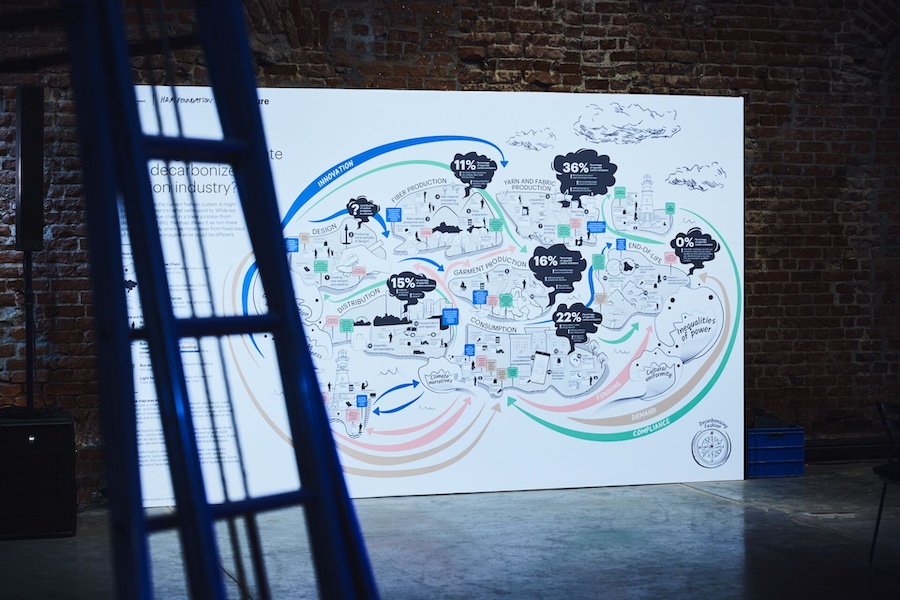
The System Map: a practical tool to help you understand, navigate and transform the textile system. © 2026 H&M Foundation
An open-access workshop toolkit enables brands, suppliers, policymakers and investors across the textile industry to apply the System Map in their own work, identifying leverage points to halve emissions and enable a just transition.

The textile industry must halve its greenhouse gas emissions every decade until 2050. The challenge is not lack of ambitions; it’s lack of alignment. In 2024, H&M Foundation introduced the System Map, a visual framework that reimagines the textile industry as an interconnected ecosystem shaped by flows of capital, incentives, innovation, regulation and demand.

Now, H&M Foundation is launching a practical, open-source toolkit to help organisations turn that systemic insight into action. While the System Map provides a shared understanding of how emissions, power and value flows across the industry, the new toolkit enables actors to apply it within their own organisations and partnerships.

"Change won’t come from islands of perfection – in a system as interconnected as fashion, every part influences the other. The System Map helped make that visible and now this toolkit makes it usable. If we want to halve emissions every decade, we have to stop optimising in silos and start pulling the right levers together", says Anna Gedda, CEO H&M Foundation.

The System Map challenges the traditional linear view of fashion. It visualises:

  • The full textile value chain, from fibre to end-of-life
  • Indicative carbon emissions across stages
  • Systemic forces such as profit-centredness, power imbalances and cultural norms

By mapping actors, flows and leverage points, it reveals where decisions can unlock system-wide impact and where well-intended action may simply shift burdens elsewhere.

To translate this into practice, H&M Foundation engaged Accenture to develop a facilitation toolkit that can be delivered digitally or in person. The toolkit includes:

  • A keynote introduction to the System Map
  • Workshop 1: Identifying your role and sphere of influence
  • Workshop 2: Pinpointing systemic leverage points
  • Workshop 3: Reimagining a decarbonised and just future textile system

The sessions are designed for brands, manufacturers, innovators, policymakers, investors, researchers and civil society organisations.

Decarbonisation must go hand in hand with a just transition. Climate action cannot shift costs onto the most vulnerable parts of the value chain. By providing a structured way to examine power dynamics and structural barriers, the toolkit supports more coordinated and equitable climate strategies.

The System Map remains publicly available as an open industry resource. With the launch of the toolkit, the H&M Foundation aims to move the conversation from understanding the system to actively reshaping it. Structural transformation will not come from isolated efforts. It will come when more actors work from a shared view of the system and choose to redesign it together.

The System Map and toolkit are available for download here:

https://hmfoundation.com/system-map-toolkit-and-guiding-material/


More News from H&M Group

#Sustainability

Pioneering open-source framework shows how early innovation drives a just and net-zero fashion future

The non-profit H&M Foundation, in collaboration with Accenture, has unveiled From Signals to Systems Change, an insight report calling on the fashion industry to rethink its role in transformation. At its core is the Reimagined System Map, a pioneering open-source framework that visualises how early-stage innovation could drive a just and net-zero textile future.

#Sustainability

H&M Foundation funds pioneering initiative to build the factories of the future

The H&M Foundation is committing SEK 53 million (approx. EUR 5 million) towards Future Forward Factories, a five-year initiative led by Fashion for Good, to address fashion’s most polluting stage: tier 2 textile processing.

#Textiles & Apparel / Garment

Global Change Award 2026: Nominations now open

On 1 September, the H&M Foundation launched the nomination round for the Global Change Award 2026. The international innovation challenge is looking for early-stage ideas that can drive the textile and fashion industry towards circularity and climate neutrality.

#Sustainability

Ten bold ideas to decarbonise fashion: Meet the winners of Global Change Award 2025

The H&M Foundation has revealed the ten winners of the Global Change Award 2025 – spotlighting groundbreaking ideas aimed at decarbonising the fashion industry in a just way. Each winner will receive a €200,000 grant and take part in the yearlong GCA Changemaker Programme – one of the few programmes of its kind focused on early-stage fashion innovation. Designed to accelerate the industry’s journey toward net-zero, the programme offers a mix of innovation support, systems thinking and personal growth.

More News on Sustainability

#Raw Materials

Textile Exchange publishes cotton Life Cycle Assessment study to strengthen impact data

Textile Exchange has published the first in a series of seven Life Cycle Assessment (LCA) studies designed to improve the quality and robustness of environmental impact data for raw material production across the fashion, textile, and apparel industry. The first LCA study focuses on cotton and addresses critical data gaps and methodology variability through new high-quality data across key producing countries. The study includes organic, regenerative, recycled, and country averages for conventional cotton production systems, providing a clearer picture of the associated environmental impact.

#Sustainability

Experts publish APAC policy priorities

Cascale today announced the publication of its APAC Policy Priorities Paper, developed by the Asia-Pacific (APAC) Policy Member Expert Team (MET) to identify key regional sustainability challenges and provide practical, aligned recommendations for policymakers and industry stakeholders across Asia-Pacific.

#Sustainability

GOTS version 8.0 released: advanced supply chain accountability, from fibre to finished product

Global Standard is pleased to announce the release of GOTS Version 8.0, the latest update to the world's leading processing standard for organic textiles. The updated Standard strengthens requirements for air emissions and waste management, as well as criteria for product safety. It introduces new provisions on circularity, microfibre management and updates in residue testing. Version 8.0 also elevates due diligence obligations and formalises governance requirements, including ESG disclosure, anti-corruption policies and conflict-of-interest safeguards, to support credible, responsible business conduct.

#Sustainability

The nova-Institute establishes new Renewable Feedstock Department to lay the groundwork for industrial defossilisation

The transition from fossil-based to renewable carbon – sourced from biomass, CO₂ utilisation and recycling – is the cornerstone of a climate-neutral chemical industry. The nova-Institute’s new department is dedicated to providing the essential data, analyses and strategic roadmaps required to secure a reliable future feedstock supply and make this transition a commercial and ecological reality.

Latest News

#Spinning

Graf at EXINTEX – Strengthening presence in Latin America

Graf successfully participated in EXINTEX, one of the leading textile exhibitions in Latin America, together with its local agent Eurotecnica. The exhibition provided an excellent platform to engage with customers, partners and industry experts across the region.

#Techtextil 2026

Freudenberg Performance Materials presents Mehlerheytex and Filc at Techtextil 2026

Freudenberg Performance Materials will showcase textile innovations that increase efficiency, performance and sustainability in industry and mobility at Techtextil 2026. For the first time since the merger of Mehler Texnologies and Heytex, the MehlerHeytex brand will make its debut as a leading expert in coated technical textiles. Moreover, Freudenberg Performance Materials Filc (Filc), specialist for advanced needlepunch nonwovens and laminated materials, will present its groundbreaking solutions for automotive applications. Filc customers can benefit from the perfect combination of functionality, comfort and sustainability. The Freudenberg Performance Materials experts are looking forward to welcoming visitors to the trade fair at Stand A11 in Hall 11.0 from April 21 – 24, 2026.

#Recycling / Circular Economy

Advanced Recycling Conference 2026 to showcase innovations – Call for abstracts

The call for abstracts is now open for the Advanced Recycling Conference (ARC) 2026, taking place on 17–18 November 2026 in Cologne, Germany, and online. Europe’s leading platform for advanced recycling brings together hands-on solutions and cutting-edge research on recycling technologies for various waste streams like plastics, polymers, textiles or automotive, highlighting progress towards a circular renewable carbon economy.

#Research & Development

Fraunhofer IAP paves the way for "Green" carbon fibers

A new pilot plant in Guben is set to enable the production of bio-based carbon fibers. The plant is part of the Carbon Lab Factory Lausitz and will make an important contribution to the transformation of the Lausitz region—from a traditionally raw material- and basic industry-oriented region to a hub for innovative high-performance materials. The German federal government and the state of Brandenburg are providing the Fraunhofer Institute for Applied Polymer Research IAP with 53.3 million euros for this purpose.

TOP