[pageLogInLogOut]

#Sustainability

Pioneering open-source framework shows how early innovation drives a just and net-zero fashion future
Since 2015, its flagship initiative, the Global Change Award, has supported 56 teams from 23 countries with 10 million euros in grants, paving the way for circular and decarbonised business models across the textile value chain.
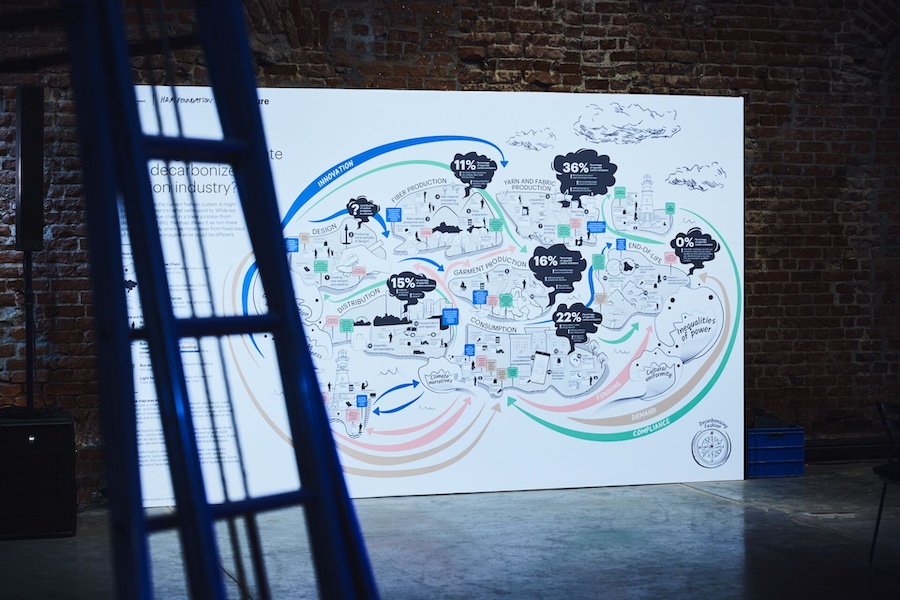
The non-profit H&M Foundation, in collaboration with Accenture, has unveiled From Signals to Systems Change, an insight report calling on the fashion industry to rethink its role in transformation. At its core is the Reimagined System Map, a pioneering open-source framework that visualises how early-stage innovation could drive a just and net-zero textile future.

Grounded in insights from innovation, philanthropy and systems thinking, From Signals to Systems Change explores how early ideas can become a catalyst for a just and decarbonised textile future. It maps the key forces reshaping fashion, from AI and geopolitics to resource scarcity and biodiversity loss, and calls on industry leaders, investors and policymakers to recognise their place in an interconnected system.

“By looking at the fashion system as it is today and reimagining what it could become, we visualised how scaling early-stage innovations might ripple across the industry“, says Annie Lindmark, Programme Director, Innovation at the H&M Foundation. Our hope is that different stakeholders will explore the System Map and ask themselves where in the system they have the most power to influence change, and in doing so, ignite new sparks of transformation.”
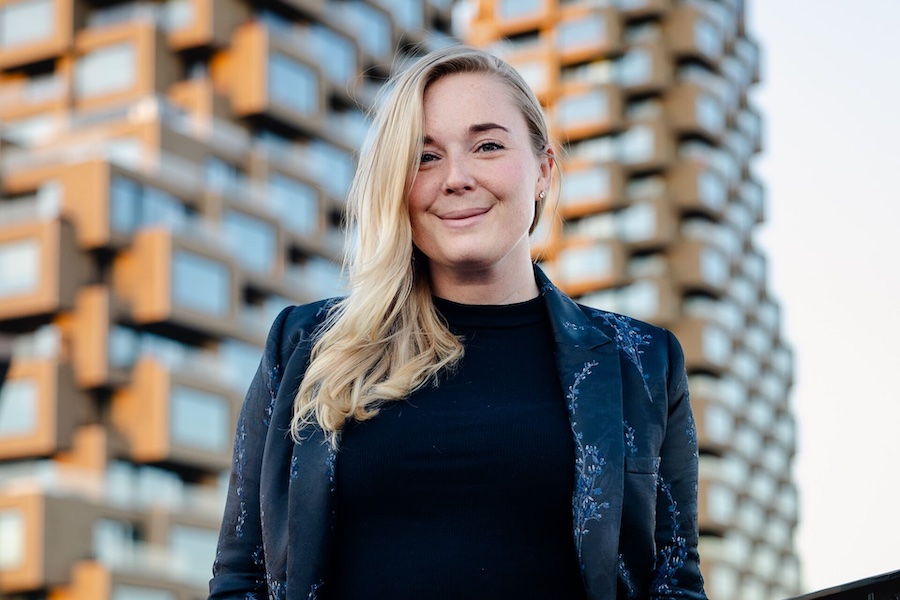

Annie Lindmark, Programme Director Innovation © 2025 H&M


A glimpse of a reimagined fashion system

To understand what early-stage innovation can achieve at scale, Accenture applied its 360-degree value approach to estimate the potential impact of four Global Change Award 2025 winners: Loom, PulpaTronics, Renasens and The Revival Circularity Lab. The findings show that small ideas, when supported early, can deliver outsized returns for both climate and communities. By 2050, their innovations could:

+++ Save 570,000 tonnes of CO2 annually, equal to the life-cycle emissions of 170 million cotton T-shirts.

+++ Save 160 billion litres of water, enough for the annual drinking needs of 200 million people.

+++ Create 30,000 designer jobs and reduce 3,000 tonnes of e-waste each year.

Philanthropy as a catalyst for systems change

As an independent, privately funded philanthropic organisation, the H&M Foundation uses philanthropy as risk capital, funding early ideas, breakthrough research and collaborations often considered too early or too uncertain. Since 2015, its flagship initiative, the Global Change Award, has supported 56 teams from 23 countries with 10 million euros in grants, paving the way for circular and decarbonised business models across the textile value chain.

From Signals to Systems Change builds on that mission by showing how early-stage ideas could unlock systemic opportunities and accelerate transformation across the industry. When changemakers thrive, systems change follows. The report is part of the Foundation’s ongoing work to support the textile industry in halving its greenhouse gas emissions every decade while promoting a just transition for both people and planet.

An open invitation

The report closes with a challenge to every actor in the system, from brands and suppliers to investors and citizens:

+++ Where in the system do you have the most power to influence change?

+++ Who must you collaborate with to turn ideas into action?

+++ What decision can you make today that signals real commitment to transformation?

From Signals to Systems Change is not just a report. It is an open invitation to imagine, collaborate and act.

Explore the report here:

https://hmfoundation.com/wp-content/uploads/2025/10/GCA-2025-Insight-Report.pdf


More News from H&M Group

#Sustainability

Practical toolkit to drive coordinated climate action launched

An open-access workshop toolkit enables brands, suppliers, policymakers and investors across the textile industry to apply the System Map in their own work, identifying leverage points to halve emissions and enable a just transition.

#Sustainability

H&M Foundation funds pioneering initiative to build the factories of the future

The H&M Foundation is committing SEK 53 million (approx. EUR 5 million) towards Future Forward Factories, a five-year initiative led by Fashion for Good, to address fashion’s most polluting stage: tier 2 textile processing.

#Textiles & Apparel / Garment

Global Change Award 2026: Nominations now open

On 1 September, the H&M Foundation launched the nomination round for the Global Change Award 2026. The international innovation challenge is looking for early-stage ideas that can drive the textile and fashion industry towards circularity and climate neutrality.

#Sustainability

Ten bold ideas to decarbonise fashion: Meet the winners of Global Change Award 2025

The H&M Foundation has revealed the ten winners of the Global Change Award 2025 – spotlighting groundbreaking ideas aimed at decarbonising the fashion industry in a just way. Each winner will receive a €200,000 grant and take part in the yearlong GCA Changemaker Programme – one of the few programmes of its kind focused on early-stage fashion innovation. Designed to accelerate the industry’s journey toward net-zero, the programme offers a mix of innovation support, systems thinking and personal growth.

More News on Sustainability

#Associations

Results of the 38th ITMF Global Textile Industry Survey

The global textile industry appears to be turning a corner, but this is more likely a fragile and possibly temporary improvement than the start of a durable recovery. According to the 38th ITMF Global Textile Industry Survey, conducted worldwide during the second half of May 2026, business sentiment, order intake, order backlogs and capacity utilization all improved versus March — yet every indicator remains weak by historical standards, and rising costs cast doubt on how long the upturn can last.

#Sustainability

Closing the Footwear Loop reveals challenges and opportunities for circular footwear

The footwear industry faces one of the most complex circularity challenges in the fashion sector. A new Phase 1 report from the Fashion for Good initiative Closing the Footwear Loop, developed together with Circle Economy, provides new insights into the composition, condition and recycling potential of post-consumer footwear waste.

#Man-Made Fibers

The updated poster on biodegradable Polymers in various environments has been released

As part of the PerPlacsBio project, nova-Institute has updated its popular poster on the biodegradability of polymers in different environments. The updated version reflects current standards, certifications and the latest scientific findings. The poster can be used to assess biodegradable alternatives for use in agriculture and forestry, and it is now available in German for the first time.

#Sustainability

A new standard to combat plastic waste in forests

With DIN SPEC 35808 “Tree Shelter for Forestry Applications,” the testing and research service provider Hohenstein, in collaboration with Rottenburg University of Forestry, as well as forestry authorities and industry partners, has established a clear framework for bio-based and fully biodegradable tree shelters. The pre-standard defines requirements and practical testing methods designed to reduce plastic waste in forests and strengthen the long-term protection of soil and the environment.

Latest News

#Nonwovens

EDANA launches landmark continence report to mark the start of the World Continence Week

Today marks the official commencement of the World Continence Week. To honour this global awareness initiative, EDANA has published a comprehensive report titled "The Central Role of Absorbent Hygiene Products in the Management of Adult Urinary Incontinence: Benefits, Costs and Environmental Impact." The World Continence Week (WCW) is an annual global initiative dedicated to raising public awareness about incontinence and bladder or bowel health issues. Traditionally held in June, this awareness week aims to shed light on a condition that affects millions of people worldwide but is frequently kept secret due to widespread social stigma, embarrassment, and taboo.

#Associations

Mario Jorge Machado re-elected President of EURATEX

The EURATEX General Assembly has re-elected Mario Jorge Machado as President of EURATEX, renewing its confidence in his leadership at a crucial moment for the European textile and clothing industry. The sector is facing rising costs, global competitive pressure and an increasingly challenging transition towards sustainability and digitalisation.

#ITM 2026

ITM 2026 makes happy participants with its international and qualified visitor profile

ITM 2026 International Textile Machinery Exhibition, one of the most prestigious meeting points of the textile machinery sector, attracted attention in its first three days, particularly with its diverse international visitor numbers. Industry professionals from all over the world had the opportunity to closely examine the latest technology machines and solutions displayed in operation. Thousands of visitors from approximately 100 countries, primarily Egypt, Pakistan, India, Uzbekistan, Syria, Turkmenistan, Tajikistan, Morocco, Algeria, and Tunisia, met at the Tüyap Fair and Congress Center for new investment and cooperation opportunities.

#ITM 2026

KARL MAYER presents a textile TEXTRONIC® innovation at ITM 2026

With highly efficient machines and continuous textile innovations, KARL MAYER underscores its role as a reliable partner for discerning top-tier customers. Just in time for ITM 2026 in Istanbul, the industry leader is introducing a true innovation: an eyelash lace with its characteristic fringed look – combined with a previously unattainable 4-way stretch. While the established fabric could until now only be produced as rigid version or with one-dimensional stretch, the new elasticity in both dimensions expands the possibilities for cross-band panel fabrics.

TOP