[pageLogInLogOut]

#Sustainability

Berry invests in industry-leading sustainability improvements to support its impact 2025 sustainability strategy

© 2021 Berry
Berry Global Group, Inc. (NYSE: BERY) announced its investment in an energy efficiency retrofit program to reduce its carbon emissions. In 2019, Berry launched its Impact 2025 strategy, where Berry pledged to increase its positive environmental impact through products, performance, and partners by the year 2025. Keeping its word, Berry’s new investment with efficiency-as-a-service (EEaaS) provider Redaptive, Inc. will result in a significant energy reduction across the Berry enterprise.

“We are extremely pleased with our partnership forged with Berry Global,” said Redaptive CEO Arvin Vohra. “The Berry team made significant commitments to the environment, and this work is more important than ever. The team at Redaptive is proud to play an important role in helping Berry reach their sustainability goals.”

Berry and Redaptive have established a 10-year program, where Redaptive anticipates upgrading more than 31,000 lighting fixtures to energy efficient LED fixtures and controls. These efforts are expected to result in significant gross savings, including an estimated 288 million kWh in energy consumption, which is equivalent to 203,000 metric tons of CO2 or 470,000 barrels of oil1. Combining its global presence and local agility, Berry solved the challenge of implementing this program around the world.


“For any large manufacturer, the competition for internal capital is always present. Therefore, it is typically difficult to scale lighting and other energy efficiency related projects across our global portfolio of almost 300 locations,” said Rodgers Greenawalt, EVP of Operations. “With Redaptive providing the funding, managing the technology deployment, and contractually guaranteeing the business outcomes, we can now quickly deploy these projects, significant GHG reduction, and enhanced safety for our employees.”

Facility improvements are essential to Berry’s success as it continually strives to reduce energy, which is the largest source of its Scope 1+2 carbon emissions. The cost of making this transition can be a rate limiter for companies. As a transformative company, Berry demonstrates its leadership by leveraging partners to pave the way for others to evaluate and potentially take on - making strides in reducing carbon emissions without increasing costs to the business or its customers.


More News from Berry Global Inc.

More News on Sustainability

#Sustainability

Practical toolkit to drive coordinated climate action launched

An open-access workshop toolkit enables brands, suppliers, policymakers and investors across the textile industry to apply the System Map in their own work, identifying leverage points to halve emissions and enable a just transition.

#Raw Materials

Textile Exchange publishes cotton Life Cycle Assessment study to strengthen impact data

Textile Exchange has published the first in a series of seven Life Cycle Assessment (LCA) studies designed to improve the quality and robustness of environmental impact data for raw material production across the fashion, textile, and apparel industry. The first LCA study focuses on cotton and addresses critical data gaps and methodology variability through new high-quality data across key producing countries. The study includes organic, regenerative, recycled, and country averages for conventional cotton production systems, providing a clearer picture of the associated environmental impact.

#Sustainability

Experts publish APAC policy priorities

Cascale today announced the publication of its APAC Policy Priorities Paper, developed by the Asia-Pacific (APAC) Policy Member Expert Team (MET) to identify key regional sustainability challenges and provide practical, aligned recommendations for policymakers and industry stakeholders across Asia-Pacific.

#Sustainability

GOTS version 8.0 released: advanced supply chain accountability, from fibre to finished product

Global Standard is pleased to announce the release of GOTS Version 8.0, the latest update to the world's leading processing standard for organic textiles. The updated Standard strengthens requirements for air emissions and waste management, as well as criteria for product safety. It introduces new provisions on circularity, microfibre management and updates in residue testing. Version 8.0 also elevates due diligence obligations and formalises governance requirements, including ESG disclosure, anti-corruption policies and conflict-of-interest safeguards, to support credible, responsible business conduct.

Latest News

#Research & Development

Textile cascade filter for removing microplastics from wastewater

Microplastics are now found almost everywhere, even in remote regions of Antarctica. They enter the human body through the food chain. Studies indicate that microplastics may have negative effects on the human health.

#Textile processing

Jeanologia showcases the future of product development

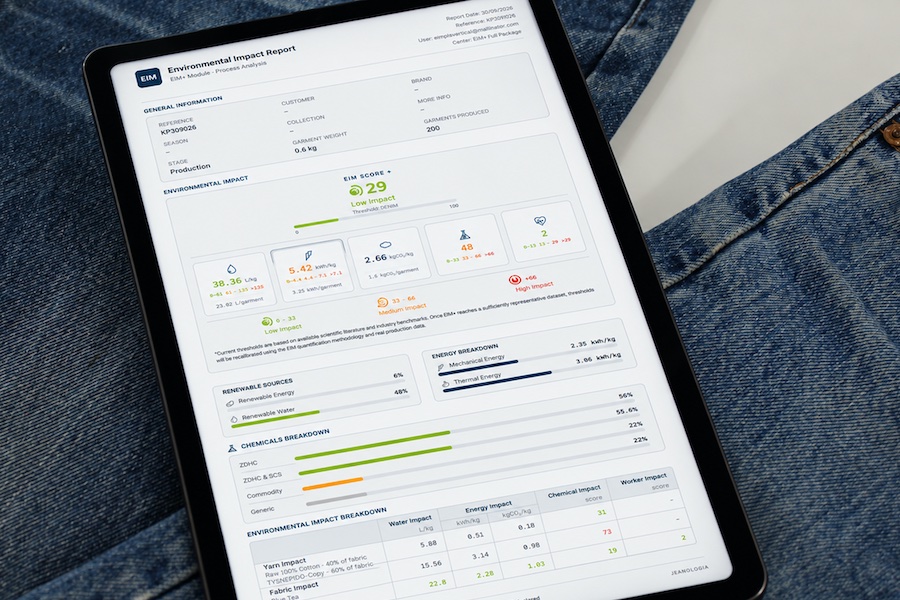
Jeanologia is showcasing how software is transforming product development in the fashion industry at PI Apparel Europe: The Fashion Technology Show, taking place on March 30–31 in London.

#Techtextil 2026

Groz-Beckert showcases cross-segment innovations for technical textiles in Frankfurt

From April 21 to 24, 2026, Groz-Beckert will present its latest innovations and solutions across the product areas of knitting, weaving, nonwovens and sewing at Techtextil 2026 in Frankfurt (Hall 12, Booth B90).

#Techtextil 2026

VANDEWIELE Group at Techtextil 2026 – Textile innovations together

The VANDEWIELEGroup will showcase its latest technologies for technical textiles at Techtextil 2026 in Frankfurt from April 21–24 (Hall 12.0, Stand C21). As a global leader in textile machinery, the group brings together specialised brands to support the evolving demands of high-performance textile applications. Visitors will discover solutions in laboratory testing, yarn joining, yarn feeding and thread tension monitoring, designed to create measurable value across the textile value chain.

TOP