[pageLogInLogOut]

#Spinning

Sustainable and efficient - Barmag's technologies for the Vietnamese textile industry

At SaigonTex from 9 to 12 April 2025 in Ho Chi Minh City, Vietnam, Barmag, a subsidiary of the Swiss Oerlikon Group, will be presenting comprehensive end-to-end solutions from a single source for its Oerlikon Barmag, Oerlikon Neumag and Oerlikon Nonwoven product brands. At the Saigon Exhibition and Convention Center, the experts from the manmade fiber technology provider will be explaining their sustainable machine and system solutions at the Illies Engineering Vietnam Co., Ltd. stand (Hall A, Stand 1J01).


Trade visitors will have the opportunity to get a comprehensive picture of the complete solutions on offer, which range from polycondensation systems to spinning and texturing through to digital solutions. The provision of all process steps from a single source ensures a harmonized technology whose design guarantees the high quality of the yarn produced.

Another focus is on sustainability. Together with partners such as Oerlikon Barmag Huitong Engineering (OBHE) and BB Engineering (BBE), the company presents specific concepts that include mechanical and chemical technologies for bottle recycling as well as for textiles, biopolymers and the circular economy. With the sustainability label e-save, the company has been offering innovative solutions for the textile industry for 20 years, hence setting standards for a more environmentally friendly future.

Recycling - the path to a sustainable future

OBHE's homogenizer enables the thermomechanical recycling of polyester waste. The well-known and commercially available raw materials such as bottle flakes, post-industrial waste and film waste are processed into high-quality PET products. The OBHE Homogenizer ensures constant polymerization conditions with an optimized residence time spectrum. Hence, the desired increase in viscosity can be specifically influenced and an excellent and homogeneous melt quality can be produced. The production of high-quality and defined rPET products with further processing of the melt to POY and FDY in the direct spinning process or for the production of PET chips is thus guaranteed and has already been proven by installed systems on the market. The OBHE homogenizer provides the customer with a flexible system for thermomechanical recycling of polyester waste. 

With the flexible compact spinning system VarioFil® R+ from BBE, PET bottle granulate and PET waste produced during start-up can be recycled and processed directly back into POY. The sustainable machine concept allows a high degree of product flexibility, including the production of spun-dyed yarn. The turnkey spinning line is also ideal for producers who manufacture small batch sizes or specialized products.

"From Waste to Value" - this is what BBE's VacuFil PET recycling system achieves. It is specially designed for the high-quality processing of textile waste. The patented technology is unique and is based on years of experience in extrusion, filtration and spinning: it combines gentle large-area flitration with targeted IV regulation for consistently excellent rPET melt quality, comparable to virgin material. A wide range of input materials can be processed: in addition to the usual bottle flakes, VacuFil is particularly suitable for production waste from the spinning mill, from start-up lumps and yarn to unmixed fabrics, which can also include post-consumer waste. The patented key component Visco+ , a liquid-state polycondensation system, quickly and reliably removes volatile impurities and automatically regulates the IV. There are also various options for further processing of the treated melt. For example, the melt can be fed into the main melt stream, processed into chips via palletization or flow directly back into the spinning mill. The VacuFil recycling system can therefore be designed modularly and flexibly to meet customer requirements.

DTY yarns - maximum flexibility and uncompromising quality

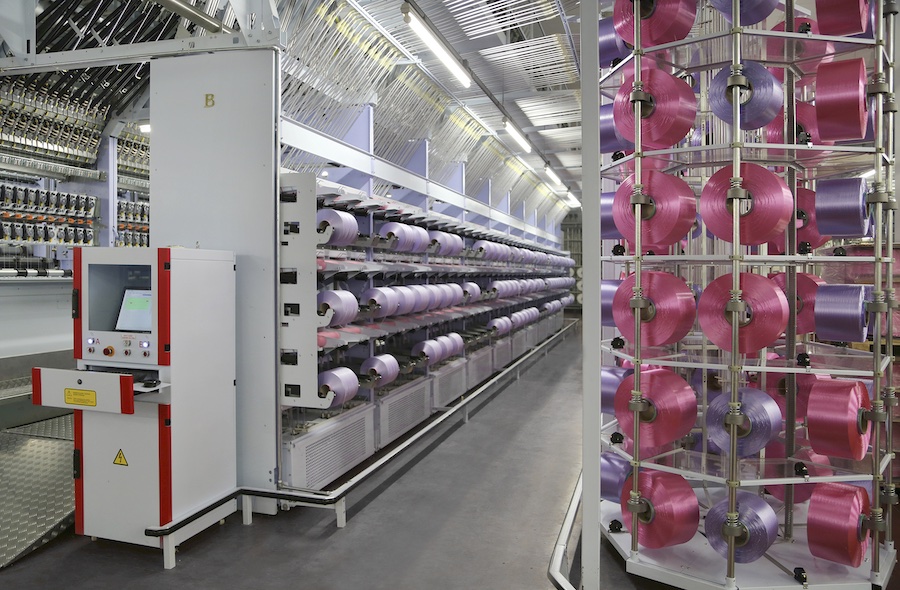
Whether for home textiles, in the clothing industry or in the automotive sector - the possible applications for texturized yarns are virtually unlimited. Oerlikon Barmag offers a wide range of DTY machine configurations for the efficient and sustainable production of high-quality textured yarns from various polymers such as polyester, polyamide, polypropylene, PLA and PTT. Thanks to sophisticated components, comprehensive know-how and tried and tested technology, the modular DTY machines - whether manual or automatic - produce texturized yarns that are ideal for downstream processes and ensure optimum OPEX costs. 

JeTex® Air texturizing from BBE enables a broad and flexible product portfolio

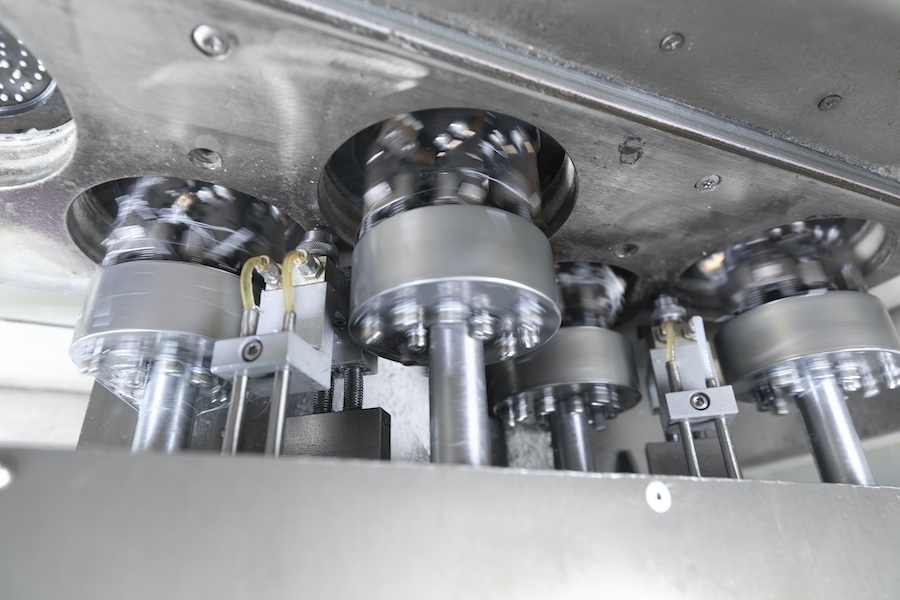
The Oerlikon Barmag subsidiary also offers a solution for texturing. The JeTex air texturing system perfectly complements the Oerlikon Barmag DTY system and enables the customer's product portfolio to be expanded to include high-quality ATY based on POY and FDY for a wide range of textile applications. The centerpiece of the system is the texturing box specially developed by BB Engineering. Alongside many other state-of-the-art components from Oerlikon Barmag, it ensures gentle yarn treatment with reliable texturing effects as well as production efficiency in terms of OPEX, handling and speed.

Particularly smart: JeTex® is not only available as a complete system, but also as a retrofit variant for existing DTY systems from Oerlikon Barmag. This allows customers to expand or convert their product portfolio to include ATY at comparatively short notice and at low cost.
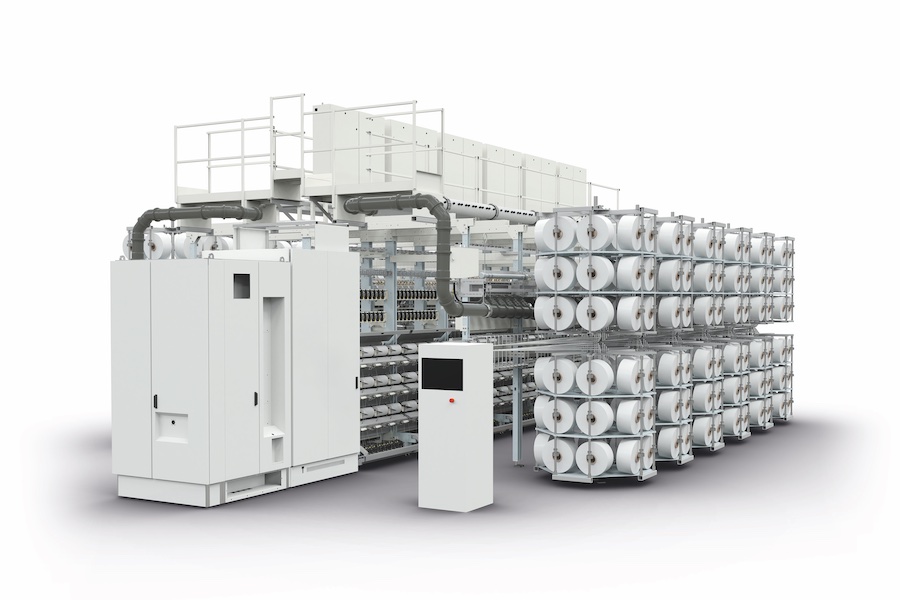
The JeTex air texturing system from BB Engineering ensures both gentle yarn treatment with reliable texturing effects and efficient production © 2025 Oerlikon


Bi-shrinkage yarns - from niche to standard

Bi-shrinkage yarns (BSY/ITY) have established themselves from a niche product to a standard yarn with a relevant market share in further processing, be it knitting, weaving or flax. The special yarn properties are visible in the end product, e.g. in crêpe or georgette fabrics or in ladies' outerwear. Oerlikon Barmag offers one- or two-stage solutions for the production of these specialty yarns. The single-stage solution is based on the tried and tested Barmag WINGS FDY concept, while the two-stage solution is based on eFK texturing machine technology. Both score over conventional technologies in terms of energy savings, production speed, process flexibility and quality.
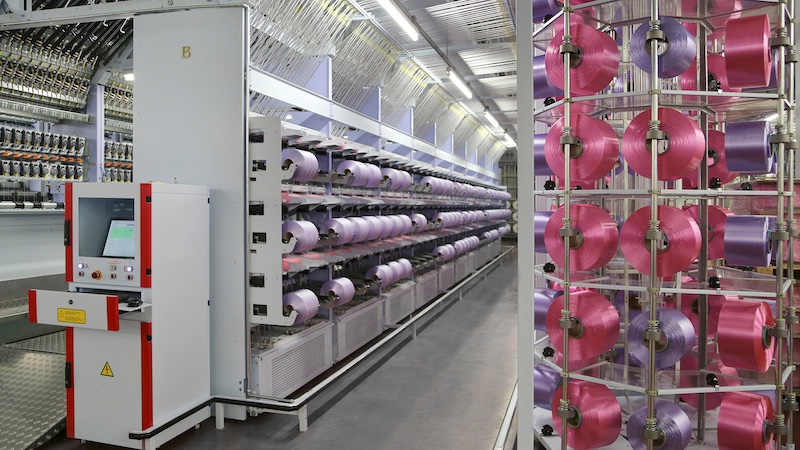
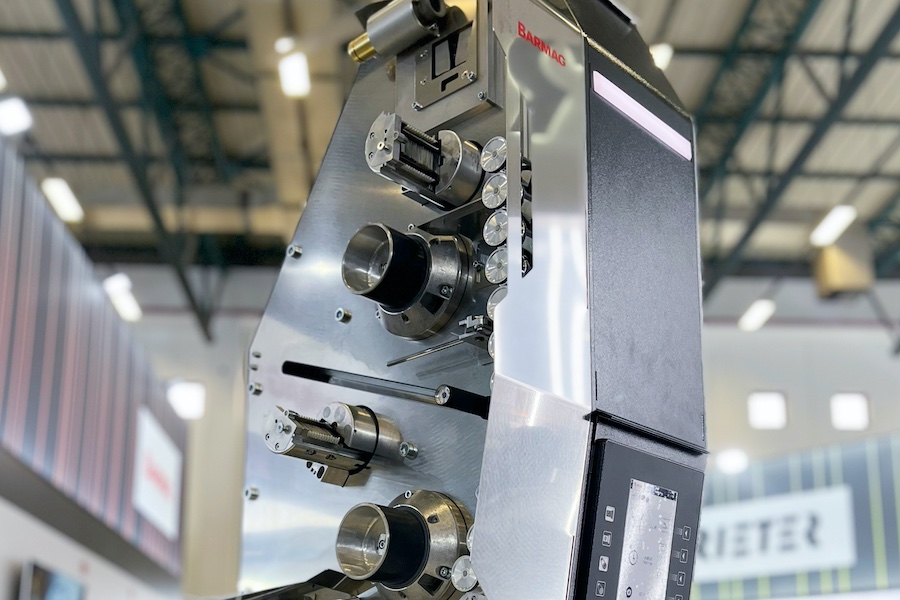
The eAFK Big V multi-spindle texturing machine is part of Oerlikon Barmag's efficient solution for the production of excellent quality high-titer yarns © 2025 Oerlikon


EvoSteam - innovative production of staple fibers

The innovative EvoSteam process from Oerlikon Neumag is the future of more sustainable staple fiber production. It impresses with considerable savings in energy, water and raw material consumption and thus leads to a significant reduction in operating costs (OPEX) and the CO2 footprint - while at the same time providing excellent fiber qualities for downstream processes.
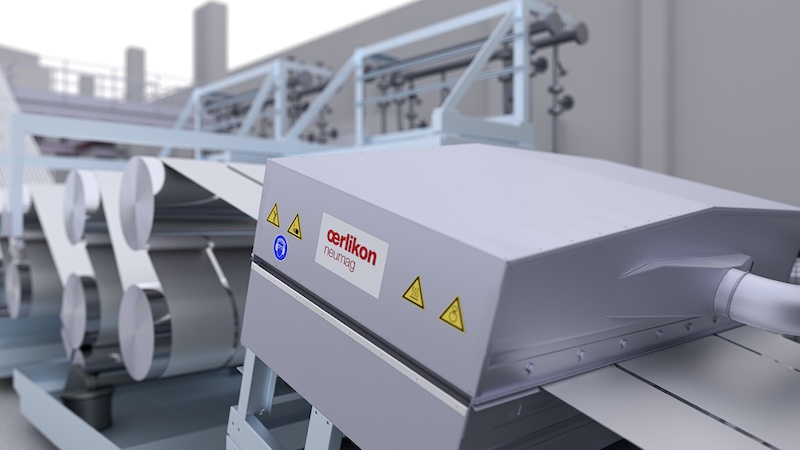
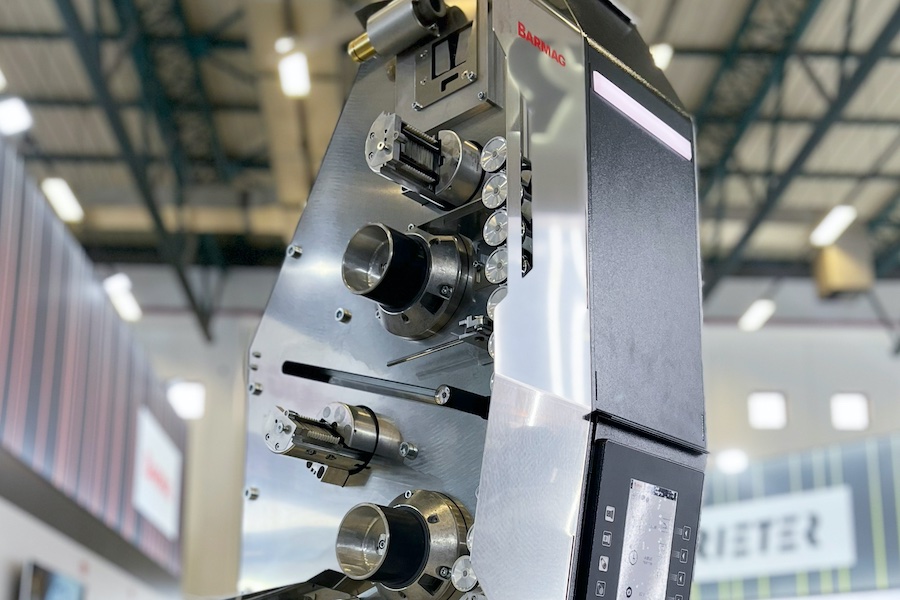
The Oerlikon Neumag EvoSteam staple fiber process is now bluesign® verified © 2025 Oerlikon


More News from Barmag, Zweigniederlassung der Barmag GmbH & Co. KG

#Spinning

Object Carpet tests production of rPET BCF yarn on Neumag BCF line

In a joint project with Object Carpet GmbH, Denkendorf; the Institute for Textile Technology (ITA), Augsburg; and Next Generation Recyclingmaschinen GmbH (NGR), Feldkirchen, Austria, Barmag investigated the processing of recycled polyester for BCF yarn. The goal was to evaluate the fundamental suitability of 100% recycled carpet material for reuse in carpet yarn production to create a closed-loop system in carpet manufacturing. To date, commercial rPET BCF processes have been based solely on rPET from bottle pellets.

#Spinning

Barmag and Hitech Automation enter into partnership for an auto-doff system for texturing machines

Barmag (Suzhou) Technology Co., Ltd. and Hitech Automation Solutions PVT LTD. of Surat, India, have agreed to an exclusive partnership to jointly market Hitech’s Doffmatic automation solution for Barmag’s proven manual eFK texturing machines. In many texturing facilities, manual doffing processes remain heavily operator-dependent – resulting in issues such as increased scrap, inconsistent quality, and limited productivity.

#Spinning

Specialist in fine counts: New type 2777 ceramic oiler

With the new Type 2777 ceramic oiler, Barmag has added a solution for fine titers and microfilaments to its portfolio of original parts.

#ITM 2026

Barmag and Neumag showcase innovations across all manmade fiber processes

For the first time, Barmag is presenting itself alongside its new parent company, Rieter: At this year’s ITM in Istanbul, both companies will be represented from June 9 to 13 at the Tüyap Fair Convention and Congress Center in Hall 7, Booth 702B. As a technology leader in the field of chemical fiber equipment, Barmag will showcase its entire portfolio of systems for filament yarn, staple fiber, and nonwoven production, as well as solutions for the networked factory.

More News on Spinning

#Spinning

Ibrahim Fibres and Trützschler: A strong partnership enters its next phase with the TC 30Si

For more than two decades, Ibrahim Fibres and Trützschler have grown side by side, driven by a shared ambition to continuously improve spinning performance, strengthen technology leadership and set new benchmarks in the textile industry. Today, Ibrahim Fibres is a leading yarn and polyester staple fiber manufacturer in Pakistan. The company operates the largest number of Trützschler cards in the country, with more than 200 machines running across its mills in Faisalabad, and plays an important role in one of Asia’s largest textile industries.

#Spinning

New spinning package with two-step filtration for recycled yarns and more

At the ITM in Istanbul, BB Engineering unveiled its new, patented ValuePack spinning package for the first time, which features a two-stage filtration system. This is particularly beneficial for re-cycling processes. Until now, spinning packs have used either metal powder (“sand”) or filter candles as filter media. Both options are suitable for differ-ent applications, and each has its own specific advantages and dis-advantages.

#Research & Development

GenuTrace client advisory: Is your cotton supply chain UFLPA ready?

U.S. Customs and Border Protection has released updated operational guidance (CBP Publication No. 5560-0526) expanding its forced labor enforcement framework. The guidance supersedes the original 2022 UFLPA Operational Guidance and now covers all forced labor enforcement authorities — UFLPA, CAATSA, and WROs/Findings — in a single unified document. For cotton importers, the enforcement posture has not softened. It has become more structured, more documented, and more demanding. Learn more about UFLPA.

#Spinning

"We will become a recycling powerhouse"

The textile industry is now in its fourth consecutive year of crisis, while automation, artificial intelligence and recycling are reshaping the rules of the game. In this interview, Rieter CEO Thomas Oetterli discusses the first signs of a market recovery, reflects on his first three years at the helm of the company, explains the integration of Barmag, outlines Rieter’s vision of the fully automated spinning mill and highlights the strategic importance of recycling. In doing so, he explains why the new Rieter Group aims to play a leading role in transforming the textile value chain into a circular economy.

Latest News

#Recycling / Circular Economy

Ence and ShareTex begin initial testing of the ATENEA innovation project to promote textile recycling in Spain

Ence and ShareTex are making progress on the Atenea R&D project, which aims to develop a complete value chain for textile recycling in Spain. Specifically, the goal of the ATENEA project—which is funded by the Center for Technological Development and Innovation (CDTI)—is to connect all the necessary stages for the recovery of textile waste, from collection and management, through recycling and transformation into new raw materials, to their incorporation into new textile products.

#Recycling / Circular Economy

DePoly Inaugurates its Showcase Plant in Monthey Switzerland

What if used plastic bottles, PET packaging material and polyester textiles could become raw materials just as high performing as virgin resources? That is the ambition of DePoly, a circular materials company based in Sion, Switzerland which inaugurated its Showcase Plant in Monthey on July 6th & 7th. The first depolymerization facility of its kind and scale in Switzerland, this industrial Showcase Plant represents a major milestone in the company's growth and its journey toward commercialization.

#Recycling / Circular Economy

Commission clarifies rules on plastic bottles recycling

The European Commission today adopted new rules on recycling of single-use plastic beverage bottles made primarily of polyethylene terephthalate (PET bottles). These rules establish, for the first time, a methodology to calculate, verify and report chemically recycled content. This is part of the Commission’s December 2025 plastics package.

#Sustainability

Global Standards establishes new non-profit foundation to strengthen governance

Global Standards gGmbH, the nonprofit organisation behind the globally recognised Global Organic Textile Standard (GOTS), announced a new governance structure designed to support its long-term mission and reinforce organisational autonomy of its Voluntary Sustainability Standards and programmes.

TOP