[pageLogInLogOut]

#Spinning

MillMaster Labtrend Simple control of wear and tear
Components & wear and tear parts © 2020 Loepfe
With its “Lab Trend”, MillMaster TOP offers a comprehensive analysis tool for determining deviating yarn properties and their causes.

Deviations in the yarn quality produced may result from the following factors:

  • Raw material change
  • Settings change
  • Wear and tear
  • Dirt
  • Climate changes

The following examples outline how the maintenance interval for wear parts can be planned and the correct selection of components can be made.

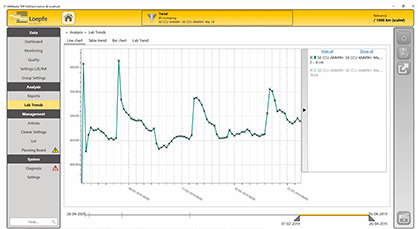
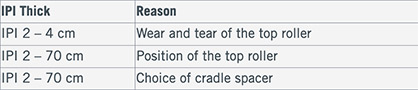
Figure 1 shows repeated IPI peaks in the range of 2 - 4 cm IPI Thick. This yarn’s irregularity pattern suggests increased wear and tear of the top roller surface due to e.g. constant friction or small grooves along the roller eventually affecting its surface structure. This is a slow, ongoing wear and tear process, which can easily be tracked with the help of “Lab Trend” in MillMaster TOP. The more the top rollers are suffering wear and tear, the more 2 - 4 cm IPI irregularities there will be in the yarn structure. Once there is an excessive increase in IPI values, it is time to take appropriate action.

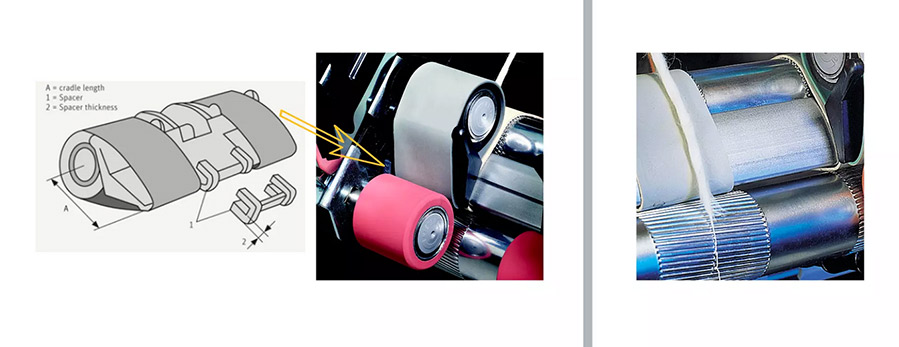
MillMaster TOP not only helps in identifying wear and tear but also helps towards the selection of the right machinery components, e.g. to determine the optimal cradle spacer for the top roller.
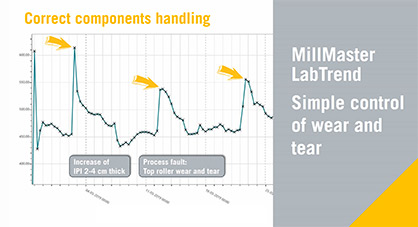
MillMaster LabTrend wear and tear © 2020 Loepfe


Figure 1: Graphic representation © 2020 Loepfe


The cradle spacer is used to optimize the main drafting zone of each ring spinning position. The selection of the right cradle spacer sometimes requires a few iterations until the optimum is found.

MillMaster TOP’s “Lab Trend” can easily visualize the influence of the used cradle spacer type and in due course contribute to achieving an optimum. This is done in real time by evaluation of 2 - 70 cm IPI Thick events, whereas the different sizes of the cradle spacers directly influence the number of these undesired thick places.

Likewise bottom apron types of various suppliers can be compared in terms of the resulting yarn quality.

Also here “Lab Trend” can easily show how different condition or quality of bottom apron types might affect the yarn irregularity and help finding the best-suitable option.

Solutions & benefits:

MillMaster TOP “LabTrend” significantly helps to identify the reasons for quality deviations and their causes without much effort. Following table provides a brief overview of the IPI influencing factors mentioned in above outlined examples.

MillMaster TOP "LabTrend" not only allows comprehensive monitoring and evaluation of the yarn quality, but also supports maintenance planning, monitoring of the machine settings and the selection of the best-suitable machine accessories.

More News from LOEPFE BROTHERS LTD.

More News on Spinning

#ITMA Asia + CITME 2026

ITMA Asia 2026: How Barmag is reshaping the future of man-made fiber production

The textile industry is entering a groundbreaking era. Manufacturers face rising energy prices, growing sustainability demands, increasing labor shortages, and an unprecedented need for flexibility. For a globally active textile industry, where competitiveness is closely linked to production efficiency and cost leadership, this means that technology is no longer merely a means of improving operational processes – it is increasingly becoming a strategic differentiator.

#Spinning

Eltex takes the tension out of heat-setting

The ACT-MULTI system developed by Eltex – a member of TMAS, the Swedish textile machinery association – is bringing individual yarn tension monitoring and automatic control to the heat-setting process, helping manufacturers maintain consistent processing conditions across every yarn position.

#Spinning

Heberlein reinforces its commitment to the Chinese market

Heberlein, globally recognised as a leading provider of air interlacing and air texturing jets for synthetic filament yarns, is consolidating its success in the Chinese market with its APh- and APe-series for DTY applications. Particularly in the field of Air Covering, Heberlein technologies combine excellent quality with significant savings in compressed-air consumption. A new service hub in Shengze City underlines the company’s long-term commitment in the Chinese market.

#Recycled Fibers

Driving circularity with Uster Recycled Fiber Matrix

The textile industry’s commitment to circularity continues to accelerate, and mechanical recycling is viewed as a targeted approach to cutting textile waste and its environmental impact. At the forefront of this drive, Uster has developed the Recycled Fiber Matrix, a two-dimensional assessment of mechanically recycled fibers to guide optimum processing and end-uses.

Latest News

#Associations

Automation, digitalization and new business models are shaping the future of footwear and leather technology

The European footwear and leather machinery industry is facing profound transformations. Global competitive dynamics, technological innovation, automation and digitalization are fundamentally reshaping markets, production processes and business models. This is one of the key findings of the new study “Threads of the Future – Footwear and Leather Technology Edition”, which was presented today by VDMA Textile Care, Fabric and Leather Technologies (VDMA TFL) during a press conference at SIMAC Tanning Tech in Milan.

#Knitting & Hosiery

SHIMA SEIKI to showcase flat knitting and digital design solutions at Egypt Stitch & Tex

Leading Japanese computerized flat knitting technologist SHIMA SEIKI MFG., LTD. of Wakayama, Japan, together with its sales representative in Egypt, TTS (EL MASRIA FOR TRADE & TECHNICAL SERVICES), will participate in the upcoming 24th International Exhibition for Textile & Carpet Machineries, Printing Technologies and Accessories (Egypt Stitch & Tex) to be held in Cairo, Egypt this month.

#Associations

EURATEX calls for urgent action on industrial competitiveness

EURATEX, the European Apparel and Textile Confederation, welcomes today’s State of the Union Address by European Commission President, Ursula von der Leyen, and in particular her recognition of Europe’s need to rebalance unfair trade, cut red tape, and strengthen its industrial and strategic autonomy.

#Raw Materials

Cotton made in Africa puts farmer dialogue at the heart of agricultural training

A new manual created by the Aid by Trade Foundation and African People & Wildlife shows how Cotton made in Africa aims to transform cotton cultivation through dialogue rather than directives.

TOP