[pageLogInLogOut]

#Spinning

FET’s game changer for the biomedical market
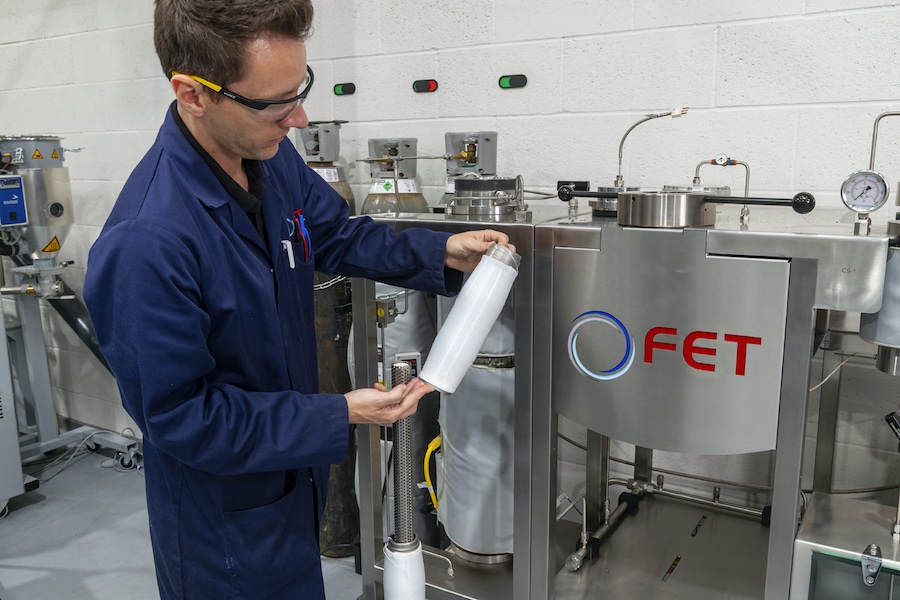
A much more sustainable, cost effective and very flexible process for manufacturing critical fibres based on ultra high molecular weight polyethylene (UHMWPE) is being launched by the UK’s Fibre Extrusion Technologies (FET).
FET’s closed-loop supercritical CO2 system can achieve more than 95% solvent recovery without loss of performance. © 2025 FET


Unbeatable properties

UHMWPE is prized in many industries due to its extraordinary properties. The fibre is, for example, ten times stronger than steel by weight, while exhibiting outstanding abrasion resistance, low friction and high impact strength. UHMWPE fibres are also chemically inert, resistant to most chemicals and UV light and do not absorb water. They maintain performance in a wide range of temperatures and despite their toughness are extremely lightweight.

As a result, they are unbeatable in demanding applications such as high-performance ropes in maritime industrial and rescue applications. In addition, they are invaluable in ballistic protection, cut-resistant clothing and high-performance sports gear – and increasingly in medical implants.

Biomedical market

“FET has supplied many extrusion systems to the biomedical market, most notably for the production of both resorbable and non-absorbable sutures,” says FET Managing Director Richard Slack. “In exploring what else we could do in assisting these customers, it became clear that there was a need for smaller quantities of UHMWPE fibres in bespoke sizes.”

“The current systems for manufacturing UHMWPE filament yarns are on a huge scale, with very complex processing routes,” adds Research and Development Manager Jonny Hunter. “This means the supply chain is currently very inflexible with minimal opportunity for new product development. These disadvantages have been fully addressed in the development of our new FET-500 series lab and small scale gel spinning system.”
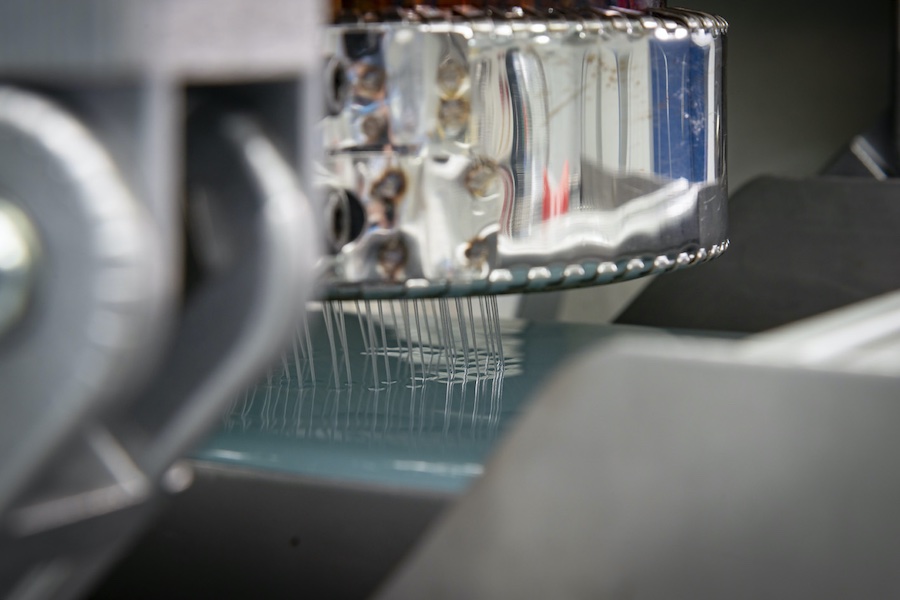
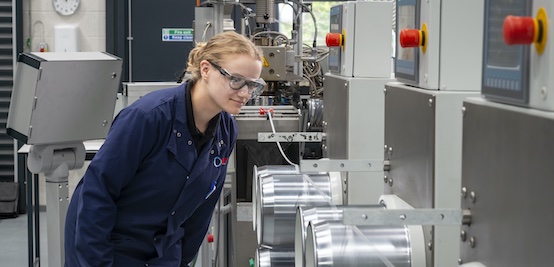
The FET-500 gel spinning system in action close up. © 2025 FET


Solvent extraction

A major FET innovation is the introduction of a patented batch system for solvent extraction exploiting supercritical carbon dioxide (CO2).

UHMWPE production, until now, has involved the use of large volumes of hazardous solvents such as dichloromethane (DCM) or hexane. The UHMWPE powder is mixed with mineral oil to form a gel which is subsequently extruded, cooled and solidified. The oil is then extracted from the fibres using DCM or hexane and the solid fibres are then drawn at high temperature to further align the polymer chains, resulting in final strong and tough fibres. Typically, it takes 10 kg of Hexane to extract 1 kg of oil. 

“Solvent reclamation using extraction baths and hot air drying chambers is not practical for the scale of our system,” explains FET’s Senior Material and Process Scientist Kris Kortsen. “The current baths employed can be up to 200 metres long and the waste volumes are considerable. Expertise is needed in dealing with such dangerous chemicals and overall the process has an immense environmental impact.

“CO2, by contrast, is a cheap and abundant sustainable solvent that is non-toxic, non-flammable and leaves no residue.” 

Closed loop

FET’s closed-loop system can achieve more than 95% solvent recovery without loss of performance, resulting in residue-free UHMWPE filament yarns via a vastly improved route in terms of both safety and logistics.

A further innovation is the highly modular drawing system based on heated godet rollers, enabling flexible temperature and drawing control for new product development and the ability to be expanded at any time to meet customer needs.

A comprehensive LCA study detailing the full savings potential is currently being prepared and will be published shortly.

“Having processed over 130 separate polymers in the development of our extrusion systems, we believe the FET-500 is a game changer,” concludes Richard Slack. “We believe there is a big gap in the market for smaller quantities of UHMWPE, and our first line is now fully operational at the FET Fibre Development Centre in Leeds. We look forward to demonstrating it and discussing its full potential with interested companies from around the world.”
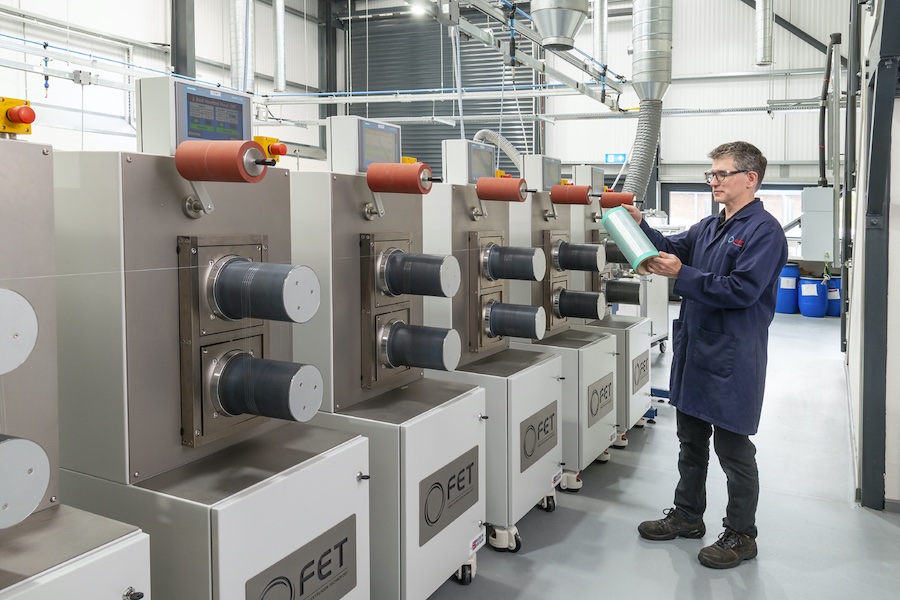
A highly modular drawing system based on heated godet rollers enables flexible temperature and drawing control for new product development. © 2025 FET


More News from Fibre Extrusion Technology Ltd.

More News on Spinning

#Recycling / Circular Economy

Rieter and partners launch Recycling Powerhouse for industrial-scale textile recycling

Recycling Powerhouse Ltd. was established in July 2026 to industrialize, standardize and scale textile recycling. Based in Switzerland, the venture will operate a franchise-driven business model that enables the production of high-quality, certified recycled yarns. The project is supported by the following partners: Rieter Group, the world’s leading system supplier for natural and man-made fibers, Säntis Textiles, a Swiss textile engineering company, and Valvan, a Belgian sorting technology company. The first blueprint franchise operation is scheduled to launch early 2027 in partnership with Suhail Industrial Holding Group in Qatar.

#Spinning

Rieter sees Barmag integration on track as orders and sales rise

The first half of 2026 was shaped by the successful completion of the largest acquisition in Rieter’s history. The Man-Made Fiber Division enables entry into the growth segment of man-made fibers and sustainably strengthens Rieter’s market position in the Asia region. The expanded Group is now the world’s leading system supplier for the processing of natural and man-made fibers. In the first half of the year, initial cost savings in material costs and operating expenses have already been realized. The targeted synergies are expected to amount to at least CHF 20 million by the end of the 2028 financial year. Due to the completion of the acquisition on February 2, 2026, the first half of the year for the Man-Made Fiber Division only amounts to five months.

#Spinning

Barmag Fuzhou Customer Day concludes successfully, boosting high-quality chemical fiber growth in Fujian & Guangdong

Barmag hosted its Customer Day themed “A New Era. Powered by Innovation.” in Fuzhou on June 28, welcoming nearly one hundred invited customers from Fujian and Guangdong provinces. Georg Stausberg, CEO of Barmag Group, attended along-side the sales and R&D expert China team to jointly present integrated solutions covering the entire man-made fiber value chain.

#Spinning

STEELTOP®: A new benchmark in flat tops for spinning preparation

Modern carding generations achieve higher production performance, placing significantly greater stress on flat tops. Higher cylinder speeds and increased fiber density, combined with tighter carding gaps, create more demanding operating conditions. At the same time, poorer raw material quality and the increased use of recycled materials further intensify these challenges. With STEELTOP®, Trützschler introduces a new full steel flat top series developed for these demanding modern carding processes.

Latest News

#Digital Printing

Where every detail counts: Experiential applications of DTF and UV-DTF printing

Personalisation has moved far beyond the traditional logo on a t-shirt. Today, brands want to create complete experiences, where every detail – from clothing and accessories to décor and packaging – feels distinctive and reflective of their identity.

#Europe

The Digital Product Passport registry is now live

On 20 July, the European Commission launched the Digital Product Passport Registry together with a testing environment, marking an important milestone in making the Digital Product Passport (DPP) a practical reality for businesses placing products on the EU market.

#Europe

EU ban on destroying unsold clothing and footwear now in force

The European Union's ban on the destruction of unsold clothing, clothing accessories and footwear has entered into force. Since July 19, 2026, large companies across the EU have been prohibited from destroying unsold textile products, while medium-sized companies will be required to comply with the same rules from 2030.

#Recycled Fibers

Eastman Naia™ brings its inside-out denim vision to Kingpins New York

Following its debut at Kingpins Amsterdam, Eastman Naia™ brings the next chapter of its denim story to Kingpins New York, taking place July 22–23. At Booth Green 7, Naia™ presents its denim proposition built around three complementary design directions: Performance Denim, Fashion Denim and Authentic Denim.

TOP