[pageLogInLogOut]

#Retail & Brands

H&M Group drives the agenda on collaborative financing solutions for impactful climate action
© 2023 H&M
H&M Group is taking a leadership position in establishing collaborative financing solutions that enable the necessary decarbonisation of fashion supply chains. To realise this ambition, H&M Group, together with Southeast Asia’s largest bank, DBS, has initiated a collaborative finance tool – a first-of-its-kind green loan programme that facilitates supply chain decarbonisation in the apparel sector.

The 28th Conference of the Parties of the UNFCCC (COP 28), the world’s highest decision-making platform for climate issues, will bring together heads of state, climate experts, political leaders, youth delegates and civil society in Dubai this week. This time, the conference aims to build on previous successes and pave the way for future ambition to effectively tackle the global challenge of climate change. H&M Group’s and DBS’ representatives will be on site to engage on emerging policies and to discuss best practices and innovative solutions. 

"H&M Group has been engaged in climate mitigation for years and we continuously push ourselves to demonstrate climate leadership within our industry. We see that our industry is committed to tackle its negative climate impact. But we also see that impactful climate action requires collaborative financing. For us, sustainability investments are not only a responsible approach but a strategic necessity for future success."

Ulrika Leverenz, Head of Green Investment, H&M Group


"Accelerating net zero for supply chains requires the rapid scaling of low-carbon technologies and new, innovative financing models to drive adoption. The collaborative finance tool is a prime example of how we can create impact for suppliers. DBS is excited to be harnessing our extensive network in Asia, in partnership with H&M Group, to provide access to sustainable financing in a practical way – by directly funding factory upgrades to help suppliers improve their energy efficiency and decarbonise."

Tan Su Shan, Group Head of Institutional Banking, DBS 


© 2023 H&M
© 2023 H&M


In line with the group’s ambition to achieve net-zero CO2e emissions by 2040, H&M Group has for the past years set focus on making funding available to reduce greenhouse gas emissions across and beyond its own supply chain. Its Green Fashion Initiative enables supplying factories to invest in the technologies and processes needed to reduce energy demand and replace fossil fuels across the fashion industry. 

© 2023 H&M
© 2023 H&M


To help accelerate the adoption of green initiatives across the supply chain, a collaborative finance tool was developed. Through the programme, suppliers get access to financing from DBS and technical support from sustainability consultant, Guidehouse, to embark on factory upgrades to decrease their climate impact. Unlike traditional banking solutions which seek to encourage such green activities indirectly, this programme directly provides financing with highly favourable terms to suppliers for specific GHG emission reduction activities, as approved by H&M Group.

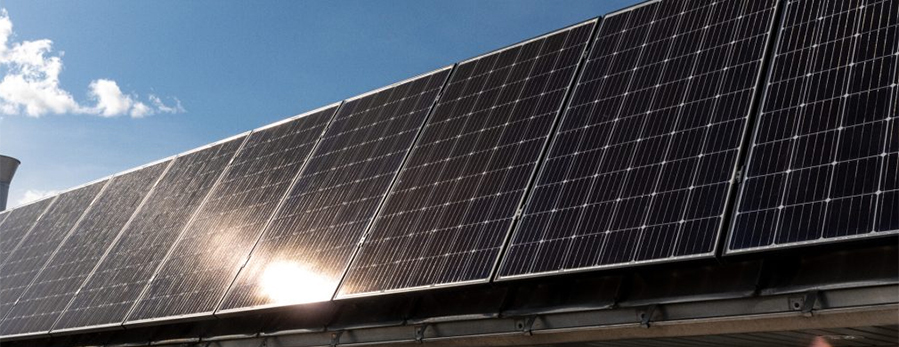
Earlier this year, the collaborative finance tool completed the first successful transaction with a manufacturer in India to fund capital expenditures to reduce scope 3 greenhouse gas emissions. With the support of the loan, supplier Raj Woollen financed the installation of solar panels, energy-efficient motors, as well as water conservation technologies to conserve resources and reduce carbon emissions. 


"Raj Woollen is committed to its sustainability and environmental initiatives, and one key goal is to reduce the impact of our manufacturing processes on the environment. This joint project with H&M Group, Guidehouse, and DBS has been a successful combination of expert energy assessment, close support in selecting the most suitable technology solutions, and an attractive financing model. We are confident that this will ensure the highest possible results in our decarbonisation journey, and we are grateful for this partnership."

Sumeet Nath, Raj Woollen Industries


Recognising the complexity and scope of the climate challenge, H&M Group identifies collaboration as a cornerstone of its climate action framework and collaborative financing efforts as the only way to create rapid change at scale. Existing collaborative financing models and those currently under development have the potential to build an ecosystem of solutions. However, further commitment from brands and investors is needed to co-invest and share the financial responsibility of a project and give further alternatives to support suppliers in their decarbonization journey. H&M Group encourages other brands and financial institutions to join its initiative and the group’s COP28 delegation is looking forward to meeting involved stakeholders at the conference to continue the dialogue.
More News from TEXDATA International

#ITM 2026

ITM 2026: The new geography of textile production

New production hubs are emerging across North Africa and Central Asia, while Türkiye is accelerating its transformation toward higher-value, technology-driven and more sustainable textile manufacturing.

#Research & Development

“Production is a product”

From technical textiles and AI-driven robotics to the limitations of textile circularity: Professor Dr Thomas Gries looks back on more than two decades of development at ITA Aachen. In the interview, he explains why production technology remains a decisive success factor, discusses international collaborations and innovation ecosystems, and shares his views on the transformation of production landscapes and the challenges facing an increasingly regulated industry.

#Knitting & Hosiery

“We need to move away from the price trap and return to a value-driven mindset.”

With its new Textile Innovation Center, KARL MAYER is sending a strong signal for innovation, collaboration, and the future of textile applications. In this interview, Karl Josef Mayer discusses new opportunities in warp knitting, the processing of staple fibres, recycling, the changing role of machinery manufacturers, and why the textile industry must once again focus more strongly on the value of textiles. by Oliver Schmidt

#Associations

“Innovation, resilience and international experience remain the great strengths of the Swiss textile machinery industry”

Geopolitical uncertainty, growing competitive pressure from China, new free trade agreements and the shift towards a circular economy are currently reshaping the global textile industry. In this interview, Cornelia Buchwalder discusses the current mood within the Swiss textile machinery sector, the industry’s distinctive innovative strength, new market opportunities in India and Asia, and the technological trends that could shape the upcoming trade fair cycle leading up to ITMA 2027.

More News on Retail & Brands

#Textiles & Apparel / Garment

Global size study for brands and retailers to optimize fit and market coverage

Hohenstein Apparel Fit Solutions, a global leader in apparel fit, sizing, and product development, today announces the launch of its Global Size Study, a new initiative designed to equip brands to better understand and serve their target consumers through more accurate, market-relevant sizing.

#Recycling / Circular Economy

Recover™ secures multi-year recycled cotton agreement with H&M

Recover™ has signed a multi-year agreement with H&M to support the integration of its recycled cotton fiber, RCotton, for use in H&M’s products. Since early 2024, H&M and Recover™ have collaborated on product development, which now enables scaled commercial introduction of Recover™ mechanically recycled cotton into H&M’s collections.

#Sustainability

GORE-TEX® KIDSWEAR launches innovative membership scheme for kids’ jackets

With its revolutionary new membership model, GORE-TEX® Kidswear now offers families a simple, flexible and sustainable way of kitting out their children in top-quality jackets. It is aimed at the parents of children aged between five and ten and kicks off with a choice of functional winter jackets.

#Sustainability

H&M Foundation funds pioneering initiative to build the factories of the future

The H&M Foundation is committing SEK 53 million (approx. EUR 5 million) towards Future Forward Factories, a five-year initiative led by Fashion for Good, to address fashion’s most polluting stage: tier 2 textile processing.

Latest News

#ITM 2026

KARL MAYER presents a textile TEXTRONIC® innovation at ITM 2026

With highly efficient machines and continuous textile innovations, KARL MAYER underscores its role as a reliable partner for discerning top-tier customers. Just in time for ITM 2026 in Istanbul, the industry leader is introducing a true innovation: an eyelash lace with its characteristic fringed look – combined with a previously unattainable 4-way stretch. While the established fabric could until now only be produced as rigid version or with one-dimensional stretch, the new elasticity in both dimensions expands the possibilities for cross-band panel fabrics.

#Raw Materials

Better Cotton Initiative welcomes new and returning Council members

The Better Cotton Initiative (BCI) has confirmed a series of appointments and reappointments to its Council, the multistakeholder board responsible for BCI’s strategic direction.

#Man-Made Fibers

DYNEEMA® and NP Aerospace advance personal protection for military servicewomen

Dyneema®, owned by Avient Corporation, an innovator of materials solutions, is supplying its high-performance unidirectional (UD) materials to world-leading armor manufacturer NP Aerospace, enabling the production of armor systems designed specifically to fit the female body. With 2,000 new armor systems, including 4,000 plates, made in the United Kingdom (UK) and delivered in June 2026, this collaboration addresses a long-standing lack of high-quality personal protection specially built for female defense and security personnel.

#Man-Made Fibers

Textile Exchange publishes comprehensive polyester LCA study

Textile Exchange has released a new Life Cycle Assessment (LCA) study on polyester, providing detailed data on the environmental impacts of both virgin and recycled polyester production. The study aims to strengthen understanding across the fashion, textile and apparel industries and support more informed decision-making regarding polyester sourcing and production.

TOP