[pageLogInLogOut]

#Research & Development

Panty liners prevent bacterial vaginosis
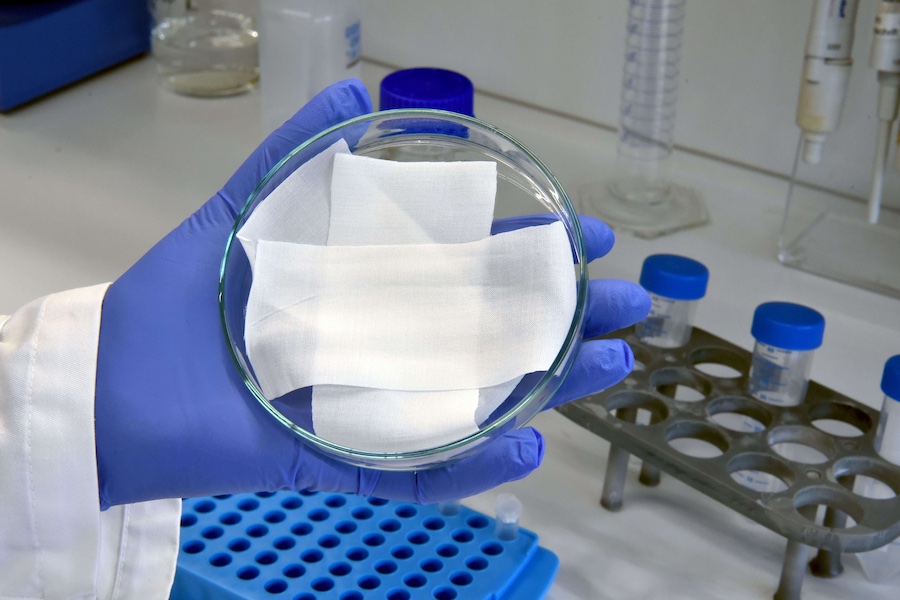
Textile finished with pH-lowering active substances before pH measurement. © 2025 Photo: DITF
Worldwide, almost one third of women of childbearing age suffer from bacterial vaginosis. This is when the sensitive microbiome of the vagina becomes unbalanced. Such a disorder of the vaginal flora can cause urogenital infections, abscesses on the ovaries or fallopian tubes or premature births. This significantly increases the risk of infertility in women and of contracting a sexually transmitted disease or HIV.

As part of a BW Sprint project, the German Institutes of Textile and Fiber Research Denkendorf (DITF) have laid the basis for the development of a panty liner that supports the health of the vaginal environment and can prevent bacterial vaginosis.

The microbiome is the totality of all microorganisms such as bacteria, viruses and fungi on and in the human body. It is of central importance for the immune system. If the microbiome is out of balance, pathogens can spread more quickly. A disorder of the vaginal flora often results in a reduction of lactic acid bacteria present in a healthy microbiome, resulting in less lactic acid (lactate) being released and a significant increase in the pH value in the vagina. This increases the risk of bacterial vaginosis.

There is currently no satisfactory prevention or treatment for bacterial vaginosis. Treatment with antibiotics in accordance with medical guidelines leads to a relapse rate of around 50 percent. This places a heavy physical and, in most cases, psychological stress on the women affected.

At the DITF, a research team has laid the basis for the development of a panty liner loaded with lactide. Lactide is the cyclic diester of lactic acid. It can be incorporated into a textile carrier in various ways. An effective method is to spin a solution of polymer and active substance into fibers. The application of a coating loaded with active substance to a cellulose textile was also tested at the DITF. When the panty liner is worn, the lactide released in the physiological environment turns into lactic acid (lactate). The pH value in the vaginal environment can be lowered to a “healthy”, slightly acidic level. This can make a decisive contribution to preventing bacterial vaginosis and avoiding its recurrence.
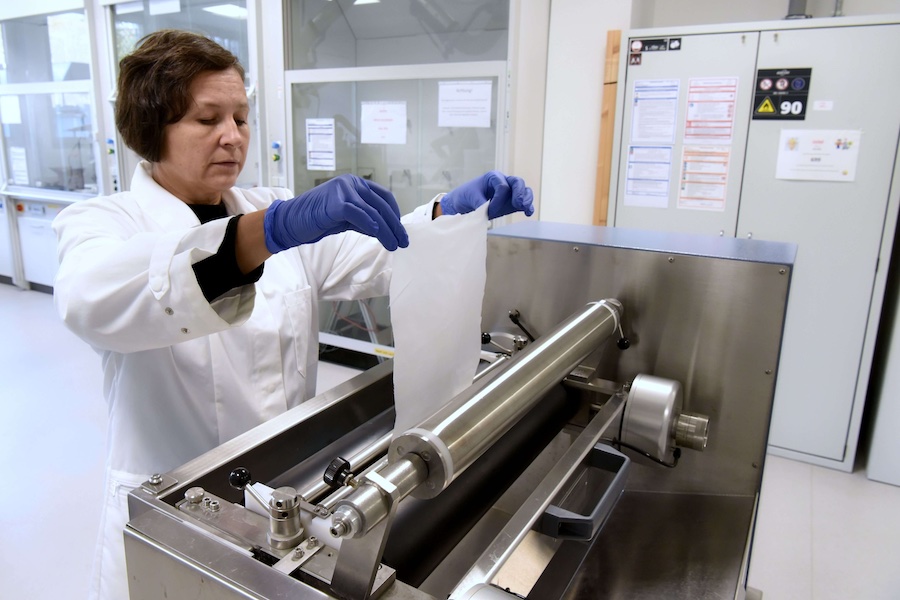
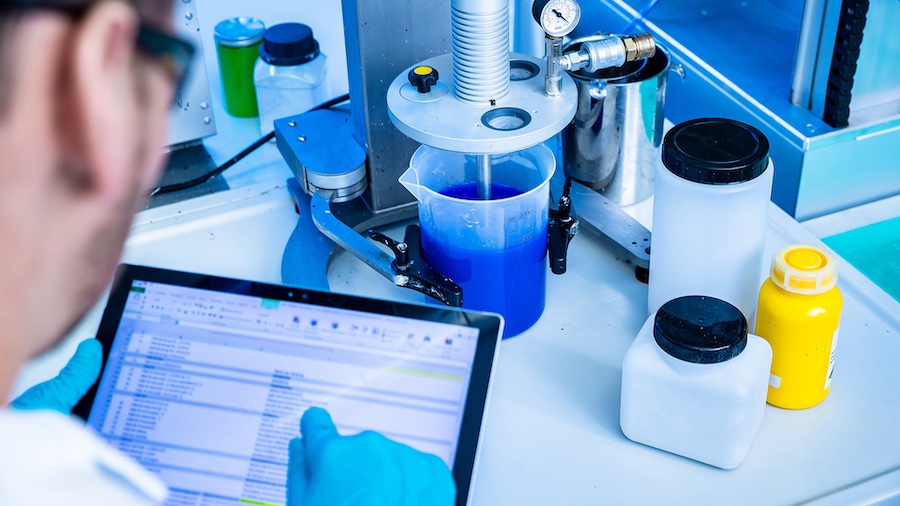
Finishing a fabric on a laboratory padder. © 2025 Photo: DITF


The release rate of the active substance must take into account the actual duration of use of panty liners. To achieve this, an active substance had to be found that is released within a few minutes for a few hours in a temperature- and moisture-controlled manner. Another requirement is to use resource-saving and environmentally friendly materials.

Initial tests with simulated vaginal fluid showed that lactide-loaded fibers and coated fabrics can reduce the pH value from an “unhealthy” value of over 4.6 to a “healthy” value of 3.8 within a short period of time.

Further research projects will continue to pursue this promising approach toward a preventively effective panty liner. To this end, a realistic vaginal test model will be developed to further optimize the textile materials loaded with active substances. The focus will be on body and environmental compatibility.
More News from Deutsche Institute für Textil- und Faserforschung Denkendorf

#Research & Development

More safety and comfort for protective clothing thanks to auxetic fabrics

When everyday materials are pulled, they stretch or elongate in the direction of the pull and become narrower in cross-section. We can also observe this property in two-dimensional textiles. Auxetic structures behave differently here. They have the striking property of not changing under tensile stress or even increasing their width or thickness. These properties are advantageous, for example, in protective textiles or textile filter media. The DITF are researching auxetic fabrics for various applications.

#Research & Development

DITF send a signal for climate protection

The German Institutes of Textile and Fiber Research Denkendorf (DITF) have successfully implemented extensive investments in photovoltaic systems at their site in Denkendorf. The systems installed on the roofs of the buildings and covered parking lots have a total installed capacity of 840 kilowatt peak (kWp). The DITF invested 1.6 million euros in this with the support of the state of Baden-Württemberg. The system was ceremonially put into operation on September 17, 2025.

#Research & Development

4.2 million Euros for research into textile recycling

Around the world, used textiles are still rarely recycled and pile up into huge mountains of waste. A recent study by the Boston Consulting Group (BCG) drew attention to this problem. However, the low recycling rate is also due to the fact that only a small percentage of used textiles are actually suitable for recycling into high-quality materials and for demanding applications. The German Institutes of Textile and Fiber Research Denkendorf (DITF) are addressing this problem with their research.

#Research & Development

Denkendorf fiber chart revised

A companion during studies and for practical use in the workplace: generations of textile experts have used the Denkendorf Fiber Chart to keep track of all the important characteristic values of textile raw materials. Following the first two editions in the 1970s and 1980s, Denkendorf scientists have comprehensively revised the Fiber Chart. The third edition is now available in digital form for the first time.

More News on Research & Development

#Research & Development

Fraunhofer CCPE presents the “Monomaterial Design Set” – Innovative solutions for circular product design

Composite materials made from different types of plastic often extend the lifetime of products but make recycling more difficult in the circular economy. That is why Fraunhofer CCPE has developed the “Monomaterial Design Set”. This new approach helps to reduce the variety of plastics used in durable products and offers circular solutions for designers and product developers.

#Research & Development

How innovations drive BASF’s success

“Innovation has always been part of BASF’s DNA. Especially in these volatile times, it is crucial to leverage our innovative strength to develop competitive solutions that differentiate us as a company in our markets and give us a competitive edge,” said Dr. Stephan Kothrade, Member of the Board of Executive Directors of BASF and Chief Technology Officer, at the company’s Research Press Briefing held today. To achieve this, BASF implemented its “Winning Ways” strategy about a year ago with the clear goal of becoming the preferred chemical company to enable its customers’ green transformation.

#Research & Development

Small tolerances, big impact and a recyclable alternative to elastane

ITA Master's student Janne Warnecke investigated tension differences over the fabric width in the weaving process and thereby contributed to quality assurance; ITA Bachelor's student Jasmin Roos found a basis for the development of recyclable yarns and textiles. For these developments, they were awarded the Walter Reiners Foundation's Promotion and Sustainability Prizes on 27 November. Peter D. Dornier, Chairman of the Walter Reiners Foundation, presented the awards at the Aachen-Dresden-Denkendorf International Textile Conference (ADD-ITC) in Aachen, Germany.

#Associations

Young researchers recognised for cutting-edge work in recycling, fibre technology and textile mechanics

At the Aachen-Dresden-Denkendorf International Textile Conference held in Aachen at the end of November, Peter D. Dornier, Chairman of the Walter Reiners Foundation of the VDMA, honoured five successful young engineers. Promotion and sustainability prizes were awarded in the categories bachelor/project theses and diploma/master theses. Academic theses that develop solutions for resource-saving products and technologies, for example, are eligible for the sustainability awards.

Latest News

#Heimtextil 2026

Mimaki demonstrates versatile, simple TRAPIS textile printing at Heimtextil 2026

Mimaki’s textile pigment transfer printing system, TRAPIS, is able to print on a diverse range of fabrics - unlike traditional processes - including natural fibres and synthetic fabrics. The full solution will be shown on Mimaki’s booth (Hall 3.0 Stand A97), as the company returns to Heimtextil to showcase its advancements in sustainable, high quality and efficient textile printing.

#ITM 2026

The Technology Hub for global denim trends: ITM 2026

The ITM 2026 International Textile Machinery Exhibition, to be held at the Tüyap Fair and Congress Center in Istanbul from June 9–13, 2026, brings together groundbreaking technologies in denim production. From smart production systems to eco-friendly raw materials, from digital washing solutions to laser effect technologies, innovations that will shape the future of denim will be showcased for the first time at ITM 2026.

#Natural Fibers

38th International Cotton Conference Bremen: Let´s Talk about Cotton!

The 38th International Cotton Conference Bremen, to be held on 25-27 March 2026 in Bremen’s parliament building on market square, once again sends a powerful signal for professional excellence and international dialogue. The focus is on the latest market trends and technical innovations throughout the entire value chain – from agriculture and quality assurance to processing and the circular economy. With its high-calibre speakers, the conference remains an indispensable forum for anyone involved in shaping the cotton industry scientifically, technically, or economically.

#Recycled_Fibers

Leading fashion brands step up to unlock the next chapter of Circulose

Since 2024, under new ownership and leadership, Circulose has set a renewed strategic direction focused on securing long-term commitments with partner brands to bring CIRCULOSE® back to market at scale. This strategy has proven successful.

TOP