[pageLogInLogOut]

#Research & Development

4.2 million Euros for research into textile recycling
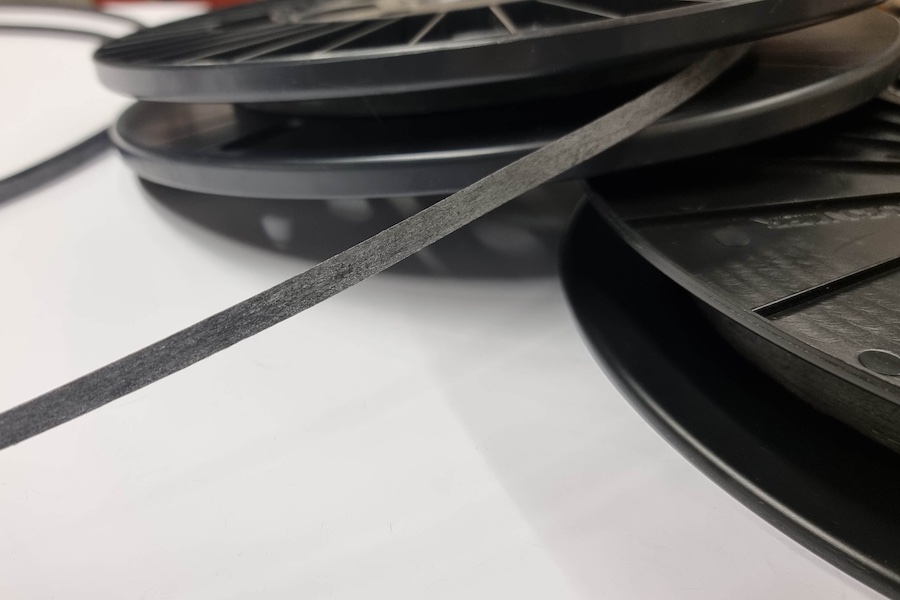
Around the world, used textiles are still rarely recycled and pile up into huge mountains of waste. A recent study by the Boston Consulting Group (BCG) drew attention to this problem. However, the low recycling rate is also due to the fact that only a small percentage of used textiles are actually suitable for recycling into high-quality materials and for demanding applications. The German Institutes of Textile and Fiber Research Denkendorf (DITF) are addressing this problem with their research.
Tapes for high-performance applications made from recycled carbon fibers. © 2025 DITF


Europe's largest textile research center has launched two research projects with a total project volume of over 4.2 million euros.

To promote the recycling of high-performance fibers such as carbon and glass fibers, the DITF will establish a center for the development of high-performance fiber composite structures based on recycled high-performance fibers (HiPerReF) over the next two years. There, scientists are developing a complete process chain for the industrial-scale production of highly oriented semi-finished products from recycled carbon and glass fibers. In order to achieve maximum performance in the component, the interaction of all machines and equipment is being optimized to produce commercially available semi-finished products such as prepreg and non-porous composite plastics with a fiber volume fraction of over 45 percent.

The CYCLOTEXUM project focuses on recycling classic textile waste into high-quality yarns. The aim is to intelligently combine existing mechanical, physical, and chemical process steps so that fine, uniform yarns can be produced from secondary raw materials. The Material Flow and Cost Accounting (MFCA) developed at the DITF makes it possible to review all technological developments for economic efficiency and sustainability.

The research work of the two centers provides the national and global textile industry with effective tools and solutions for an effective textile circular economy.
More News from Deutsche Institute für Textil- und Faserforschung Denkendorf

#Research & Development

Panty liners prevent bacterial vaginosis

Worldwide, almost one third of women of childbearing age suffer from bacterial vaginosis. This is when the sensitive microbiome of the vagina becomes unbalanced. Such a disorder of the vaginal flora can cause urogenital infections, abscesses on the ovaries or fallopian tubes or premature births. This significantly increases the risk of infertility in women and of contracting a sexually transmitted disease or HIV.

#Research & Development

DITF send a signal for climate protection

The German Institutes of Textile and Fiber Research Denkendorf (DITF) have successfully implemented extensive investments in photovoltaic systems at their site in Denkendorf. The systems installed on the roofs of the buildings and covered parking lots have a total installed capacity of 840 kilowatt peak (kWp). The DITF invested 1.6 million euros in this with the support of the state of Baden-Württemberg. The system was ceremonially put into operation on September 17, 2025.

#Research & Development

Denkendorf fiber chart revised

A companion during studies and for practical use in the workplace: generations of textile experts have used the Denkendorf Fiber Chart to keep track of all the important characteristic values of textile raw materials. Following the first two editions in the 1970s and 1980s, Denkendorf scientists have comprehensively revised the Fiber Chart. The third edition is now available in digital form for the first time.

#Research & Development

Carbowave: Energy efficiency in carbon fiber production

A new technology uses microwaves and plasma heating to produce carbon fibers in an energy-efficient manner. This means high-strength composite materials can be produced more cheaply and efficiently. The German Institutes of Textile and Fiber Research (DITF) are part of the Carbowave research consortium, which aims to improve and commercialize microwave and plasma-induced carbonization.

More News on Research & Development

#Associations

Young researchers recognised for cutting-edge work in recycling, fibre technology and textile mechanics

At the Aachen-Dresden-Denkendorf International Textile Conference held in Aachen at the end of November, Peter D. Dornier, Chairman of the Walter Reiners Foundation of the VDMA, honoured five successful young engineers. Promotion and sustainability prizes were awarded in the categories bachelor/project theses and diploma/master theses. Academic theses that develop solutions for resource-saving products and technologies, for example, are eligible for the sustainability awards.

#Research & Development

The region of renewable raw materials: Central German Alliance for Bioplastics

The development of sustainable plastic solutions is rapidly gaining importance in light of global environ- mental pollution, dwindling fossil resources and ambitious climate protection targets. As part of the re- gional alliance RUBIO, which brings together 18 partners from central Germany and the Berlin-Branden- burg area, the bio-based and biodegradable plastic polybutylene succinate (PBS) was comprehensively investigated, starting with the raw material, through the manufacturing process, to industrial application.

#Nonwoven machines

Cooperation in the field of meltblown laboratory technology

The Nonwoven Institute (NWI) at North Carolina State University and Oerlikon Nonwoven will be collaborating in the field of meltblown laboratory technology in the future. This was announced by Professor Raoul Farer, Executive Deputy Director of the NWI and Professor at the Wilson College of Textiles at North Carolina State University, and Dr. Ingo Mählmann, Sales Director Nonwoven at Oerlikon Neumag, during this year's ITMA Asia and CITME in Singapore.

#Recycling / Circular Economy

European research project addresses textile waste through integrated recycling technologies

A major European research initiative coordinated by Fraunhofer UMSICHT has been launched to develop integrated solutions for textile waste recycling. The AUTOLOOP project aims to create a comprehensive system that could process 1.24 million tonnes of textile waste annually by 2050, whilst potentially creating over 130,000 green jobs across the EU. This project aims to develop, test and integrate automated sorting, tracing, and closed-loop recycling technologies for polyester-based textiles (NRT), addressing the pressing challenge of textile waste management.

Latest News

#Exhibitions & Events

Groz-Beckert showcases textile innovation at ShanghaiTex 2025

From December 16 to 19, 2025, the global textile industry will gather at ShanghaiTex at the Shanghai New International Expo Center (SNIEC), where Groz-Beckert will present its latest highlights and innovations across its five product areas – Knitting, Weaving, Nonwovens, Sewing, and Spinning – at Hall N3, Booth A05.

#Man-Made Fibers

Teijin Carbon Europe receives EcoVadis Silver status – ranked among the top 15% of evaluated companies

Teijin Carbon Europe (TCE) has been recognized for its sustainability performance and has been awarded the EcoVadis Silver Medal in the latest assessment. In its first-ever EcoVadis evaluation, the company achieved a notable 72 out of 100 points, ranking among the top 15% of all companies evaluated worldwide, within the “Manufacture of Man-Made Fibres” category.

#Weaving

Vandewiele Group: Innovation across the textile value chain at ICFE Istanbul 2026

At the 2026 Istanbul Carpet & Flooring Expo (ICFE), Vandewiele Group presents its latest advancements spanning the entire textile value chain. From spinning and weaving to tufting, carpet manufacturing and digital finishing, the Group demonstrates how integrated innovation can boost performance, efficiency and sustainability across all stages of production. As a global technology leader, Vandewiele continues to develop solutions that strengthen processes, enhance product quality and enable smarter, greener manufacturing.

#Recycling / Circular Economy

Advanced Recycling Conference 2025 fuels innovation across key waste streams

The Advanced Recycling Conference (ARC) 2025 brought together nearly 220 experts from 28 countries to spotlight pioneering advancements and foster industry collaboration in recycling across diverse waste streams including plastics, textiles, automotive and other materials.

TOP