[pageLogInLogOut]

#Research & Development

TU Dresden’s ITM and KOTMI sign MOU to promote research into recycled fibers and industrial textile applications

The Institute of Textile Machinery and High Performance Material Technology (ITM) at TU Dresden and the Korea Textile Machinery Convergence Research Institute (KOTMI) have signed a Memorandum of Understanding (MOU) to strengthen their collaboration in recycled fiber applications for industrial textile products. The agreement marks a significant step in fostering joint research and development in sustainable textile technologies.


Driving innovation in recycled fiber applications

The strategic partnership between ITM and KOTMI aims to accelerate research in the use of recycled fibers for industrial textiles, focusing on eco-friendly solutions for the textile and fiber industry. The MOU also facilitates:

+ Cooperation on government-funded projects

+ Establishment of professional exchange and collaboration networks

+ Joint research efforts in sustainable textile innovations

Collaboration in the ecoLoop-rCF-yarn project

KOTMI is already an active research partner of ITM in the international project “EcoLoop-rCF-Yarn”, which focuses on:

+ Energy-efficient loop technologies for recovering recycled carbon fibers (rCF)

+ Development of dust- and twist-free hybrid yarns and fabrics for composite applications in the automotive industry

This project is jointly funded by the Federal Ministry of Economics and Climate Protection (BMWK) in Germany under the Central Innovation Program for SMEs (ZIM) and by the Ministry of Trade, Industry and Energy (MOTIE) of the Republic of Korea.

Strengthening scientific cooperation between Germany and Korea

The signing of this MOU reinforces scientific ties between Germany and South Korea, enhancing collaboration in sustainable textile technologies. By aligning efforts in research and innovation, both institutions aim to contribute to the advancement of environmentally responsible textile solutions for various industrial applications.

This agreement underscores the commitment of ITM and KOTMI to pioneering sustainable textile developments, fostering a global approach to research in fiber and textile technologies.

More News from Institute of Textile Machinery and High Performance Material Technology (ITM)

#Research & Development

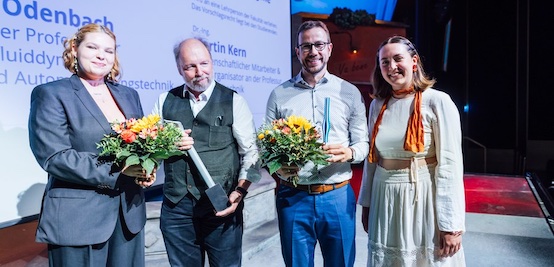
Teaching Award for the Day Of The Faculty of mechanical science and engineering 2025

On June 28, 2025, almost 300 guests celebrated the Day of the Faculty of Mechanical Science and Engineering at the Boulevardtheater Dresden. At this year's ceremony, over 60 graduates from the Mechanical Engineering, Process Engineering and Natural Materials Technology and Material Science degree programs were given a ceremonial send-off into professional life, 9 doctoral graduates were congratulated on the successful completion of their dissertations and prizes worth a total of 13,500 euros were awarded.

#Research & Development

Award at the SAMPE Germany Symposium 2025 for outstanding dissertation

Hung Le Xuan was awarded the Innovation Prize at the SAMPE Germany Symposium 2025 last week for his dissertation "Novel textile reinforcements with integrated textile-based in-situ sensors for the reinforcement of existing concrete structures against short-term dynamic events".

#Research & Development

Commissioning of the FRS 1800 high-temperature rheometer at the ITM

In March 2025, the new Furnace System 1800 (FRS 1800) high-temperature rheometer from Anton Paar was put into operation at the Institute of Textile Machinery and High Performance Material Technology (ITM) at TU Dresden. The installation was carried out by Fabian Barth and Peter Brandes from Anton Paar in collaboration with Florian Pötzsch and Dr. Dilbar Aibibu from the ITM.

#Research & Development

Wood wool instead of crude oil: Scientists at TU Dresden develop sustainable biocomposites

In the "Lignowool_2" project, TUD researchers are developing a composite material made of wood wool and biodegradable, textile plastic fibers. The so-called lignowool composites represent a sustainable alternative to petroleum-based plastics. In future, they are to be used in the automotive industry for door panels and trunk floors, for example. This is a technical application of wood wool and promotes the use of natural materials.

More News on Research & Development

#Research & Development

The region of renewable raw materials: Central German Alliance for Bioplastics

The development of sustainable plastic solutions is rapidly gaining importance in light of global environ- mental pollution, dwindling fossil resources and ambitious climate protection targets. As part of the re- gional alliance RUBIO, which brings together 18 partners from central Germany and the Berlin-Branden- burg area, the bio-based and biodegradable plastic polybutylene succinate (PBS) was comprehensively investigated, starting with the raw material, through the manufacturing process, to industrial application.

#Nonwoven machines

Cooperation in the field of meltblown laboratory technology

The Nonwoven Institute (NWI) at North Carolina State University and Oerlikon Nonwoven will be collaborating in the field of meltblown laboratory technology in the future. This was announced by Professor Raoul Farer, Executive Deputy Director of the NWI and Professor at the Wilson College of Textiles at North Carolina State University, and Dr. Ingo Mählmann, Sales Director Nonwoven at Oerlikon Neumag, during this year's ITMA Asia and CITME in Singapore.

#Recycling / Circular Economy

European research project addresses textile waste through integrated recycling technologies

A major European research initiative coordinated by Fraunhofer UMSICHT has been launched to develop integrated solutions for textile waste recycling. The AUTOLOOP project aims to create a comprehensive system that could process 1.24 million tonnes of textile waste annually by 2050, whilst potentially creating over 130,000 green jobs across the EU. This project aims to develop, test and integrate automated sorting, tracing, and closed-loop recycling technologies for polyester-based textiles (NRT), addressing the pressing challenge of textile waste management.

#Research & Development

Feasibility study shows potential to convert textile waste into PHB bioplastic

Textile waste could serve as a valuable source of raw materials for sustainable plastics in the future, according to the joint TexPHB feasibility study conducted by the Fraunhofer Institute for Applied Polymer Research IAP, Beneficial Design Institute GmbH and matterr GmbH. The study will be presented to the public for the first time at a network meeting on 25 November 2025 at the State Chancellery in Potsdam.

Latest News

#Recycling / Circular Economy

Advanced Recycling Conference 2025 fuels innovation across key waste streams

The Advanced Recycling Conference (ARC) 2025 brought together nearly 220 experts from 28 countries to spotlight pioneering advancements and foster industry collaboration in recycling across diverse waste streams including plastics, textiles, automotive and other materials.

#Dyeing, Drying, Finishing

Navis TubeTex announces U.S. partnership with Icomatex

Navis TubeTex, a global leader in advanced dyeing and finishing machinery solutions, is pleased to announce a new partnership with Icomatex (www.icomatex.com), a respected European manufacturer of high-quality stenters and textile finishing equipment. Under this agreement, Navis TubeTex will exclusively represent the Icomatex stenter line in the United States.

#Recycling / Circular Economy

ADVANSA launches ADVA®tex: A new step toward textile-to-textile recycling

ADVANSA has introduced ADVA®tex, a new filling fibre made entirely from recycled pre-consumer textile waste, positioning the material as a significant step forward in textile-to-textile (T2T) recycling. The fibre is designed for use in duvets, pillows, mattresses, and furniture applications and is available in three versions.

#Knitting & Hosiery

KARL MAYER celebrates 35 years of EL pattern drive

KARL MAYER is celebrating an anniversary this year: on 30 November 1990, the first warp knitting machine with electronic guide bar control, the KS 4 EL, was delivered – another milestone for patterning. As early as 1980, the SU gearbox with the MRS42SU had initiated the transition from mechanical chains to digital data.

TOP