[pageLogInLogOut]

#Recycling / Circular Economy

Recycling Atelier Augsburg and Kelheim Fibres cooperate
© ITA Augsburg gGmbH
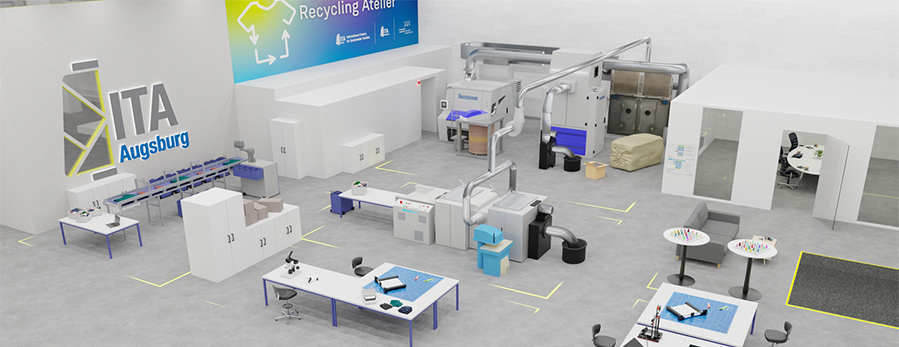
Kelheim Fibres, the world's leading manufacturer of viscose speciality fibres, has joined Recycling Atelier Augsburg. Recycling Atelier Augsburg is a unique centre for research and development in the field of textile recycling. It is located at the Institut für Textiltechnik Augsburg an affiliated institute of Augsburg University of Applied Sciences. The two institutions founded the Recycling Atelier in June 2022 together with twelve partners from the German textile industry.

As a model factory, the Recycling Atelier Augsburg combines the most important processes of textile recycling and offers holistic and comprehensive research along the value chain," explains Georg Stegschuster, head of the Recycling Atelier Augsburg.

The scientists research on all process steps of textile recycling: from material analysis to sorting, preparation and textile processing to sustainable product design. Comprehensive data collection and the use of artificial intelligence as well as innovative materials play a central role.

Kelheim Fibres is a producer of high-quality viscose fibres, which consist of cellulose, the main component of the renewable raw material wood, and are used worldwide for products in areas such as hygiene, textiles, and technical applications.


"In New Business Development as well as Fibre and Application Development, we follow the Open Innovation concept - the cooperation with the Recycling Atelier offers us an ideal platform for this. Here we work with partners to advance sustainability and performance," explains Maik Thiel, project manager at Kelheim Fibres.

Recycled cotton fibres are often very short or of uneven length, which makes further processing of 100 % recycled material a challenge. This is where the speciality fibres from Kelheim Fibres come into play, whose addition should enable the production of high-quality new products, such as nonwovens. In the future, the fibres provided by Kelheim Fibres will also be made from recycled pulp. Closing the loop further.

In the Recycling Atelier, the focus is on the triad of technical and ecological sense as well as economic benefit. In this way, the partners of the Recycling Atelier are standing up against fast fashion, outsourced corporate responsibility and a general decline in raw material quality, which often fuels downcycling - the low-quality reuse - of materials.


More News from Institut für Textiltechnik of RWTH Aachen University (ITA)

#Research & Development

Networking Day 2026: Industry stakeholders unite around textile recycling

In 2026, the Industry Research Group (IRG) Polymer Recycling once again brought together some of the key stakeholders in textile recycling for its annual Networking Day. This year, the event took place at EREMA’s premises in Ansfelden, Austria. It brought together key players from across the textile recycling value chain for a day of structured exchange and in-depth discussions.

#Research & Development

2026 general meeting of the Friends and Supporters of RWTH Aachen at ITA

The Friends and Supporters of RWTH Aachen e. V. (proRWTH) looked back on a successful year of support at their 2026 general meeting. The meeting took place at Institut für Textiltechnik (ITA) of RWTH Aachen and was combined with a joint session of the Executive Board and the Administrative Board. Before the general meeting began, participants were given a guided tour of ITA, providing them with fascinating insights into current research and development topics in textile engineering.

#Research & Development

TERNAfil wins first place at PitchMiUp Night 2026 in Minden

The RWTH spin-off TERNAfil has developed MAXCarbon, a new high-performance hybrid fibre that combines the mechanical performance of carbon with the temperature and corrosion resistance of ceramic materials. For this development, TERNAfil was awarded first prize at the PitchMiUp Night in Minden on 21 May 2026.

#Research & Development

Carbon-ceramic hybrid fibre proves its worth – NRW Minister for Science Mona Neubaur congratulates ITA start-up TERNAfil

MAXCarbon technology, a novel carbon-ceramic hybrid fibre developed by ITA spin-off TERNAfil, secured third place at the HIGH-TECH.NRW Demo Day on the TÜV NORD campus in Essen. The technology combines the strength of carbon fibres with the temperature and corrosion resistance of ceramic materials. Mona Neubaur, Minister for Science in North Rhine-Westphalia, congratulated the team on their success and on winning prize money of 4,000 euros.

More News on Recycling / Circular Economy

#Recycling / Circular Economy

Managed workwear services are providing a blueprint for the circular textile economy

Managed workwear service providers are demonstrating how commercial success and circularity can go hand in hand by extending garment lifespans through repair, laundering, reuse and recycling, according to “Managed workwear services—a circular textile economy ahead of the game”, a new 14‑page report from the global business information company Textiles Intelligence.

#Recycling / Circular Economy

Eco-design as the foundation of circular textiles

Based on the results of an extensive European analysis, the Erasmus+ project Skills4Circularity is currently developing three practice-based training modules covering recycling technologies, eco-design for the circular economy and sustainable manufacturing. This was preceded by a comprehensive company survey and a joint analysis conducted by the project partners under the leadership of IVGT. The results show that the greatest challenges lie not so much in a lack of technology as in skills gaps.

#Recycled Fibers

Usha Yarns secures growth equity investment from Fullerton Carbon Action Fund

Usha Yarns Limited (“Usha Yarns”), a producer of high-quality recycled yarns with advanced, well established production processes, announced a growth equity investment from the Fullerton Carbon Action Fund (“Fullerton”), a private equity strategy managed by Fullerton Fund Management that backs established mid-market companies across Emerging Asia to accelerate decarbonisation.

#Recycling / Circular Economy

German 'ZOLL' turns end-of-life uniforms into valuable raw materials

Together with CWS Workwear, the German Customs Administration is extending the life cycle of service uniforms through reuse, recycling and material recovery, demonstrating how circular economy principles can be successfully implemented in the public sector while delivering significant savings.

Latest News

#Functional Fabrics

PERFORMANCE DAYS announces new focus topic & forums for October 2026

With its upcoming October 13–14, 2026 edition, PERFORMANCE DAYS is placing the spotlight on one of the textile industry’s most important transformations: “Bio-Based Materials – From Fiber to Fabric”, a two-part Focus Topic exploring the future of bio-based innovation across the textile value chain. Part 1, presented in October 2026, will focus on fibers and next-generation material developments, while Part 2 at the March 2027 edition will shift the perspective toward dyeing, finishing, additives, and processing technologies.

#Nonwoven machines

MENANG rapidly resumes production with new ANDRITZ airlay line after major fire

MENANG, a Malaysian manufacturer of nonwoven automotive components, has resumed production after a major fire severely damaged its airlay line in mid-March 2026. A new airlay line supplied by ANDRITZ enabled production to restart within only four months.

#Exhibitions & Events

Febratex 2026 to be the largest edition of the leading textile trade fair in the Americas with 10 exhibition halls

Febratex 2026 will be the largest edition in the history of the leading textile trade fair in the Americas. Dedicated to the textile and apparel manufacturing industries, the event will take place from August 18–21, 2026, in Blumenau, Santa Catarina, Brazil, with a strong focus on technology, sustainability, and business generation.

#Raw Materials

Cotton Brazil Dialogues field trip brings international stakeholders closer to Brazil’s cotton production chain

How do you build trust across the global textile value chain? By opening the farm gates. This is the principle behind the Cotton Brazil Dialogues. At the end of July, the programme welcomed its first group of international participants for a five-day immersion into Brazilian cotton production, combining field visits with technical workshops to showcase the quality, sustainability, innovation and traceability behind one of the world’s leading cotton origins.

TOP